The Making of a Culinary Icon: Matt Johnson’s ‘Tony’ and the Resurrection of Anthony Bourdain

The cinematic biopic is a genre often fraught with the perils of hagiography or sanitized "greatest hits" storytelling. When the subject is a figure as polarizing, brilliant, and fiercely "no-bullshit" as the late Anthony Bourdain, the stakes are exponentially higher. Bourdain, the chef-turned-author-turned-cultural-ambassador who revolutionized how the world views food and travel, was a man who famously loathed inauthenticity. Any film attempting to capture his essence must navigate the razor-thin line between tribute and caricature.
Matt Johnson’s latest feature, Tony, manages to navigate this minefield by narrowing its focus. Rather than attempting a sweeping cradle-to-grave narrative, Johnson zeroes in on a singular, transformative summer in 1975. The result is an evocative, gritty, and surprisingly tender "origin story" that captures the man before he became the myth. Starring Dominic Sessa in a performance that signals the arrival of a major new movie star, Tony explores the friction between Bourdain’s literary ambitions and the primal, visceral reality of the restaurant kitchen.
Main Facts: A Specific Vision of a Cultural Giant
Tony is not a film about the globetrotting host of Parts Unknown. Instead, it is a period drama set in the mid-1970s, based on the formative early chapters of Bourdain’s seminal 2000 memoir, Kitchen Confidential: Adventures in the Culinary Underbelly. The film follows a 19-year-old Anthony "Tony" Bourdain during a pivotal summer in Provincetown, Massachusetts—a time when he was a restless Vassar College student trying to find his voice.
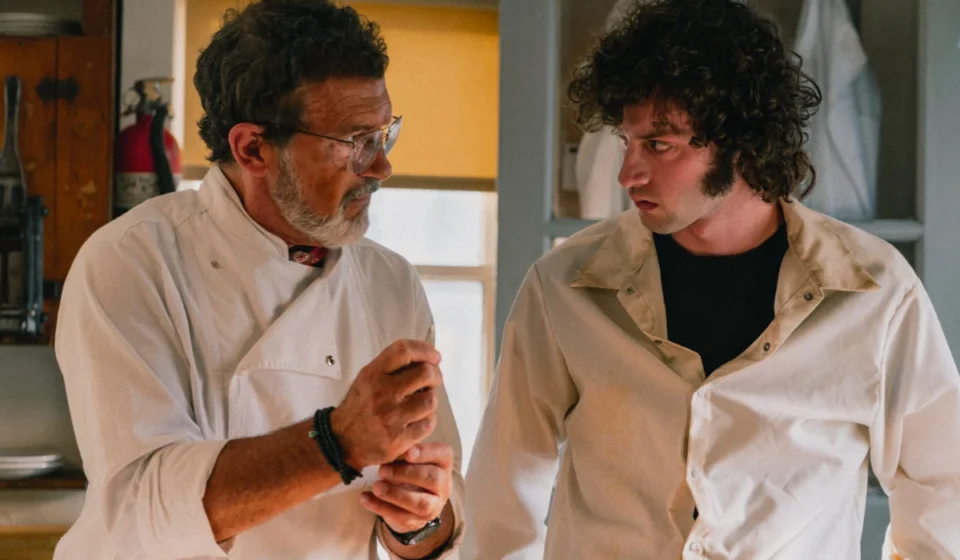
Directed by Matt Johnson (Blackberry, Nirvana The Band the Show the Movie), the film eschews the polished aesthetics of modern culinary dramas like The Bear in favor of a raw, "kitchen-sink" realism. The cast is led by Dominic Sessa, who previously garnered acclaim in The Holdovers, and features Academy Award nominee Antonio Banderas as "Chef," a pivotal mentor figure who introduces Tony to the "Zen" of the culinary arts.
The film’s central thesis is that the Anthony Bourdain the world came to know—the cynical, poetic, and deeply empathetic observer—was already present in the 19-year-old dishwasher. By focusing on his failures, his arrogance, and his early addiction to the "drama" of the kitchen, Johnson crafts a portrait that feels remarkably true to the spirit of the man himself.
Chronology: The Summer of 1975
The Vassar Pitch and the Sting of Rejection
The narrative arc of Tony begins at Vassar College, where a young Bourdain is seen attempting to navigate the ivory tower of academia. In an opening scene that establishes his "extraordinary gift of gab," Tony pitches a novel to a panel of unimpressed English professors. He is seeking a prestigious summer writing fellowship, positioning himself as a subversive, post-counterculture intellectual.
When he is rejected, the film captures the "charisma of anger" that would become a Bourdain trademark. This rejection serves as the catalyst for his departure to Provincetown. Entitled, brilliant, and nursing a bruised ego, Tony flees to the coast, ostensibly to follow a girl, but subconsciously to find a world that matches his internal turbulence.
Arrival in Provincetown: The Lie and the Descent
Upon arriving in Provincetown, Tony is a man living a double life. He stalks Nancy (Emilia Jones), a savvy and tough local worker he is half-enamored with, while telling everyone he successfully secured the Vassar fellowship. This lie provides him with a fragile sense of class superiority, even as he runs out of money.
The turning point occurs when Tony spends his last few dollars on a hedonistic display of raw oysters and beer at a local bar, ending in a drunken spectacle. After being unceremoniously thrown out by the owner, Tony returns the next day to apologize—a rare moment of humility that leads to his first job in a professional kitchen: washing dishes at a bare-bones seafood shack called The Flagship.
The Flagship: From Dish Pit to Prep Station
The mid-section of the film documents the "unwashed reality" of 1970s restaurant life. Tony is thrust into a world of "screw-loose types," including the hedonistic Stavros (Stavros Halkias) and the aggressive, sociopathic Sal (Leo Woodall).
Under the watchful, almost liturgical eye of "Chef" (Antonio Banderas), Tony begins the slow process of "crawling out of himself." He starts in the "scuzzpit" of the dish station, eventually graduating to food prep. Through the heat, the morning lines of cocaine, and the late-night house parties, Tony discovers that while he wanted to be a writer, he was physically and temperamentally "meant" for the kitchen.
Supporting Data: Contextualizing the Bourdain Legacy
To understand the impact of Tony, one must look at the data surrounding Bourdain’s literary and cultural footprint. Kitchen Confidential, the source material for the film, spent over 40 weeks on the New York Times Bestseller list and has been translated into over two dozen languages. It transformed the "chef" from a hidden servant into a rock star, a transition the film depicts in its infancy.
The Production Aesthetic
Director Matt Johnson utilizes a style described by critics as having the "organic flow and humanity" of a Richard Linklater film. By using invisible craft and a focus on "existential spontaneity," Johnson avoids the hyper-stylized "food porn" tropes of modern cinema. The film emphasizes the "funk and the flavor" of 1975—a time when Provincetown was a rougher, less gentrified enclave of artists, addicts, and laborers.
The Casting of Dominic Sessa
Industry analysts have noted that Tony serves as a "movie star" moment for Dominic Sessa. While The Holdovers introduced him as a talented newcomer, Tony requires him to carry the weight of a cultural icon. Sessa’s portrayal captures Bourdain’s specific physicality—the tall, moptop-wearing "hungry dog" look—and his psychological complexity. The film also explores Tony’s relationship with his mother, Gladys (Dagmara Domińczyk), a brilliant editor at The New York Times, suggesting that his "voice of judgment" was a maternal inheritance.
Official Responses and Critical Reception
Early critical responses to Tony have been overwhelmingly positive, particularly regarding its authenticity. A central theme in the discourse surrounding the film is the "Bourdain Bar"—the idea that a biopic of Anthony Bourdain is only successful if the subject himself would have liked it.
The "Bourdain Bar"
Critics have argued that Bourdain, a notorious film fanatic who loathed "laughably inauthentic" biopics, would have found Tony to be a "clear" success. This is attributed to the film’s refusal to sanitize his character. It portrays him as a "charmer, a troublemaker, a middle-class Jersey refugee with some serious demons, an aspiring writer… and an asshole." By embracing the "asshole" aspect of his persona, the film gains a level of credibility that more reverent biopics lack.
Comparison to ‘The Bear’
Inevitably, Tony is being compared to the Hulu hit series The Bear. However, early reviews suggest that Tony reaches a level of "kitchen-sink reality" that the television show occasionally misses. While The Bear focuses on the high-stress anxiety of modern fine dining, Tony captures the "rock ‘n’ roll" seductive quality of 1970s kitchen culture—the cold-beer-at-midnight glory and the "culinary fetishism" of a simpler time.
Antonio Banderas’s Performance
Banderas has received significant praise for his portrayal of "Chef." Critics describe his performance as a "delectable blend of gentleness and cutthroat authority." Banderas represents the "Zen" of the kitchen, serving as a foil to Tony’s chaotic energy. His character’s devotion to the task at hand—even something as mundane as making his own ketchup—is depicted as a form of "Eucharist," a holy pursuit that eventually provides Tony with a "crucible of faith."
Implications: The Future of the Biopic and the Bourdain Mythos
The release of Tony has several significant implications for the film industry and the legacy of its subject.
A New Model for the Biopic
Tony suggests that the most effective way to profile a complex historical figure is not through a comprehensive life story, but through a "snapshot" of a formative period. By focusing on the summer of 1975, Matt Johnson allows the audience to see the "becoming" of a legend, rather than just the legend himself. This "Linklater-esque" approach to the biopic could influence future films in the genre.
The Sessa Ascendancy
The film cements Dominic Sessa as one of the most promising actors of his generation. His ability to channel Bourdain’s specific brand of "voluble, simmering" anger while remaining vulnerable and "cringe-worthy" in his youthful confusion marks him as an actor capable of profound psychological depth.
Re-evaluating the "Kitchen Confidential" Era
For the culinary world, Tony serves as a reminder of the raw, undisciplined roots of the modern celebrity chef era. It strip-mines the nostalgia for the 1970s to show the "addiction and abuse" alongside the "funk and the flavor." It reinforces Bourdain’s original message: that the kitchen is a place where "troubled souls" find themselves by "crawling out of themselves."
Ultimately, Tony is more than a tribute to a fallen icon; it is a film about the universal experience of the "life-changing summer." It captures the drifting freedom of youth and the moment a person realizes that their true calling might not be what they imagined, but what they discovered while washing dishes in the heat of a Provincetown July. For the legions of Bourdain fans, the film offers something rare: a glimpse of the man before the world took hold of him, caught in the invisible craft of a summer that never truly ended.