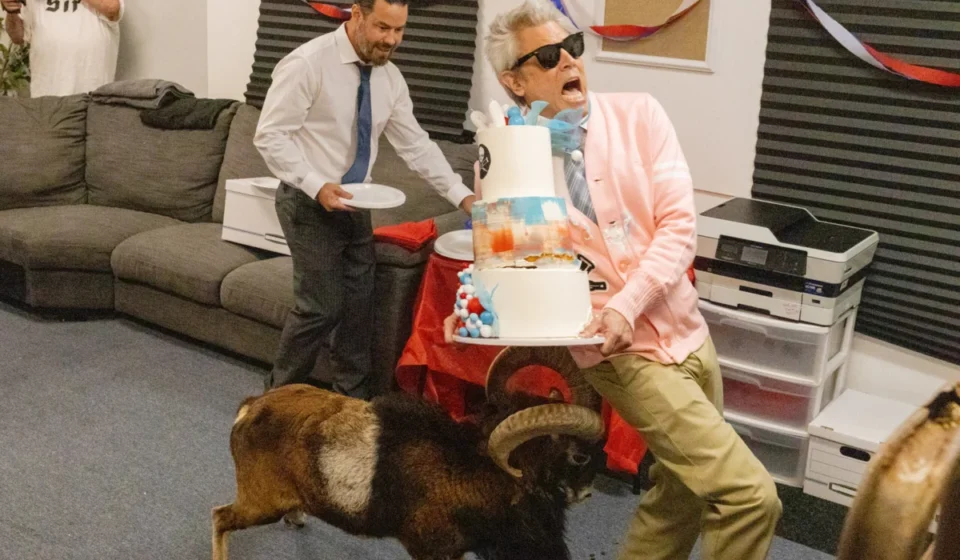

As the dust settles on the Jackass franchise—a cultural phenomenon that defined the early 21st century’s appetite for the absurd—the finality of Jackass: Best and Last (2026) feels less like a curtain call and more like the end of an era. For over two decades, Jeff Tremaine has been the architect of this controlled mayhem, moving from the scrappy, DIY ethos of Big Brother magazine to the polished, high-budget spectacle of global cinema. As the series reaches its conclusion, Tremaine finds himself in a position few would have predicted: the reluctant auteur of a legacy that bridges the gap between low-brow slapstick and genuine emotional resonance.
The Genesis of an Unlikely Empire
The origins of Jackass were never intended to be a long-distance run. In the late 1990s, Tremaine, working as an art director for Big Brother, was simply looking to curate the most vibrant personalities in the skateboarding world. He wasn’t trying to build a franchise; he was trying to capture lightning in a bottle.
"Seeing all these guys as babies, that hit me a little bit," Tremaine reflects. "We thought that we would get one episode on TV—if we did—and it would just get shut down. We weren’t built to run long-distance, but somehow we did."
The turning point came when Johnny Knoxville filmed himself being shot while wearing a bulletproof vest. That singular, terrifyingly candid moment shifted the trajectory of Tremaine’s career. It was no longer just about skateboarding; it was about the raw, unfiltered human condition. Alongside cocreators Knoxville and Spike Jonze, Tremaine began to shape a sensibility that was, at its core, deeply punk rock—a "fuck you" to the mainstream that somehow, paradoxically, became the mainstream.
A Chronology of Controlled Mayhem
The evolution of the Jackass production model is a case study in the tension between artistic vision and corporate regulation. In the early days, the production was a mobile, chaotic entity—often literally a single van housing the cast, the crew, and the equipment.
The Guerrilla Era (2000–2005)
This was the "no-permit" phase. The spontaneity was the point. The production team would identify a target—like kidnapping Brad Pitt or filming a bit at a crowded hot dog stand—and execute it within minutes. There was no room for hesitation, and the lack of structure was the fuel that powered the show’s most iconic, unrepeatable moments.
The Scaling Up (2006–2015)
With the release of Jackass Number Two and Jackass 3D, the scope ballooned. The transition to high-budget filmmaking forced a change in approach. Tremaine, once a guerrilla filmmaker, had to learn how to guard the "spontaneity" of his cast within an increasingly rigid, unionized, and heavily regulated studio environment. It was during this period that he clashed with the MPAA over creative control, famously fighting to keep long, slow-motion shots of stunts that the censors deemed "unnecessary."
The "Forever" Legacy (2022–2026)
By the time Jackass Forever and Best and Last were produced, the franchise had matured into a well-oiled, albeit dangerous, machine. The production now required meticulous planning and safety measures, yet the fundamental goal remained the same: to capture authentic human reactions. Even when the cast is older and the stakes (physically and professionally) are higher, the core team remains committed to the same brand of "stupid" that launched the show.
The Art of the "Exceptional Dumb-Dumb"
One of the most persistent, yet often overlooked, aspects of Tremaine’s work is his fine arts background. While critics often pigeonhole him as just another "knucklehead," his approach to directing is profoundly deliberate. He does not script the dialogue; he curates the environment.
"I don’t tell anyone what to say," Tremaine explains. "It is their real personalities. But it’s really more about putting them in situations where I know they’re going to say something funny. I always have Chris Pontius right next to the action. I have no idea what he’s going to say, but I know if this bit isn’t as funny as it’s supposed to be, if you go to Chris, it’s going to turn a C into an A."
This is the "Tremaine Touch." He understands the psychology of his performers, knowing exactly when to push them for a second take and when to let the chaos unfold naturally. The infamous "Magic Trick" from Jackass Forever, where Knoxville was severely injured by a bull, stands as a testament to this. It was a moment of profound tension where the director had to make the difficult call to demand a retake, fully aware of the physical toll it would take on his friend.
Critical Reassessment: From Low-Brow to MoMA
Perhaps the most fascinating implication of the Jackass legacy is the shift in critical reception. When the franchise premiered at the Museum of Modern Art (MoMA) in 2010, it marked a turning point. Critics began to analyze the films not as mere violence, but as a subversion of traditional masculinity.
Tremaine remains humble, and perhaps a bit wary, of this academic framing. "I’ve always struggled with intellectualizing what we do," he says. "To me, it is just so surface-level: ‘This is what we do and it’s stupid. We’re magnifying stupid.’ That’s all it is to me."
Yet, he acknowledges that the shift in criticism is telling. "We never got good reviews in the beginning—terrible reviews, always—and that fueled me. Not to try to get better reviews, but to think, ‘This is great, fuck you.’ When Jackass Forever started getting nice reviews, I was like, ‘This doesn’t feel right. Either we’ve been doing it too long… or maybe we’re just not fucking punk anymore."
Implications for Future Filmmakers
The Jackass phenomenon has effectively written the blueprint for a new genre of documentary-comedy. By celebrating healthy, if unorthodox, male friendships and providing a space for vulnerability through physical comedy, Tremaine has created a blueprint that is as much about human connection as it is about injury.
His work on the American Airlines safety PSA—a sleek, musical-inspired production—proved that his visual language transcends the skate-punk aesthetic. It demonstrated that Tremaine possesses a sophisticated understanding of pacing, rhythm, and tone, even if he chooses to apply those skills to projects that would make traditional studio executives faint.
Final Reflections
As Tremaine approaches 60, he admits to a strange conflict: he wants to evolve, yet the voice that guided him for two decades remains stubbornly the same. "I’m almost 60 years old, and I still like to draw dicks on things," he laughs. "It’s weird to me that that is still funny to me. I’m waiting to grow up."
Perhaps the beauty of Jackass is that it never did "grow up." In an era of polished, CGI-heavy entertainment, the series stood as a bastion of tactile, human, and wonderfully flawed reality. Jeff Tremaine didn’t set out to be an auteur, but in his relentless pursuit of the "stupid," he captured something essential about the American spirit—a refusal to take the world seriously, even when the world is looking back with a critical, academic eye. As the cameras stop rolling for the final time, one thing is certain: the world is a little less reckless, and a little less vibrant, without the Jackass crew in the van.