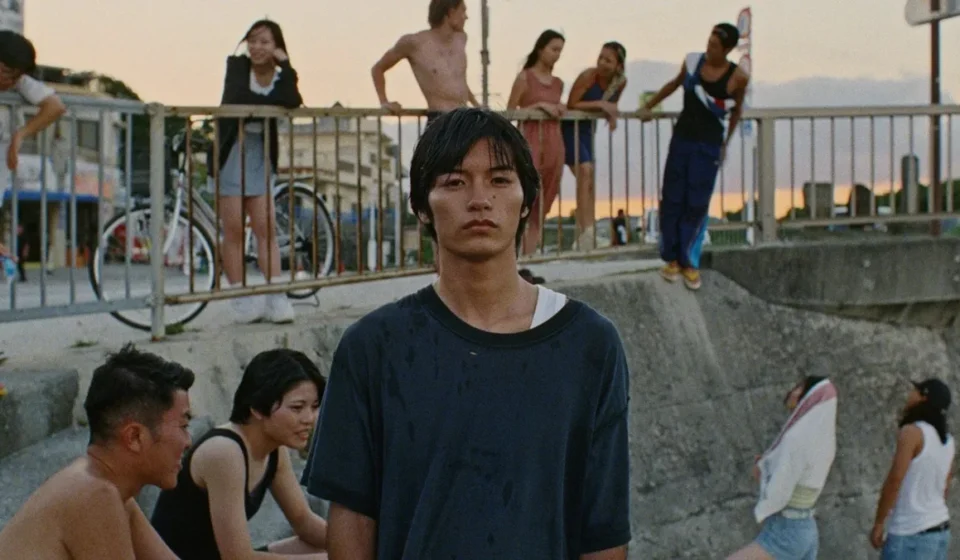
The Heat of Adolescence: Exploring the Post-Colonial Tensions in Xavier Tera’s ‘The Color of the Sun’

For anyone who has navigated the treacherous, humid waters of queer adolescence, the experience is often defined by a singular, destabilizing encounter: the moment you realize you are infatuated with someone who exists in a world of effortless, heteronormative confidence. It is a toxic, dizzying cyclone of self-doubt, where the object of your desire—usually someone slightly older and more self-assured—serves as a mirror reflecting everything you feel you are not.
In his sensuous, evocative debut feature, The Color of the Sun, writer-director Xavier Tera masterfully excavates this universal ache. Set against the backdrop of 2012 Okinawa, the film is not merely a portrait of burgeoning sexuality, but a haunting exploration of the lingering shadows of imperialism and the physical, emotional weight of being a stranger in one’s own land.
The Geography of Desire: Okinawa 2012
Tera situates his narrative in the unique, fraught landscape of Okinawa, where the local Ryukyu culture exists in a delicate, often uncomfortable proximity to a vast and permanent American military presence. Decades after the conclusion of World War II, the base remains a physical manifestation of a geopolitical stalemate, a reality that dictates the rhythms of life for the island’s youth.
At the center of this world is Kamei (Naoto Shimajiri), a teenager suspended in the lethargic, stifling heat of the final summer between high school and the uncertain reality of adulthood. His life is stagnant, marked by a strained relationship with an aloof grandfather and a deeply internal, gnawing depression. This inertia is shattered by the arrival of Colin (West Mulholland), an American teen from the base whose blond hair and swagger act as a catalyst for a psychological upheaval. As the two orbit one another, the film transforms into a complex study of the "other"—the American outsider and the local boy—finding common, if jagged, ground.
A Chronology of Longing
The film’s narrative arc follows the slow, simmering tension of that fateful summer. Initially, Kamei is a young man in a state of spiritual torpor. His relationship with his girlfriend, Sayaka (Yuma Taira), is a hollow vessel; they move through the motions of intimacy with a painful, awkward lack of chemistry, serving as a reminder of the masks teenagers wear to conform to societal expectations.
As the film progresses, the arrival of Colin shifts the axis of Kamei’s world. The language barrier between the two—Kamei speaking Japanese and Colin speaking English—does not hinder their connection; rather, it provides a shroud of ambiguity. In their silences and their broken, translated exchanges, they find a space to project their desires and frustrations.

The film’s most provocative sequence—a scene evocative of the raw, uncomfortable realism found in Alfonso Cuarón’s Y Tu Mamá También—sees the boys and their friends engaging in a late-night, shared act of masturbation in the flickering light of a television screen. It is a moment of profound vulnerability, where the boundaries of friendship, competition, and sexual discovery blur into something both "Larry Clark-adjacent" and entirely unique to Tera’s directorial vision.
Technical Mastery: The Aesthetic of Humidity
The sensory experience of The Color of the Sun is largely defined by the masterful cinematography of Sayombhu Mukdeeprom. Known for his frequent collaborations with directors like Luca Guadagnino and Apichatpong Weerasethakul, Mukdeeprom captures Okinawa as a place where the air itself feels heavy with sweat, hormones, and repressed longing.
The images are sun-drenched and saturated, yet they possess a weight that feels suffocating. Every frame is baked in the humidity of the island, turning the environment into a silent character that pressures the protagonists. This visual language supports the film’s narrative focus: the internal, often silent, explosion of a young man coming to terms with his own identity in an environment that offers him little room to breathe.
Production Insights and Collaborative Vision
The Color of the Sun is, in many ways, a deeply personal project for Tera. Drawing from his own experiences moving from Tokyo to Okinawa during the COVID-19 pandemic, the director identified striking parallels between the American military presence in Japan and the colonial legacies of the British and French in his native Canada.
The production was bolstered by a heavy-hitting team, including producer Jeremy O. Harris, the Tony-nominated playwright whose own work often probes the intersections of race, sexuality, and power. This collaboration has yielded a film that feels both intimate and expansive. Naoto Shimajiri’s performance as Kamei is a standout; it is a "combustibly internalized" portrayal that relies on micro-expressions and silence to convey a lifetime of buried angst.
Implications: Identity, Nationality, and the "Other"
Beyond the romantic tension, The Color of the Sun serves as a poignant commentary on the intersection of identity and geography. The film is never explicitly declarative about Kamei’s sexuality, a stylistic choice that mirrors the contemporary trend in queer cinema to prioritize mood and ambiguity over traditional labels. Instead, it posits that identity is something fluid, shaped as much by the soil one stands on as by the desires one hides.

The symbolism of colorblindness, while occasionally cumbersome, ultimately pays off in a closing shot that provides a thematic anchor for the film. The characters, like the island itself, exist in a state of liminality—they are caught between cultures, between childhood and adulthood, and between what they are told to be and who they truly are.
A Critical Appraisal: The Path Forward
While the film is a triumph of atmosphere and performance, it is not without its flaws. At nearly two hours, the pacing occasionally falters. There are moments where Kamei’s silence, while thematic, risks alienating the audience, testing the patience of the viewer. Some of the domestic subplots, particularly those involving his mother, feel underwritten, though they ultimately serve the film’s melancholic coda.
Despite these minor pacing issues, the film succeeds in its core ambition: to bring the viewer back to the "hormonal stickiness" of youth. It is a story about the cruelty of summer, the toxicity of idolizing the "other," and the lingering, painful beauty of the transition into selfhood.
Official Reception and Distribution
Premiering to significant interest at the 2026 Venice Film Festival, The Color of the Sun has already begun to garner critical acclaim for its daring, uncompromising vision. It stands as a significant debut, cementing Xavier Tera as a director to watch. As of this writing, the film is actively seeking U.S. distribution. Given its thematic resonance with the current wave of queer independent cinema and its visual pedigree, it is likely to find a dedicated home in the arthouse circuit, where audiences hungry for complex, non-linear narratives will find much to dissect.
In an era where many coming-of-age films rely on safe, formulaic structures, The Color of the Sun dares to be as messy, uncomfortable, and radiant as the youth it depicts. It is a haunting, sun-drenched meditation on the cost of growing up in the shadow of giants, and the quiet, devastating courage it takes to finally see yourself—clearly, and without filters—for the very first time.