
The Director’s New Lens: How Autodesk Flow Studio is Redefining Generative Filmmaking

The landscape of digital cinema is undergoing a profound shift. For the past two years, the industry has been dominated by the "prompt-and-pray" era of generative AI, where filmmakers sacrifice precision for the sake of spontaneity. Today, Autodesk is challenging that paradigm with the launch of Autodesk Flow Studio, a platform that pivots away from pure text-to-video generation in favor of a "directable" workflow. By integrating a sophisticated 3D Editor with a node-based 2D Canvas, Autodesk is attempting to bridge the chasm between raw generative power and the exacting requirements of professional film production.
The Core Philosophy: Moving Beyond the Prompt
At the heart of Flow Studio is a rejection of the "single-prompt movie" myth. Nikola Todorovic, co-founder of Wonder Dynamics and a central figure in the development of Flow Studio at Autodesk, argues that the true potential of AI in cinema lies not in automation, but in augmentation.
"We are moving past the novelty phase," Todorovic explains in a recent fxpodcast interview. "Generative AI has been excellent at creating the first 80 percent of a shot—the atmosphere, the textures, the lighting. But the final 20 percent—the specific, nuanced directorial decisions—is where most models fail. Flow Studio is designed to capture that final 20 percent by allowing directors to maintain spatial and performance control throughout the process."
The platform is designed to be agnostic regarding the scale of the production. Whether it is an independent filmmaker working solo or a mid-sized studio team of five, the workflow remains consistent: build the scene in 3D, and then use generative models to "paint" the cinematic finish.

A Chronology of Control: From Wonder Dynamics to Flow Studio
To understand the significance of Flow Studio, one must look at the trajectory of the technology that preceded it.
- The Early Days of AI Filmmaking: Early generative tools focused on massive, unpredictable video models. While capable of producing stunning visuals, they lacked "persistence." A character might change their shirt mid-scene, or a camera move might defy the laws of physics, making these tools largely useless for long-form narrative storytelling.
- The Wonder Dynamics Breakthrough: The foundational technology behind Flow Studio grew out of the work done at Wonder Dynamics. By utilizing roughly 25 distinct machine learning and computer vision systems, the team successfully automated the technical drudgery of compositing CG characters into live-action plates.
- The Integration Phase: Autodesk’s acquisition of this expertise signaled a pivot. Instead of treating AI as a "black box" that produces finished clips, the company began treating AI as a series of modular tools.
- The Current Milestone: With the launch of the 3D Editor + Canvas, Flow Studio now allows for the combination of Gaussian splat-based worlds (powered by World Labs’ Marble) with traditional camera tracks, motion capture, and AI-driven image generation.
The 80/20 Rule: Why Precision Matters
The "80/20 rule" cited by Todorovic serves as the central pillar of the Flow Studio marketing and design strategy. In a traditional text-to-video model, if a director wants to move a character three feet to the left or change the focal length of the lens, the AI is forced to re-generate the entire scene. This is inefficient and, more importantly, creatively destructive.
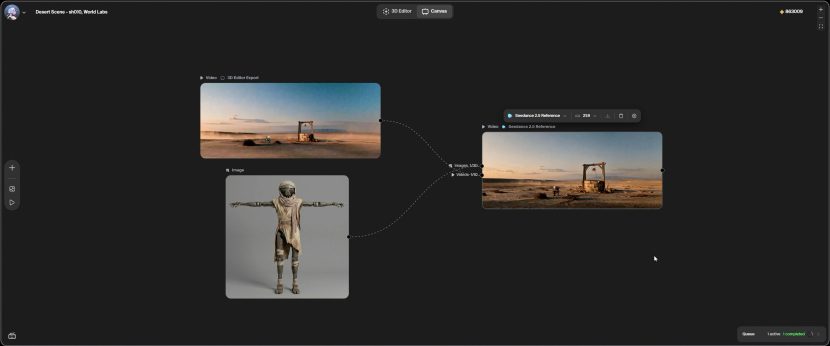
Flow Studio solves this by separating the staging from the rendering. By establishing the performance, camera movement, and environment in a 3D environment first, the director creates a "ground truth" that the AI must respect.
The 3D Editor: Establishing Spatial Logic
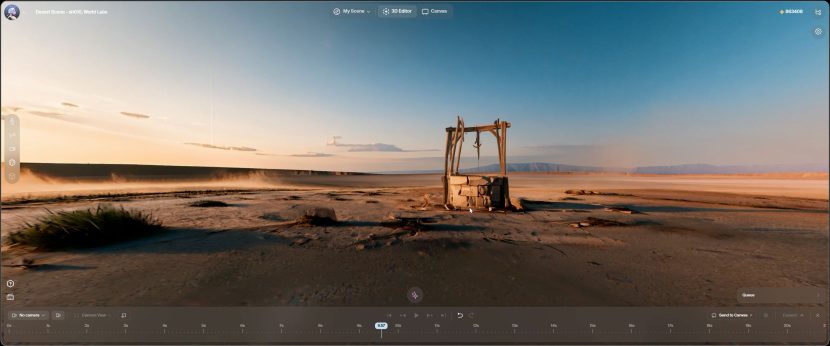
The 3D Editor allows creators to treat their AI workflow like a traditional 3D pipeline. Artists can:

- Block Scenes: Arrange characters and assets in 3D space.
- Import Data: Bring in existing motion-capture data or camera tracks from previous shoots.
- Direct Performance: Use recorded human performance as the primary driver for characters, ensuring that nuance, timing, and intent are preserved.
- Use Spatial Environments: Leverage Gaussian splats to create realistic, spatially coherent worlds that can be navigated with a virtual camera.
The Canvas: The Node-Based Finishing Room
Once the 3D scene is set, artists move to "Canvas." This node-based environment is where the generative heavy lifting occurs. Instead of relying on the AI to "guess" where the light should be, the artist uses the 3D scene as a guide. The AI models are then tasked with specific jobs: lighting integration, atmospheric effects, and cinematic finishing. This keeps the generative output tethered to the director’s original vision.
Supporting Data: Why Human Performance is Irreplaceable
A significant portion of the discourse surrounding Flow Studio involves the importance of human-centric performance. There is a prevailing trend in the AI industry to use audio-to-animation models, which, while convenient, often lead to "uncanny" or generic acting.
Todorovic remains firm: "You cannot prompt your way to a great performance." Flow Studio emphasizes recorded human performance as the foundational data. By driving characters with real human motion and audio, the system preserves the timing and emotional stakes that AI models, on their own, often struggle to synthesize.
The platform acknowledges that while AI is evolving, the most compelling storytelling remains rooted in human behavior. The goal is to offload the "mathematical" burden of animation and rendering, not the creative burden of acting.
Official Responses and Industry Implications
The industry response to this workflow has been one of cautious optimism. By providing a tool that mimics the traditional studio pipeline—pre-visualization, layout, animation, and lighting—Autodesk is effectively speaking the language of veteran filmmakers.
"The criticism of ‘AI slop’ is valid," notes an industry analyst familiar with the platform. "When you remove control, you get the statistically average, safest version of a scene. By giving artists the ability to reach in and manipulate the 3D coordinates, Autodesk is pushing the medium toward ‘creative specificity.’"
The Adoption Curve
Todorovic anticipates a classic technological adoption curve for Flow Studio:
- Phase One: Social media creators and experimental filmmakers utilize the platform to push the boundaries of what is possible in short-form content.
- Phase Two: Commercial and music video directors adopt the tech to reduce costs and increase the speed of high-end, iterative visual effects.
- Phase Three: Major film and television studios integrate the tools into their existing, massive pipelines, using Flow Studio to streamline pre-production and asset generation.
Future Implications: The Democratization of Complexity
Perhaps the most profound implication of Flow Studio is the reduction of the "mathematical barrier to entry." Historically, to produce a complex CG shot, one needed to understand lighting, texture mapping, rigging, and simulation. While those skills remain vital, Flow Studio acts as a translator. It allows a storyteller with a vision to orchestrate a complex scene without having to master every underlying physical equation.
This does not imply that specialists are obsolete. Rather, it suggests that the role of the specialist is shifting. Instead of spending weeks manually building a digital environment from scratch, an artist might spend their time curating the best generative outputs, refining the 3D layout, and using their expertise to guide the AI models to a more polished result.
Conclusion: A New Grammar for Cinema
Autodesk Flow Studio represents a departure from the "magic wand" approach to AI. By embedding generative models into a traditional 3D environment, Autodesk is building a bridge between the future of synthetic media and the established grammar of filmmaking.
The platform is not trying to replace the director; it is trying to give the director back their camera. As the technology continues to evolve, the focus will likely remain on this delicate balance: how much control should be handed to the machine, and how much must remain in the hands of the human creator? If Flow Studio is any indication, the answer lies in a hybrid future where AI handles the physics, but the filmmaker holds the lens.
For those looking to explore the platform, the message is clear: start with a performance, anchor it in 3D space, and use the power of generative models to build the world around it. The future of film isn’t a prompt—it’s a process.