The Avian Mirror: How György Pálfi’s ‘Hen’ Reimagines the Human Condition Through a Chicken’s Eye

For nearly half a century, Werner Herzog’s 1977 masterpiece Stroszek has cast a long, cynical shadow over the cinematic depiction of chickens. The film’s final sequence—a haunting, surreal coda featuring a chicken pecking at a miniature piano in a roadside tourist trap—has long served as a bleak visual shorthand for the inescapable banality of life and the dehumanizing labor required to sustain the American Dream. Herzog himself famously distilled this existential dread into a chilling observation: “Look into the eyes of a chicken, and you will see real stupidity. It is a kind of bottomless stupidity, a fiending stupidity. They are the most horrifying, cannibalistic, and nightmarish creatures in the world.”
That sentiment has endured as modern cinema’s definitive stance on the species, positioning the bird as a mindless, twitching automaton. However, after witnessing fifty years of global entropy since Stroszek, Hungarian auteur György Pálfi has decided it is time to flip the script. In his latest feature, Hen, Pálfi challenges Herzog’s grim assessment. Are chickens truly the most nightmarish creatures on Earth? Or are we simply projecting our own moral failings onto them? Pálfi’s answer is a striking, cockeyed, and deeply philosophical inquiry that asks us to reconsider our place in the pecking order by viewing humanity through the unblinking, inquisitive eyes of a hen.
A Feathered Odyssey: The Chronology of an Escape
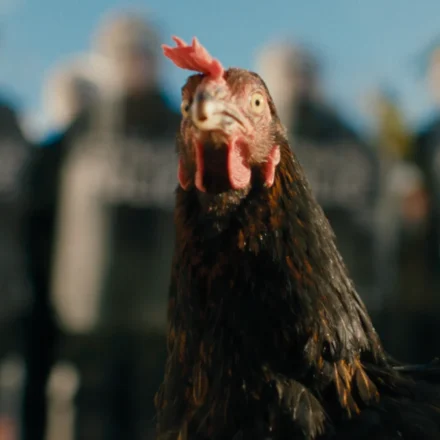
Hen unfolds as a narrative of precarious survival. The protagonist—a jet-black Leghorn chicken—begins her journey in the claustrophobic, industrialized horror of a Greek factory farm. Plucked from her flock due to the distinct color of her plumage, she is destined for a dinner plate until a factory worker decides to bring her home to his wife.
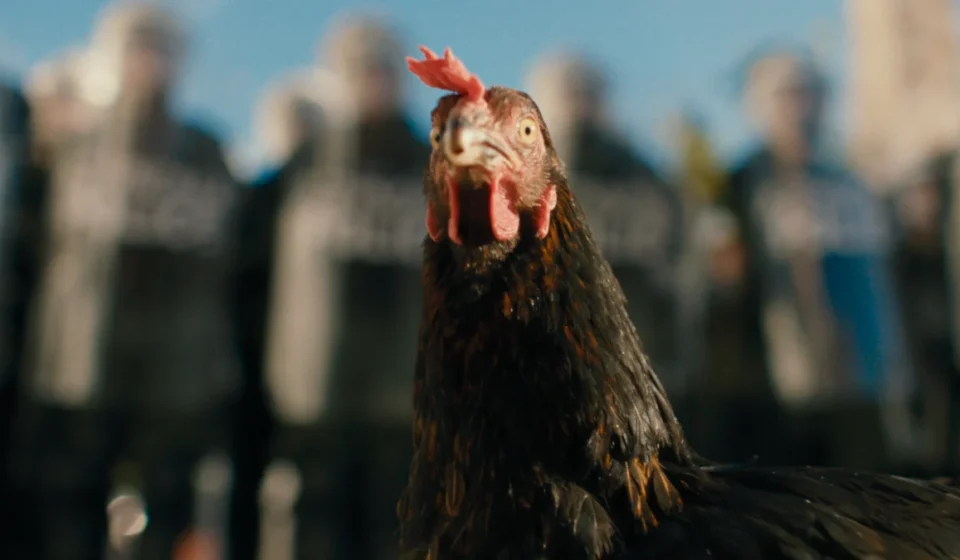
The turning point occurs when the worker stops his truck to refuel, providing an opening for our heroine to flee. Played with remarkable, unscripted charisma by a hen named Feri (and her seven indistinguishable stunt doubles), the bird makes a desperate dash for freedom. Her liberation, however, is short-lived. She is quickly intercepted by Titan, a dog whose owner, a proprietor of a ramshackle, struggling seaside restaurant, is grappling with far more pressing existential threats than his next meal.
As the film progresses, the chicken’s life becomes inextricably linked to the human dramas unfolding around her. She navigates the hierarchies of the restaurant’s barnyard, survives near-death encounters with predators, and exists as a silent, oblivious observer to the encroaching tides of modern European crises—migrant influxes, civil unrest, and the systemic breakdown of societal structures.
Supporting Data: The Technical Craft of the "Chicken-POV"
The ingenuity of Hen lies not in its dialogue, but in its visual language. Pálfi makes the bold decision to tell the story through the limited, often disorienting perspective of the chicken. This is achieved through the judicious, often jarring deployment of Point-of-View (POV) shots.

The production utilized innovative techniques to capture the world at the bird’s eye level. In one standout sequence, the hen finds herself trapped inside a cardboard box. Pálfi employs a Metal Gear Solid-inspired visual gag, showing the box shifting and sliding across the floor as the hen maneuvers from within. This touch of wry, dry humor highlights the director’s refusal to turn the film into a heavy-handed, didactic lecture.
The film’s atmosphere is further elevated by:
- Giorgos Karvelas’ Cinematography: Utilizing saturated colors and a low-angle lens, Karvelas transforms mundane rural settings into something approaching a chicken’s idea of a Western.
- Szabolcs Szoke’s Score: A hyper-dynamic soundscape that contrasts the frantic, repetitive life of the hen with the simmering, often violent tension of the human world.
- Naturalistic Performance: Pálfi takes immense pains to avoid anthropomorphizing Feri. She is not a Disney protagonist; she is a bird, driven by primal instincts, unaware of the camera’s gaze, and utterly indifferent to the complex political tragedies occurring just outside her field of vision.
The Implications: A Mirror to Our Own Stupidity
The core tension of Hen is found in the contrast between the chicken’s lack of moral responsibility and our own willful avoidance of it. While the human characters in the film are portrayed as archetypes—fragments of a broken society—the animals are treated with an intensity that suggests they might be the only ones truly "present" in the landscape.
When Pálfi juxtaposes the brutal reality of the migrant crisis with a scene of a hen navigating a courtship ritual soundtracked by a classic Greek love song, the implication is devastating. We are reminded that while we pride ourselves on our intellect and our capacity to build, govern, and exploit, we are just as capable of "cannibalistic" behavior as the creatures Herzog so vehemently condemns.
The film’s final act serves as a chilling summation of this philosophy. By cutting from the singular, relatable journey of one egg being laid to a vast, industrialized sea of eggs bobbing in factory machines, Pálfi strips away the comfort of individualism. One chicken is a protagonist; a thousand chickens are a statistic. The film forces us to confront the reality that we are quite comfortable with the "stupidity" of mass-producing life, provided we don’t have to look into the individual eyes of those we consume.
Official Reception and Critical Stance
While the film is prone to long, meditative stretches that mirror the repetitive nature of the hen’s existence, this pacing is intentional. It acts as a necessary buffer against our own desire for rapid-fire, human-centric narrative payoffs. Pálfi does not goose the audience; he does not manipulate our emotions with cheap tricks. Instead, he allows the sheer, unvarnished reality of the animal to serve as the ultimate rebuke to our own societal hubris.

Hen is a challenging, sober, and remarkably strange piece of cinema. It is a film that demands patience, but rewards the viewer with a profound, uncomfortable realization: we have become so efficient at farming, managing, and consuming the world around us that we have lost the ability to observe it.
As we watch Feri simply "henning around," blissfully ignorant of the geopolitical collapse unfolding in the background, we are forced to ask why we find her life so compelling while we turn a blind eye to the suffering of our own species. By the end of the runtime, Pálfi has successfully flipped Herzog’s axiom. It is not the chicken that possesses "bottomless stupidity," but the human, who—despite the evolutionary advancements of the last 50 years—remains just as capable of turning on his own kind the moment the hunger sets in.
Hen is a haunting, brilliant, and essential reminder that even when we are not watching, the world is watching us. And if the eyes of the chicken are truly as empty as Herzog claims, perhaps it is only because they have seen enough of our history to know that there is nothing left worth reflecting.
Grade: B
Dekanalog will release "Hen" in theaters on Friday, November 6.