The Ascent of Belgian Action: "Attack on Paradise" and the Evolution of the High-Rise Thriller

The landscape of European genre cinema is undergoing a seismic shift, moving away from traditional art-house dramas toward high-octane, culturally resonant action vehicles. At the forefront of this transformation is Attack on Paradise, a film that serves as both a high-stakes thriller and a deeply personal manifesto for its star and co-creator, Saïd Boumazoughe. Directed by Bob Colaers, the film is more than just a Belgian iteration of the "one man against the odds" trope; it is a stylish, neon-soaked exploration of modern Antwerp’s multicultural identity, wrapped in the visceral package of a siege movie.
By blending the claustrophobic tension of Die Hard with the gritty urban realism of Assault on Precinct 13, Attack on Paradise signals a new era for Belgian filmmaking—one that is unapologetically commercial, visually arresting, and representative of the diverse communities that define the nation today.
I. Main Facts: A Personal Vision Realized
At the heart of Attack on Paradise is Saïd Boumazoughe, the Belgian-Moroccan actor whose "created by" credit appears prominently alongside director Bob Colaers. This distinction is vital to understanding the film’s DNA. For Boumazoughe, this project is the realization of a personal fantasy: an action vehicle that mirrors his own background while adhering to the rigorous demands of the genre.
Key Production Details
- Director: Bob Colaers (marking his second feature after the horror-comedy Trizombie).
- Lead Actor/Co-Creator: Saïd Boumazoughe.
- Screenplay: Sven Huybrechts, Saïd Boumazoughe, and Salahdine Ibnou Kacemi.
- Cinematography: Steven Vanvolsem.
- Score: Maxim Lany and Jonas Nuttin.
- Setting: A seventeen-story housing project in Antwerp, transformed into a criminal fortress.
The film distinguishes itself from Hollywood counterparts by rooting its narrative in the "multicultural modern reality" of Antwerp. While the "prodigal son" narrative is a staple of global cinema, Attack on Paradise adjusts the lens to focus on the socio-political frictions of immigrant communities and the often-fraught relationship between minority populations and law enforcement.
II. Chronology: From Wrongful Arrest to Vertical Warfare
The narrative structure of Attack on Paradise is built on a relentless forward momentum, beginning with a moment of social injustice and escalating into a full-scale paramilitary conflict.
The Catalyst: Seven Years Lost
The story opens with Suleyman (Boumazoughe), a lanky, hoody-clad young man walking through his neighborhood. A near-collision with an unmarked police vehicle sparks a verbal confrontation—a moment that highlights the hair-trigger tensions in the city. The officers, quick to profile Suleyman based on his appearance, arrest him on dubious charges. This prologue sets the stage for Suleyman’s character: a man who has been hardened by a system that never gave him the benefit of the doubt.
The Return: A Changed Home
Seven years later, Suleyman is released from prison. His first priority is his mother, Fatma (Fatima Khanfour), who is ailing and residing in the "Paradise" housing project. Their reunion is a masterclass in emotional complexity; Fatma oscillates between the overwhelming joy of seeing her son and the "slap-happy rage" of a mother who felt abandoned during his incarceration.
However, the "Paradise" Suleyman left is gone. In his absence, the complex has been seized by "Prince" (Achmed Akkabi), an international fugitive who has turned the seventeen-story building into a sovereign underworld headquarters. The police have long designated the area a "no-go zone," but the day of Suleyman’s return coincides with a massive, long-planned police raid designed to decapitate Prince’s empire.
The Siege: The Basement to the Penthouse
The film’s central conflict ignites when Suleyman descends to the building’s basement to retrieve stored belongings. As he is underground, the police raid commences. The building transforms into a vertical battlefield. Suleyman is trapped between a ruthless criminal organization and a police force that views civilian casualties as an acceptable byproduct of the mission.
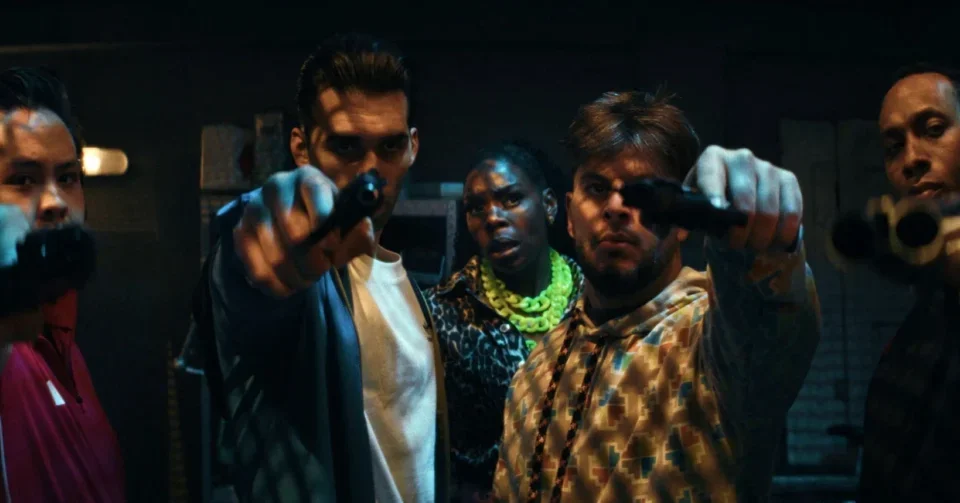
Finding himself in the crossfire, Suleyman forms an uneasy alliance with Yasmine (Clara Claymans), the sole survivor of a decimated SWAT team. Together, they must navigate the "levels" of the building, each floor presenting new threats and eccentric lieutenants of Prince’s army.
III. Supporting Data: The Craft Behind the Chaos
What prevents Attack on Paradise from becoming a routine action exercise is the meticulous attention to style and characterization provided by the creative team.
Visual and Auditory Identity
Cinematographer Steven Vanvolsem eschews the traditional "gritty" grey palette of European crime dramas. Instead, he bathes the housing project in "candied hues"—vibrant neons and saturated colors that give the film a comic-book energy. This aesthetic choice elevates the film from a mere police procedural to a stylized genre piece.
The score, composed by Maxim Lany and Jonas Nuttin, complements this visual flair. It evolves alongside the action, shifting from ominous brass sections to pulsing electronic beats. Notably, the score incorporates motifs reminiscent of the Muslim call to prayer, a subtle but powerful nod to Suleyman’s faith and the cultural fabric of the setting.
The "Messy" Action Aesthetic
Editor Brian Ent focuses on a specific brand of action. Unlike the hyper-choreographed, "gun-fu" style popularized by the John Wick franchise, Attack on Paradise opts for an "entertainingly messy" tenor. The fights are brutal, unpolished, and feel high-stakes. Suleyman is not a superhero; he is a "beleaguered, resourceful" man fighting for survival, which makes his eventual triumphs more grounded and satisfying.
IV. Official Responses and Critical Reception
Early reviews and industry reactions suggest that while Attack on Paradise utilizes familiar tropes, its execution and cultural specificity make it a standout entry in the Belgian canon.
Critical Consensus
Critics have praised the film for its "energy and style to spare." While some have noted that the script—penned by Sven Huybrechts, Boumazoughe, and Salahdine Ibnou Kacemi—is the most "routine" element of the production, the consensus is that the film’s pacing and character quirks prevent "macho monotony" from setting in.
The inclusion of offbeat details—such as remote-control doors, a knife fight on a waterbed, and even a goat—adds a layer of good-humored absurdity that distinguishes the film from more self-serious action movies.
Character Highlights
While Achmed Akkabi’s "Prince" provides a solid, sneering antagonist, critics have pointed out that his subordinates often steal the show. The "rogues’ gallery" includes:
- The Lion (Jamal Ben Saddik): A brutish professional boxer.
- Minza (Rudy Mukendi): A former Congolese child soldier, bringing a chilling backstory to the henchman role.
- Tchuko (Soroush Helali): An Albanian gun runner.
- Nikita (Imanuelle Grives): A drug-trade overseer whose past romantic history with Suleyman adds a layer of personal tension to the carnage.
V. Implications: The Future of Belgian Cinema and Representation
The success of Attack on Paradise has broader implications for the Belgian film industry and the portrayal of minority communities in European media.
1. The Rise of the "Belgian Action Wave"
For decades, Belgian cinema was primarily known for its social realism (exemplified by the Dardenne brothers). However, a new generation of filmmakers—including Bob Colaers and the duo Adil El Arbi and Bilall Fallah—is proving that Belgium can produce high-quality genre cinema that competes on a global stage. Attack on Paradise serves as a proof of concept that local stories can be told through the lens of international action tropes.
2. Redefining the "Action Hero"
By centering the narrative on a Belgian-Moroccan protagonist, the film challenges traditional casting norms. Suleyman is not a sidekick or a villain; he is the "near-invincible one-man army." This shift is significant in a European context, where actors of North African descent have historically been pigeonholed into roles associated with crime or radicalization. Here, the crime is the backdrop, but the hero’s journey is one of reclamation and familial duty.
3. Antwerp as a Cinematic Hub
The film utilizes Antwerp not just as a location, but as a character. The "multicultural modern reality" mentioned by creators is reflected in the casting, the languages spoken, and the music. This authenticity resonates with domestic audiences while providing international viewers with a fresh perspective on a European city rarely seen in this light.
4. Commercial Viability Abroad
With its brisk pacing and high production values, Attack on Paradise is well-positioned for international distribution. Its "good-humored effort" and stylistic flourishes make it an easy sell for streaming platforms looking for high-quality global action content.
In conclusion, Attack on Paradise may not reinvent the wheel of the action genre, but it applies a vibrant new coat of paint and a powerful engine. Through Saïd Boumazoughe’s personal vision and Bob Colaers’ energetic direction, the film stands as a testament to the power of genre cinema to reflect and celebrate the complex, diverse realities of the modern world. It is a "highly enjoyable" ride that signals a bright, neon-colored future for Belgian action.