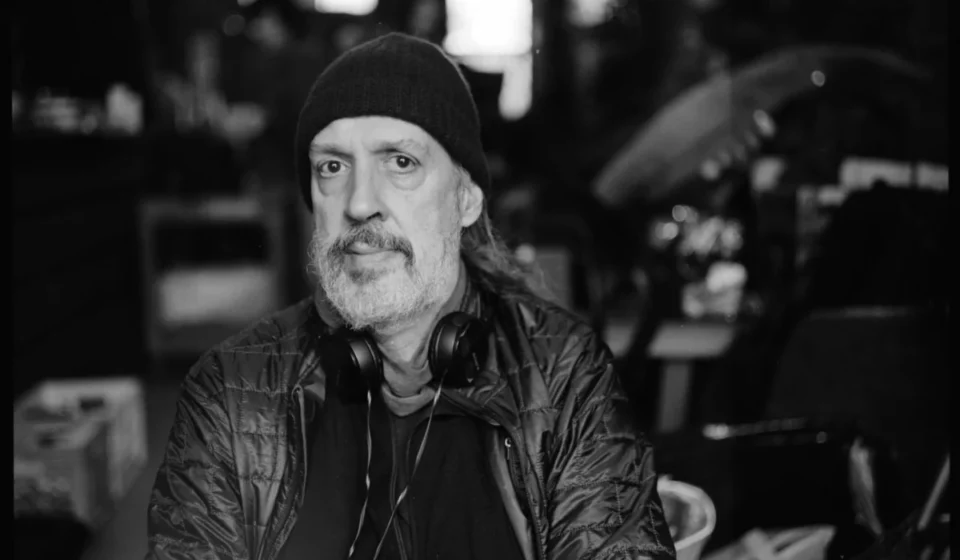

For decades, Kent Jones was the sharpest set of eyes in the American film criticism landscape. As a contributor to Film Comment and a key figure in the institutional preservation of cinema history, he became renowned for his forensic, deeply empathetic ability to deconstruct performance. Whether he was dissecting the kinetic abandon of Nicole Kidman in Moulin Rouge!, the quiet, lived-in desperation of Robert Forster in Jackie Brown, or the primal intensity of Daniel Day-Lewis in There Will Be Blood, Jones’ writing never felt like mere observation. It felt like an invitation to understand the architecture of the human soul as expressed through the medium of the moving image.
It is perhaps the most natural evolution in modern independent cinema that Jones, having spent years analyzing the "how" and "why" of great acting, would eventually step behind the camera to facilitate those moments himself. Following his transition from celebrated documentary filmmaker—with works on titans like Elia Kazan, Val Lewton, and Alfred Hitchcock—to narrative feature director, Jones has cultivated a reputation for eliciting career-defining work from his leads. His 2018 debut, Diane, was a masterclass in controlled, emotionally devastating storytelling, anchored by a powerhouse turn from Mary Kay Place. Now, with his latest feature, Late Fame, Jones cements his status as an actor’s director, guiding Willem Dafoe through a performance of such specific, haunting complexity that it is difficult to imagine the film existing without him.
The Narrative Core: A Poet’s Reckoning
Late Fame, adapted by writer Samy Burch from the novella by Arthur Schnitzler, centers on Ed Saxberger, a forgotten New York poet who spends his days laboring in the obscurity of the post office. The plot kicks into motion when Saxberger is unexpectedly rediscovered by a group of aspiring writers—a self-styled "enthusiasm society" that views him not as a relic, but as a revered master.
What distinguishes the film from a standard "artist’s comeback" story is its tonal delicacy. In Burch’s adaptation, the young acolytes who swarm Saxberger are treated with genuine warmth and empathy. The film navigates the treacherous waters of artistic ego, the pursuit of authenticity, and the fragility of legacy without ever resorting to the easy cynicism often found in stories about the literati. Where Schnitzler’s original prose was sharp, biting, and somewhat disparaging of his protagonist, the film opts for a more humanist approach.
"It’s easy to imagine Billy Wilder making a completely different movie out of the same material," Jones noted in a recent interview. "When I read the novella, I thought the situation was great, but I preferred Samy’s script because it took some of the edge off. My tendency was to go even further in that direction. I wanted to get you as close as possible to the characters so you could feel their ridiculousness, but at the same time see the beauty of the delusion."

A Chronology of Collaboration
Jones’ journey to Late Fame was not a linear path, but rather a convergence of his own history and his desire to mesh his sensibilities with those of other creators. Unlike Diane, which was deeply personal and rooted in the stories of women within his own family, Late Fame represents a collaborative synthesis.
"I liked the idea of meshing with somebody else," Jones explained. "In this case, it was two other people: Samy and Schnitzler."
A crucial entry point for Jones was the film’s atmospheric recreation of the New York City of the 1970s and 1980s. It was a period that mirrored the formative years of both the director and his star. "Willem and I spent a lot of time talking about the New York of that moment, because it’s important to both of us. Once Willem came on board, he was practically the only actor that would make sense in that part."
The casting process was not without its hurdles. Two other actors were originally attached to the role before falling out of the project. Rather than viewing these departures as setbacks, Jones characterizes them as serendipitous shifts that allowed the project to evolve. It is a philosophy that defines his current directorial style: an acceptance that the final product is rarely the one you envisioned on day one.
The Dafoe Factor: Erasure of the Performer
The success of Late Fame rests squarely on the shoulders of Willem Dafoe. His portrayal of Ed Saxberger is a feat of erasure; there is an uncanny lack of space between the actor and the character. Despite the fact that Dafoe’s own meteoric career bears little resemblance to the stagnated life of a post-office-bound poet, the performance feels entirely authentic.

Jones’ camera serves as a silent partner to this transformation. By employing a handheld, multi-camera approach, Jones allowed the camera to act as a witness to Dafoe’s micro-expressions rather than a choreographer of his movements. The rhythm of the film is dictated not by a predetermined editing pace, but by the physical and emotional cues Dafoe provides in the moment.
"There are some people who think that actors are interchangeable—that if one leaves, you just get another one," Jones said. "But whenever there’s an actor in a role, it becomes a completely different entity."
Philosophical Implications: Control vs. Letting Go
For a man who spent his life analyzing the rigid structures of classic cinema, Jones’ directorial philosophy is surprisingly fluid. He acknowledges a fundamental irony in the filmmaking profession: "A lot of the language of film criticism is about control, and a lot of the work of being a film director is about letting go."
This duality is central to his process. He maintains that while a director must provide a unifying vision, they must also be susceptible to the "new values" that arise during production—a concept he attributes to his long-time mentor and collaborator, Martin Scorsese. By refusing to treat his actors as mere props within a landscape, Jones creates a collaborative environment that he describes as an "adventure."
This philosophy extends into the edit suite, where the film finds its pulse. Jones is wary of "imposing a beat," favoring instead a natural rhythm that reflects the ebb and flow of life. Quoting Bob Dylan—"Sometimes the beat gets in the way of the rhythm"—Jones emphasizes that the goal is balance. The result is a film that feels remarkably unhurried, yet possesses a gravitational pull that keeps the viewer engaged in the minutiae of Saxberger’s existence.

A Career of Engagement
While some might suggest that Jones, who did not direct his first feature until later in his career, is a "late bloomer," the reality is that his entire life has been a long-form preparation for the director’s chair. His thirty-five-year association with Martin Scorsese, his tenure as the director of the New York Film Festival, and his prolific output as a critic were all, in hindsight, part of a singular trajectory.
"I always wanted to make films, period," Jones reflects. "I always wanted to engage with them. It was great to write about them, and then it was great to make films about the making of them, and then to make fiction films."
When asked if this path was carefully designed, Jones remains humble, citing the role of serendipity in his journey. "Luck is really important, but it’s equally important to take advantage of luck and to know what it is that you’re being lucky about. I don’t think that there was really a plan. But then is there for anybody?"
As Late Fame prepares to hit theaters this Friday, August 7, it serves as a testament to the idea that the best stories are those that allow for spontaneity. Kent Jones has successfully bridged the gap between the observer and the creator, proving that while he may have started his feature-directing career later than most, he brought with him a lifetime of wisdom—and a profound willingness to let the film become whatever it needs to be.