Tactical Terror: Adam Wingard’s ‘Onslaught’ and the Evolution of the Military-Slasher Genre

The landscape of contemporary genre cinema has often been divided between the hyper-expensive studio tentpoles and the minimalist, high-concept indie darlings. For director Adam Wingard and screenwriter Simon Barrett, the journey has been a pendulum swing between these two extremes. After a multi-year excursion into the "MonsterVerse" with the colossal Godzilla vs. Kong, the duo has returned to the visceral, razor-wire intimacy that first defined their careers. Their latest offering, Onslaught, represents a homecoming of sorts—a 92-minute exercise in tension, military-industrial critique, and elevated slasher tropes that serves as a bridge between the high-octane summer blockbuster season and the atmospheric "spooky season" of autumn.
Main Facts: The Return of the Wingard-Barrett Partnership
Onslaught is a military-infused slasher thriller that centers on a 12-hour countdown to an inevitable massacre. The film stars Adria Arjona as Celeste, a former army sniper turned trailer park manager, who finds herself caught between her traumatic past and a burgeoning bio-mechanical nightmare. The production marks a significant stylistic pivot for Wingard, moving away from the CGI-heavy spectacles of kaiju battles and returning to the "neon-noir" and "horror-synth" aesthetics that made The Guest (2014) a cult classic.
Produced under a framework that emphasizes "elevated genre," the film explores the intersection of private military contracting and experimental science. While the film has been noted for its occasional narrative inconsistencies—feeling at times like a project that required a final polish to its "nuts and bolts"—it is being hailed as Wingard’s most aesthetically accomplished work to date. With a lean 92-minute runtime, Onslaught prioritizes visceral momentum over complex world-building, utilizing a "ticking clock" mechanic to maintain a high-stress environment for both the characters and the audience.
Chronology: From Operation Paperclip to the 12-Hour Countdown
The narrative structure of Onslaught is divided into three distinct threads that remain largely parallel before colliding in a chaotic final act. This chronological daring is one of the film’s most discussed features, as it forces the audience to balance domestic drama with high-concept sci-fi horror.
The Historical Prologue
The film begins with a "snappy" and aggressive opening montage that moves backward through American military history. This sequence places a heavy emphasis on "Operation Paperclip"—the post-WWII program that brought German scientists to the United States. This historical anchor introduces the film’s primary antagonist, Dr. Hans Kammler (played by Dan Stevens), suggesting a lineage of unethical experimentation that stretches from the Third Reich to modern private contractors.
The Domestic Setup
Following the prologue, the story settles into a trailer park for U.S. Army veterans. We are introduced to Celeste (Arjona), whose daily life is a struggle to manage the compound while battling PTSD-induced "black-and-white memories" of her time as a sniper. The arrival of her ex-husband, who drops off their daughter Daisy (Blake Kennedy), sets the emotional stakes. For the first hour, the film functions almost as a character study of a veteran trying to reclaim a sense of domestic normality.
The Bunker Experiments and the Breach
Simultaneously, the film follows Dr. Kammler and his domineering wife Hanna (Rebecca Hall) in a covert military bunker. They are finalizing experiments on a trio of sociopathic super-soldiers. These "human weapons" are the result of torturous conditioning and bio-enhancements. When the experiment inevitably fails and the soldiers escape, the film shifts into a "road movie" of carnage, as the trio hacks and shoots their way through local townships, moving inexorably toward Celeste’s trailer park.
The Final Stand
The threads finally converge in the "Onslaught" of the title. Celeste, alongside a few surviving neighbors—including the wise Josiah (Reginald VelJohnson) and the somewhat incompetent local sheriff Kovacks (Eric Wareheim)—must turn the trailer park into a fortress. The final 30 minutes are a relentless display of inventive weaponry and "zombified" combat, concluding as the sun rises on the aftermath of the 12-hour countdown.
Supporting Data: Casting, Aesthetic, and Technical Execution
The success of Onslaught relies heavily on its ensemble cast and its specific audiovisual language. The film utilizes a "Halloween-meets-The Terminator" palette, characterized by high-contrast lighting and a pulse-pounding score.
Performance Analysis
- Adria Arjona: As Celeste, Arjona provides the film’s emotional anchor. Critics have noted her "hard-as-nails" performance, which is softened only by her protective maternal instincts. Her portrayal of a sniper allows for a more grounded approach to the action sequences compared to the supernatural abilities of her adversaries.
- Dan Stevens and Rebecca Hall: Reunited after previous collaborations, Stevens and Hall lean into the "heightened" nature of their roles. Stevens, as the heavily made-up Dr. Kammler, delivers a performance that borders on the operatic, while Hall provides a chilling, domineering counterpoint.
- The Supporting Cast: The inclusion of Reginald VelJohnson adds a layer of "80s action" nostalgia, while Eric Wareheim provides necessary, albeit slapstick, levity to an otherwise grim narrative.
Technical Craft
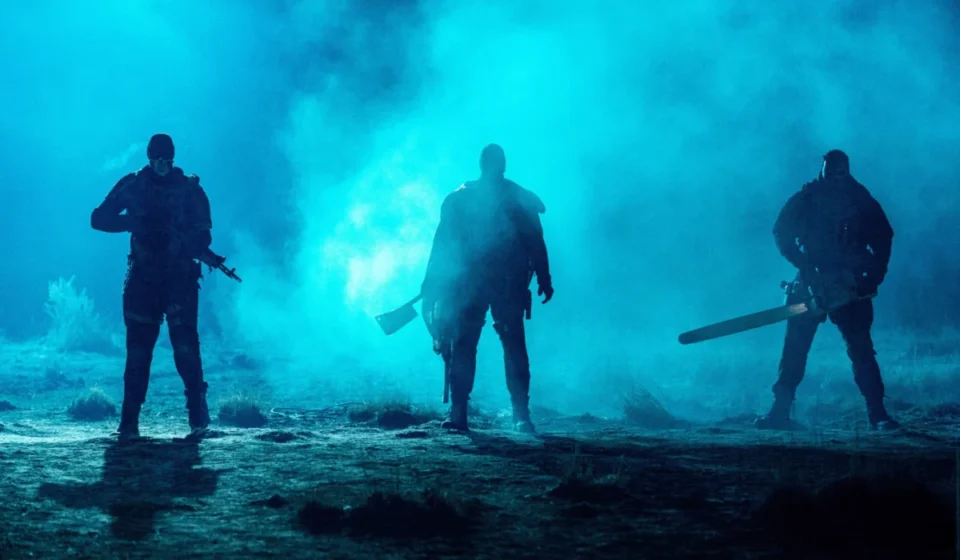
The film’s aesthetic is bolstered by the work of composer Matthew Pusti. The score is designed to "pluck on the nerves," utilizing industrial synths that mirror the cold, mechanical nature of the super-soldiers. Visually, Wingard employs "horror-tinged imagery" to depict the villains. These soldiers are portrayed as shapeless forms against the night sky, identifiable only by their glowing eyes and camo-gear, evoking a sense of "zombified" dread that elevates them above standard action movie henchmen.
Official Responses and Creative Intent
While official studio statements have focused on the film’s viability as a "midnight movie" hit, Adam Wingard and Simon Barrett have been vocal about the creative philosophy behind Onslaught.
Returning to "The Guest" Territory
In promotional interviews, Wingard has described Onslaught as a spiritual successor to The Guest. He noted that while the "MonsterVerse" was a rewarding challenge, there is a specific creative freedom found in lower-budget, R-rated genre films. "We wanted to make something that felt like a punch to the gut," Wingard stated in a recent press junket. "It’s about the language of the military-industrial complex fueling horror."
Addressing the Social Subtext
The film has drawn attention for its "racial undertones," specifically the fact that the experimental soldiers are primarily Black men being tortured by a scientist with Nazi ties. Screenwriter Simon Barrett has clarified that while these themes inform the plot, the film is not intended to be a "message movie" in the traditional sense. Instead, these elements are meant to provide a "backgrounded" layer of social horror that adds weight to the "gory, whizzbang action." The intention was to use the tropes of the 80s slasher to comment on the dehumanization inherent in modern warfare.
Implications: The Future of the "Elevated Slasher"
The release of Onslaught carries several implications for the film industry and the trajectory of Wingard’s career.
The Viability of Mid-Budget Genre Films
Onslaught serves as a test case for the "mid-budget" genre film in an era of streaming dominance. By blending high-concept sci-fi (super-soldiers) with a grounded domestic thriller (the mother-daughter drama), the film attempts to appeal to multiple demographics. Its success suggests that there is still a significant appetite for "visceral violence" and "midnight verve" that doesn’t require a $200 million price tag.
The Evolution of the Slasher
The film redefines the "slasher" by replacing the masked killer with the "enhanced soldier." This shift reflects a modern anxiety regarding technology and state-sponsored violence. By giving the villains "glowing eyes" and "inventive weapons," Wingard bridges the gap between the supernatural horror of the 1980s and the tactical shooters of the 2020s.
Critical Reception and Room for Growth
Despite its "structural misfortunes"—specifically the "vestigial" third movie involving a clean-up crew led by Drew Starkey’s character, Cyrus—the film has been received as a "worthwhile" addition to the Wingard-Barrett canon. The primary takeaway for future projects in this vein is the need for tighter narrative integration. The "delayed gratification" of the eponymous onslaught worked to build character empathy but risked losing the audience’s interest in the villains’ early-movie exploits.
In conclusion, Onslaught is a flawed but formidable entry into the military-horror subgenre. It reaffirms Adam Wingard’s status as a stylist capable of finding beauty in the grotesque and tension in the tactical. As the industry moves toward the "spooky season," Onslaught stands as a reminder that the most terrifying monsters are often the ones we build ourselves in pursuit of the ultimate weapon.