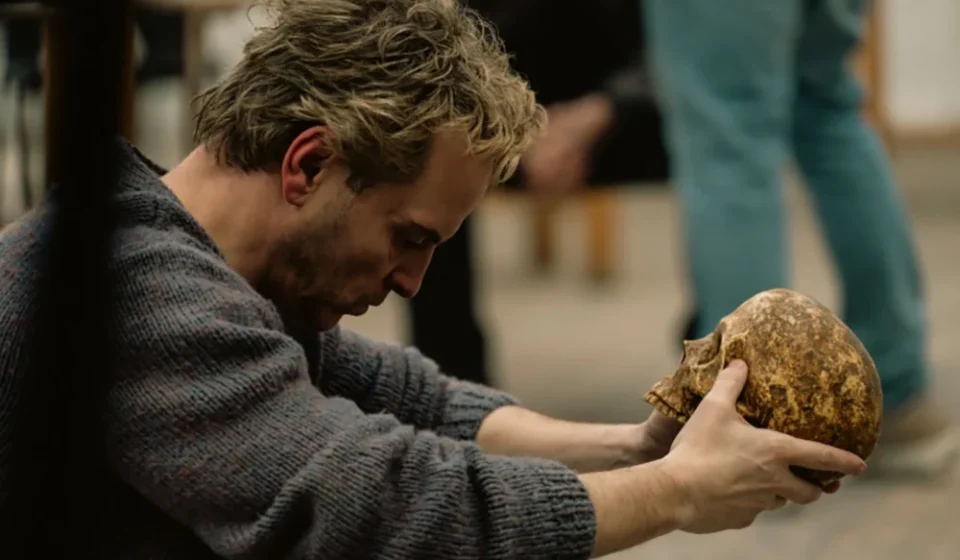

The BFI London Film Festival (LFF) has announced that its 70th anniversary edition will kick off with the European premiere of Elsinore, a sweeping biographical drama that captures the final, transcendent chapter of Scottish actor Ian Charleson’s life. Directed by Simon Stone (The Dig) and featuring a powerhouse performance by Andrew Scott, the film is poised to be one of the most significant cinematic events of the year.
The premiere, scheduled for October 7, will take place at the Royal Festival Hall—a location of poignant symbolic weight, situated mere steps from the National Theatre, the site of Charleson’s final, historic performance in Hamlet.
The Genesis of a Masterpiece: Main Facts
Elsinore chronicles the life of Ian Charleson, a titan of the British stage whose career was tragically cut short at the age of 40. The film focuses on the grueling and deeply personal preparation Charleson undertook to play the Prince of Denmark at the National Theatre while secretly battling a terminal illness.
The production boasts an extraordinary ensemble cast, including Olivia Colman, Billie Piper, Johnny Flynn, and Luke Thompson. Beyond his lead role, Andrew Scott serves as a producer, signaling his deep personal commitment to the project. The screenplay, penned by Stephen Beresford—renowned for his work on the celebrated film Pride—is described as a nuanced exploration of resilience, the craft of acting, and the indomitable spirit required to pursue art in the face of mortality.
The film is set for a wide release in U.K. cinemas on January 29 via StudioCanal, following a U.S. theatrical debut on November 20 through Focus Features. The production is a collaborative powerhouse, produced by Andrea Occhipinti (Lucky Red), Gabrielle Tana (Magnolia Mae Films), Pete Shilaimon and Mickey Liddell (LD Entertainment), as well as Stefano Massenzi and Carolyn Marks Blackwood.
A Life on the Boards: The Chronology of Ian Charleson
To understand the gravity of Elsinore, one must understand the man it portrays. Born in Edinburgh in 1949, Ian Charleson was a fixture of the British theatrical landscape throughout the 1970s and 80s. His early career saw him rise through the ranks of the West End, becoming a darling of the Royal Shakespeare Company and the Young Vic.
- 1981: Global Recognition: Charleson achieved international stardom with his portrayal of Eric Liddell in the Academy Award-winning film Chariots of Fire.
- The Mid-80s: Despite his cinematic success, Charleson remained fundamentally a man of the stage. He continued to push the boundaries of classical interpretation, earning a reputation for a rare, electric intensity.
- 1989: The Final Performance: The crux of the film centers on 1989. While physically debilitated, Charleson accepted the role of Hamlet at the National Theatre. His performance is now legendary in theatre lore, often cited as one of the greatest interpretations of the role in the 20th century. He died in January 1990, having left an indelible mark on the theatrical canon.
Elsinore seeks to bridge the gap between the public icon and the private man, focusing on the months leading up to the 1989 opening night. It is a story of a man who chose to meet his end not in silence, but in the spotlight, channeling his remaining vitality into the most complex role in the English language.
The Architecture of the Production: Supporting Data
The sheer scale of the talent involved in Elsinore suggests that it is not merely a standard biopic, but a major cultural event. The supporting cast list is a veritable "who’s who" of contemporary British acting talent:
- Supporting Cast: Monica Dolan, Matthew Beard, Joe Locke, Georgie Glen, Sadie Soverall, Adeel Akhtar, Dickie Beau, and Kadiff Kirwan.
- Veteran Presence: The film also features stalwarts Juliet Stevenson and Peter Mullan, adding layers of gravitas to the narrative.
The production design and screenplay focus on the "London experience" of the late 1980s. By centering the story in the geography of the South Bank, the filmmakers are creating a dialogue between the film’s narrative and the city’s cultural history. The choice to host the premiere at the Royal Festival Hall is intentional—it places the audience in the physical space where Charleson’s final, defiant act of artistic expression occurred.
Official Responses: A Vision for the Screen
The creators and the festival leadership have expressed that this film is a labor of love, designed to honor the legacy of a performer whose work continues to influence modern actors.
"We couldn’t be prouder to be able to present this quintessentially London film on the opening night of the BFI London Film Festival," said director Simon Stone. "Ian Charleson had many of his greatest triumphs on the stages of the West End, at the Young Vic and of course the National, where he ended his short but dazzling career playing an unforgettable Hamlet. We are so lucky to have Andrew Scott, a London Hamlet himself, breathing delicate, inspiring life into this beautiful story. I can’t wait to share it with the hometown audience!"
The sentiment is echoed by BFI London Film Festival artistic director, Kristy Matheson: "Anchored by Andrew Scott’s astounding central performance, few films will leave a lasting imprint on audiences this year quite like Elsinore. Stephen Beresford’s script offers a richly drawn world from which director Simon Stone and his exceptional ensemble of some of the U.K.’s greatest talents vividly bring the story of renowned actor Ian Charleson to the screen."
Matheson highlighted the symbolic importance of the film for the festival’s milestone: "We could not be prouder to open the 70th edition of the BFI London Film Festival with Elsinore, a film that centers community, resistance, and the triumph of art."
Implications: The Legacy of a Performance
The release of Elsinore carries significant implications for the landscape of contemporary cinema and theater.
1. The Intersection of Film and Theater
By casting Andrew Scott—who famously performed Hamlet in London in 2017 to immense critical acclaim—the film creates a metatextual layer. Audiences are not just watching an actor play an actor; they are watching a modern master of the role interpret the life of a predecessor who defined the same role under impossible circumstances. This linkage elevates the film from a standard biopic to a reflective piece on the nature of theatrical performance.
2. The Power of the "Biopic" as Social Commentary
The film arrives at a time when the arts are grappling with their own mortality and funding challenges. By highlighting Charleson’s dedication to the National Theatre, the film serves as a love letter to the British public-funded arts sector. It reminds audiences of the vital role these institutions play in humanizing complex histories and providing a space for profound personal expression.
3. A Focus on Vulnerability
The narrative arc of Elsinore focuses on the intersection of physical fragility and artistic strength. In a cinematic market often dominated by spectacle, Elsinore promises to be a quiet, internal, and intense character study. The involvement of such a high-profile ensemble suggests that the industry is leaning into "prestige drama"—films that rely on script quality and acting performance rather than high-concept gimmicks.
4. Cultural Resonance
As the film makes its journey from the LFF opening night to the broader international market, it is expected to ignite a renewed interest in the work of Ian Charleson. His career, while brief, remains a cornerstone of British acting history. Elsinore will likely serve as a gateway for a new generation to discover his performances, particularly the 1989 Hamlet, which is often archived but rarely seen by contemporary audiences.
Conclusion: A Milestone for the BFI
As the 70th BFI London Film Festival approaches, all eyes are on the Royal Festival Hall. Elsinore represents a perfect confluence of location, talent, and subject matter. It is a film that demands to be seen in the context of the city that birthed it, and by focusing on the "triumph of art," it encapsulates exactly what the festival aims to celebrate in its seventh decade.
For Andrew Scott, Simon Stone, and the entire production team, the premiere will be more than just a red-carpet event; it will be a tribute to the resilience of the creative spirit. By retelling the story of Ian Charleson, they are ensuring that the man who gave his final, bravest performance on the banks of the Thames will be remembered not for the tragedy of his end, but for the transcendent power of his art. As the curtains rise this October, Elsinore will invite the world to witness the endurance of the human spirit through the lens of one of Britain’s most beloved theatrical legends.