The Return of the King: Christopher Nolan’s ‘The Odyssey’ and the Resurrection of the Classical Epic

By [Senior Film Correspondent]
In the landscape of modern cinema, where intellectual property is mined until the bedrock cracks, it is a staggering statistical anomaly that Hollywood has not attempted a traditional, big-budget adaptation of Homer’s The Odyssey in over seven decades. Not since 1954’s Ulysses, starring Kirk Douglas, has a major studio dared to tackle the foundational text of Western literature with a straight face. This 72-year hiatus is particularly baffling when one considers that the "Hero’s Journey"—the narrative blueprint for everything from Star Wars to The Lion King—finds its genesis in Odysseus’ ten-year struggle to return to Ithaca.
Enter Christopher Nolan. In 2026, the director who successfully reinvented the superhero genre and turned a three-hour biopic about a physicist into a billion-dollar phenomenon has turned his gaze toward the wine-dark sea. Nolan’s The Odyssey is a massive, three-hour maritime fever dream that attempts to marry the grit of historical realism with the hallucinatory scale of Greek mythology. It is a film that functions as both a "greatest hits" of the Bronze Age and a complex meditation on the erosion of the human soul through time and trauma.
Main Facts: A Modern Vision of an Ancient World
Nolan’s The Odyssey is not merely a retelling; it is an architectural reconstruction. While the film retains the core plot points of Homer’s epic—the blinding of the Cyclops, the temptation of the Sirens, and the slaughter of the suitors—it filters them through Nolan’s signature obsession with temporal distortion.
The production, filmed largely on 65mm and IMAX film, eschews the "swords and sandals" camp of the mid-20th century in favor of a visceral, tactile aesthetic. Working again with cinematographer Hoyte van Hoytema, Nolan creates a world that feels "burnt and bleached," where the Mediterranean is not a tourist’s paradise but a vast, indifferent graveyard.
Key Production Details:
- Director: Christopher Nolan
- Runtime: 178 minutes
- Format: IMAX 70mm, 35mm
- Lead Cast: Matt Damon, Anne Hathaway, Tom Holland, Robert Pattinson
- Score: Ludwig Göransson
- Editing: Jennifer Lame
The film’s screenplay, also penned by Nolan, modernizes the dialogue while maintaining the high-stakes gravity of the source material. It avoids the stilted "thee and thou" of older adaptations, opting instead for a terse, Hemingway-esque clarity that emphasizes the psychological toll of Odysseus’ journey.
Chronology: The Weaving and Unweaving of Time
True to form, Nolan has dismantled the linear progression of the journey. In Homer’s original text, the story begins in medias res (in the middle of things), but Nolan pushes this technique to its breaking point. The film utilizes a fragmented timeline that mirrors Penelope’s famous shroud—woven by day and unraveled by night.
The Fragmented Narrative Arc
The film opens not with the fall of Troy, but with a grizzled, unrecognizable Odysseus (Matt Damon) washing up on the shores of Scherie. From there, the narrative radiates outward in concentric circles:
- The Present (Ithaca): Penelope (Anne Hathaway) and Telemachus (Tom Holland) struggle to maintain order against a backdrop of mounting domestic rot.
- The Recent Past (The Journey): A series of episodic, surreal encounters with the supernatural that are presented out of order, heightening the sense of Odysseus’ disorientation.
- The Distant Past (Troy): Sparse, haunting flashbacks to the Trojan War, culminating in a spectacular rendition of the Trojan Horse ruse.
This "structural cat’s cradle," as some critics have dubbed it, serves a thematic purpose. By denying the audience a clear sense of how much time has passed, Nolan forces the viewer to inhabit Odysseus’ "bleary disorientation." To our hero, ten years of wandering feels like a single, unending afternoon of terror.
Supporting Data: Casting and Technical Craft
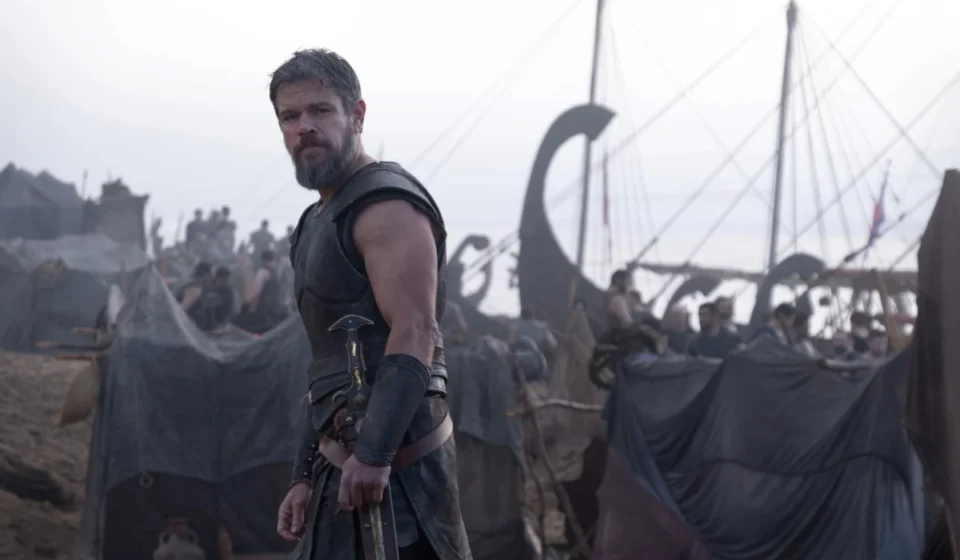
The success of The Odyssey rests heavily on the shoulders of Matt Damon. Casting the "everyman" of American cinema as the most cunning man in Greek myth is an inspired choice. Damon’s Odysseus is not the bronzed, confident warrior of Kirk Douglas; he is a "crushed, grizzled" figure whose physique suggests a man who has been beaten by the elements for a decade.
The Ensemble and Their Roles
Nolan’s penchant for star-studded ensembles is on full display here, though many A-listers appear in what are essentially "lily-gilding cameos":
- Anne Hathaway (Penelope): Stoic and tremulous, Hathaway provides the film’s moral anchor, though her character remains largely confined to the domestic sphere.
- Tom Holland (Telemachus): Portraying Odysseus’ son as "over-callow," Holland captures the insecurity of a boy trying to fill the shoes of a legend he has never met.
- Robert Pattinson (Antinous): As the lead suitor, Pattinson leans into a "pantomime villainy" that provides a sharp, lascivious contrast to the grim seriousness of the rest of the film.
- Samantha Morton (Circe): In what many consider the film’s standout performance, Morton portrays the enchantress with a "raw, wily, and volatile" energy that makes the sequence both sensual and terrifying.
- John Leguizamo (Eumaeus): Providing the film’s rare emotional heartbeat, Leguizamo plays the blind servant with a "frail, quavering" dignity.
Technical Mastery
The technical execution of the film is, by all accounts, unparalleled in the current decade.
- The Cyclops (Polyphemus): Using a mix of practical effects and "brain-melting digital assistance," Bill Irwin’s portrayal of the giant is a triumph of creature design, avoiding the "uncanny valley" that plagues most CGI monsters.
- The Score: Ludwig Göransson’s "deep electro-orchestral throb" moves away from the traditional brass-heavy epic score, instead using synthesized pulses to mimic the sound of rowing and the rhythmic crashing of waves.
- The Costumes: Ellen Mirojnick’s work, particularly Zendaya’s "starkly beautiful goddess gowns" as Athena, blends ancient Aegean silhouettes with a timeless, high-fashion sensibility.
Official Responses and Public Reception
As with any Nolan project, the release of The Odyssey has been met with both rapturous praise and calculated controversy.
Critical Consensus
Early reviews have highlighted the film’s "nakedly, viscerally spectacular" nature. Critics from Variety and The Hollywood Reporter have praised the "Trojan Horse" sequence as a masterpiece of tension and release. However, a common critique has emerged regarding the film’s "aloof, soul-skirting chill." While the film is a sensory banquet, some argue that the emotional core—the love between Odysseus and Penelope—is sacrificed at the altar of structural complexity.
The "Culture War" Casting
The casting of Lupita Nyong’o in the dual roles of Helen of Troy and Clytemnestra sparked a predictable, if wearying, right-wing culture war on social media. Critics of the casting argued for "historical accuracy," while Nolan’s supporters and historians pointed out that The Odyssey is a work of mythology, not a documentary. Nolan himself has remained largely silent on the matter, letting the film’s internal logic—where Nyong’o represents the "face that launched a thousand ships" in a hauntingly symbolic fashion—speak for itself.
Implications: The Future of the Auteur Blockbuster
The release of The Odyssey in 2026 marks a pivotal moment for the film industry. In an era where streaming services often prioritize "content" over "cinema," Nolan’s insistence on a theatrical-first, IMAX-driven experience for a classical text is a gamble of Herculean proportions.
Redefining the Epic
Nolan has proven that the "Hero’s Journey" does not need to be hidden behind the mask of a superhero or a sci-fi protagonist to be commercially viable. By returning to the source material, he has stripped the genre back to its essentials: man versus the gods, man versus the sea, and man versus himself.
The Sensory Shift
The film’s reliance on "sensory awe" over emotional sentimentality may signal a shift in how blockbusters are constructed. The Odyssey suggests that an audience can be moved not just by a character’s tears, but by the "burnt vistas of sand and scrub" and the sheer scale of a vision realized without compromise.
As audiences leave the theater feeling as though they have "been to hell and back," the industry must reckon with the fact that the oldest story in the book is still, in the right hands, the most potent. Nolan hasn’t just adapted The Odyssey; he has reclaimed it for a new century, reminding us why we tell these stories in the first place: to find our way home.