The Handcrafted Epic: Qiu Jiongjiong’s ‘Fuxi: Four Tales of Feasting’ and the Renaissance of Theatrical Cinema

Introduction: The Return of the Painter-Director
In the contemporary landscape of global cinema, where digital landscapes and generative AI are increasingly used to substitute for physical reality, the works of Qiu Jiongjiong stand as a defiant, tactile anomaly. Following the massive international success of his 2021 fiction debut, A New Old Play—which secured the Special Jury Prize at the Locarno Film Festival—Qiu has returned to the soundstage with his latest opus, Fuxi: Four Tales of Feasting.
While A New Old Play was a sprawling, three-hour odyssey through the 20th-century history of China, seen through the eyes of a Sichuan opera performer, Fuxi narrows its lens but expands its temporal scope. It is an anthology film that treats the act of eating—"Fuxi"—as both a primal biological necessity and a sophisticated cultural ritual. By utilizing highly stylized studio environments, hand-painted backdrops, and practical theatrical effects, Qiu Jiongjiong has crafted a "four-course feast for the eyes" that reaffirms his position as one of the most visually inventive filmmakers working in independent Chinese cinema today.
Main Facts: A Culinary and Cinematic Anthology
Fuxi: Four Tales of Feasting is a multi-layered narrative that spans millennia, from prehistoric tribes to the dawn of the 20th century, and even into the symbolic year of 1997. The film’s title is derived from a term translated as "a tasty delicacy, or the act of eating it," grounding the high-concept artifice in the earthy reality of Sichuan cuisine.
Key Production Elements:
- Director/Writer/Editor/Production Designer: Qiu Jiongjiong, who has taken on a more comprehensive creative role by designing the sets himself.
- Lead Cast: The film features a recurring ensemble cast, most notably Lee Kang-sheng (the iconic muse of Tsai Ming-liang) and Lee Hong-chi.
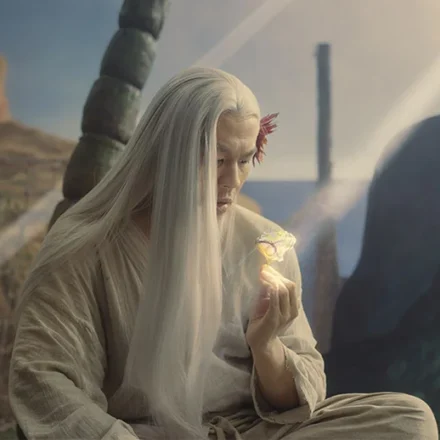
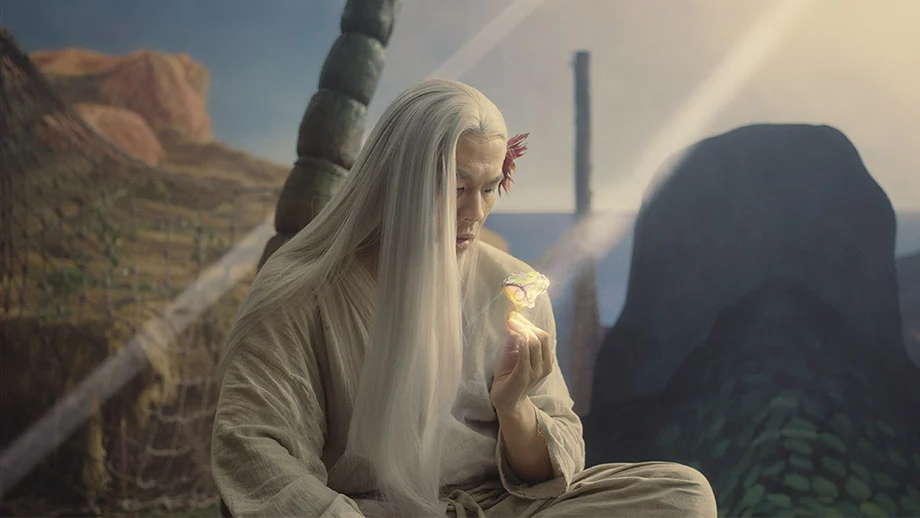
- Aesthetic Style: "Handmade" theatricality. The film eschews location shooting for soundstages filled with foam mountains, painted clouds, and "ocean waves" made of rippling blue bedsheets.
- Structure: An anthology of four distinct but thematically linked chapters, framed by a celestial observation by two figures, Sol and Luna.
Unlike the politically charged and historically linear A New Old Play, Fuxi operates in a folkloric and mythical mode. It explores how community and ritual are forged through the shared experience of food, while maintaining a stoic, almost bawdy philosophical outlook on the cycle of life: "We eat, we shit, and that’s it."
Chronology: Four Epochs of Flavor and Fate
The film is structured into four primary segments, each exploring a different era of human development and a specific relationship with sustenance.
I. The Ancestors’ Fuxi (Prehistory)
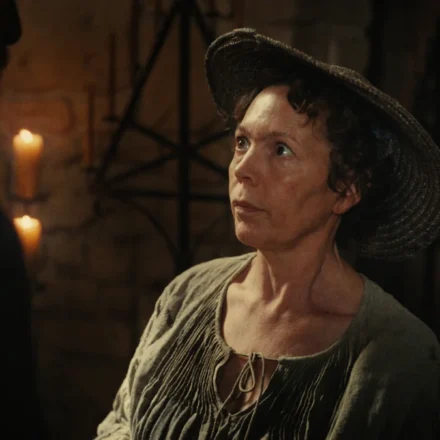
The film opens in a prehistoric setting where a tribe of humans, distinguished by their tails, grapples with mortality and lineage. Lee Kang-sheng, appearing in the first of several roles, portrays a dying "granny" with a silver rope wig. In a startling act of literal and symbolic self-sacrifice, she chops off her own tail to be boiled into a soup for her descendants. This segment establishes the film’s core theme: that the act of eating is an act of inheritance and communal survival.
II. The King’s Fuxi (The Mythic Past)
Jumping forward a millennium, the film explores the legend of Duyu, the "Cuckoo King" of Sichuan. In this era, humans have lost their tails but gained agriculture. The production design here is particularly striking, featuring tiered hillsides made of flat boards painted with abstract green swirls. The king, having abdicated to live as a bird, returns annually to taste the tributes of his subjects. This chapter highlights the transition from primal survival to a hierarchical society defined by agricultural ritual.
III. The Litterateur’s Fuxi (The Song Dynasty & 1997)
The most substantial segment focuses on Su Dongpo, the legendary Song dynasty poet and dissident (played by Lee Hong-chi). The narrative structure becomes increasingly complex here, as four spirits assemble in a stylized 1997—represented by skyscraper cutouts backlit through lighting gels—to share a banquet. Each dish served triggers a memory from Su Dongpo’s life, particularly his periods of exile. The cinematography shifts to earthy, overhead shots of browning pork belly and steaming fish, using the physicality of food to comment on the emotional weight of political banishment.
IV. Sworn Brothers’ Fuxi (The Turn of the 20th Century)
The final segment returns to a more grounded historical setting: the twilight of the Qing dynasty. A young boy flees kitchen servitude and joins a group of outlaws (or perhaps ghosts) who teach him the art of making congee. This chapter serves as a meditation on the virtues of patience and camaraderie. It bridges the gap between the grand myths of kings and poets and the everyday survival of the common man, leading into the film’s final, blunt philosophical summary of human existence.
Supporting Data: The Art of the "Handmade" Mise-en-Scène
Qiu Jiongjiong’s background as a painter is essential to understanding the "data" of his film’s construction. In an era where "resourceful" often implies low-budget compromises, Qiu uses his constraints to create a unique aesthetic language.
- Tactile Flourishes: The film uses "low-tech" solutions for "high-concept" problems. Digital effects are used sparingly, primarily to remove the wires that allow actors to float through smoke-machine haze.
- Color Palette: The film employs a "tinting" technique reminiscent of silent cinema, with interstitial sequences bathed in sepia or steel-blue.
- Culinary Detail: Unlike many films where food is a mere prop, Fuxi provides detailed, almost instructional sequences for Sichuan cooking. The use of "offcuts," such as lamb’s spine, serves as a metaphor for the resourcefulness required during times of political or social exile.
- Ensemble Versatility: By having the same actors play different roles across centuries, Qiu emphasizes the "rhyming" nature of human history. Lee Kang-sheng’s transition from a prehistoric grandmother to a female elder in the mythic past showcases a "sly charisma" that anchors the film’s artifice.
Official Responses and Critical Reception
While Fuxi: Four Tales of Feasting has yet to complete its full international circuit, early critical responses have highlighted both its visual brilliance and its shift in tone compared to Qiu’s previous work.
- The "Platform" Comparison: Critics who previously compared Qiu to Jia Zhangke (specifically his 2000 masterpiece Platform) have noted that Fuxi is less "politically ambitious" and more "folkloric." While Jia Zhangke’s work often deals with the direct impact of policy on the individual, Qiu’s work is increasingly interested in the "liminal space between textbook and myth."
- The Festival Circuit: Given Qiu’s history with Locarno, the film is expected to be a staple of the 2024-2025 festival season. Early reviews suggest that while it may be seen as "less substantial" than A New Old Play due to its anthology format, it is being hailed as a "luxury good" in terms of its production design.
- Cultural Preservation: Within China, Qiu is being recognized for his ability to translate traditional Sichuan culture and history into a modern cinematic vernacular that avoids the clichés of "heritage cinema."
Implications: A Stand Against Digital Homogenization
The release of Fuxi: Four Tales of Feasting carries significant implications for the future of independent filmmaking, particularly in Asia.
The Resistance to AI and Digital Fixes
Qiu Jiongjiong’s insistence on "intricately wrought tactile flourishes" is a political statement in itself. In a global industry where generative AI and digital shortcuts are becoming the norm, Qiu’s "handmade" approach preserves the human element of craftsmanship. Every painted backdrop and foam mountain serves as a reminder of the artist’s hand, offering a sensory experience that digital imagery cannot replicate.
The Fluidity of Fiction
The film’s frame story—featuring the celestial characters Sol and Luna—suggests a philosophy of storytelling where the borders between life, death, and fiction are porous. By repeatedly crossing these borders, Qiu argues for a type of "cinematic freedom" that isn’t bound by the constraints of realism.
The Universality of the "Bawdy" Philosophy
Finally, Fuxi posits that despite the grand shifts in history—from the invention of farming to the fall of dynasties—human nature remains tethered to the body. The film’s concluding sentiment—"We eat, we shit, and that’s it"—strips away the pretensions of modern progress. It suggests that the true "Fuxi" (the delicacy of life) is found not in grand political achievements, but in the ritual of the meal and the camaraderie of those sharing it.
In conclusion, Fuxi: Four Tales of Feasting is more than just a follow-up to a successful debut; it is a deepening of a unique cinematic philosophy. Qiu Jiongjiong has created a world that is simultaneously ancient and avant-garde, proving that the most profound stories are often those told with the simplest of tools: a painted board, a blue bedsheet, and a well-cooked meal.