The Fiber of Fantasy: Why ‘Wicker’ is the Most Audacious Cinematic Swing of 2026

Editor’s Note: This review was originally filed from the 2026 Sundance Film Festival. Black Bear will release the film in limited theaters on Friday, October 23, with a nationwide expansion to follow on Friday, October 30.
In the landscape of contemporary independent cinema, the high-concept premise is often a double-edged sword—a clever hook that struggles to sustain its own weight once the novelty wears off. However, directors Eleanor Wilson and Alex Huston Fischer have managed to weave something uniquely unsettling and strangely tender in their latest feature, Wicker. A kooky, sex-crazed folk tale that feels like a fever dream birthed from the pages of a raunchy, lost Chaucer manuscript, Wicker is a film that demands to be seen, even if it leaves the audience questioning the boundaries of human-object desire.
The Premise: A Marriage of Wicker and Will
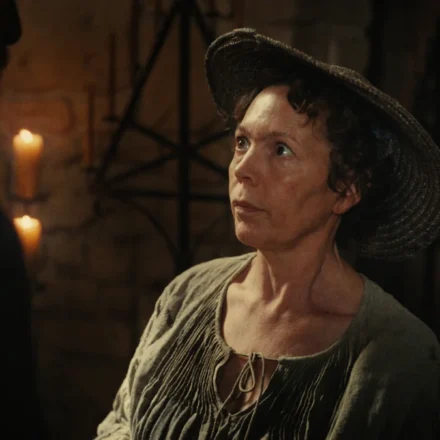
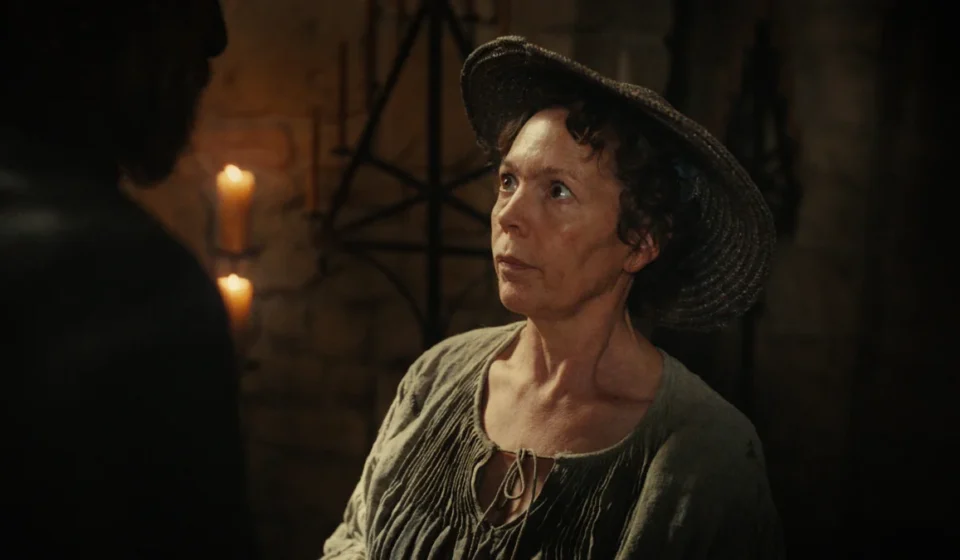
The film centers on a prickly, isolated fisherwoman, portrayed with grounded, gritty pathos by the incomparable Olivia Colman. Living on the jagged fringes of a nebulous, timeless seaside village, her character is a social pariah, defined by her pungent scent and abrasive temperament. Yet, she remains the lifeblood of the community, providing the town with the daily haul of slimy river fish necessary for their survival.
Driven by an insatiable, long-denied longing, she approaches a reclusive local basketmaker—played by Peter Dinklage—with an unusual request: to weave her a husband. Enter Alexander Skarsgård. In a performance of remarkable deadpan commitment, Skarsgård portrays a man constructed entirely of wicker fibers. His face is a haunting, masterful feat of prosthetics—a woven espadrille stretched tight over a human skull.
Chronology of a Curio: From Sundance to Theaters
The journey of Wicker began with its rapturously bizarre premiere at the 2026 Sundance Film Festival, where it immediately polarized critics and audiences alike. While the film’s pedigree—based on the short story The Wicker Husband by Ursula Wills-Jones—suggested a whimsical fable, the final product delivered a much more visceral, earthy, and ribald experience.
Following its festival circuit buzz, Black Bear secured the distribution rights, betting on the film’s "A24-ready" aesthetic to draw in arthouse crowds. The film is scheduled for a limited release on October 23, 2026, with a wider rollout on October 30, positioning it as a sophisticated, albeit highly unconventional, counter-programming option for the Halloween season.

Cinematic Craft: The Aesthetics of the Bizarre
Visually, Wicker is a triumph of atmosphere. Cinematographer Lol Crawley, whose work on The Brutalist established him as a master of textured, period-accurate lighting, brings a crisp, Academy-ratioed visual language to this world. The film exists in a liminal space; it is a period piece with no specific calendar date, hovering somewhere between the 17th and 19th centuries. It is a setting of mud, blood, and salt, rendered with a tactile intensity that makes the viewer feel the coarseness of the environment.
The production design team faced the gargantuan task of balancing the fantastical nature of the Wicker Man with the grim, grounded reality of the village. The result is a Monty Python-esque absurdity tempered by the seriousness of a prestige drama. Whether it is the visual of a "tradwife" (a radiant, magnetic Elizabeth Debicki) suffering under the thumb of a tailor, or the medical malpractice of a delightfully incompetent doctor (Richard E. Grant), the film builds a tapestry of human suffering that is as hilarious as it is horrifying.
Supporting Data: The Ensemble and the Absurd
The strength of Wicker lies in its sprawling ensemble. The village is a microcosm of sexual frustration and societal repression, and the arrival of Skarsgård’s character acts as a catalyst for the town’s hidden desires.
- Olivia Colman: While her recent filmography has seen her tackling similar roles of socially isolated, "blowzy" women, Colman brings a specific, desperate humanity to this fisherwoman that prevents the film from descending into mere parody.
- Alexander Skarsgård: Tasked with the most difficult role of his career, Skarsgård manages to evoke genuine romantic chemistry despite being essentially "fuckable furniture." His presence is cool, soothing, and inexplicably, heart-wrenchingly human.
- The Supporting Cast: From Nabhaan Rizwan’s tailor to Marli Siu’s prudish sister, the film effectively uses its characters to show how the arrival of the "Wicker Man" forces a mirror up to their own stifled lives.
Official Perspectives: Sound Design and The "Gag"
One of the most discussed aspects of the film is its audacious sound design, helmed by Andy Neil. Given that the sexual relations between Colman and Skarsgård are kept offscreen, the film relies entirely on auditory cues to convey the intensity of their union. The "growing tumescence" of a man made of wood is communicated through creaks, groans, and the rhythmic snapping of wicker—a design choice that is as technically impressive as it is narratively daring.
The directors, Wilson and Fischer, have stated in various press junkets that they were less interested in the mechanics of how such a being is created, or the biological realities of their union, than in the emotional landscape of the pairing. They treat the film’s central conceit with a straight face, which paradoxically makes the humor land with far more impact.
Implications: The Future of High-Concept Indie Film
The success—or failure—of Wicker at the box office will serve as an interesting bellwether for the industry. In an era where AI-generated content is struggling to find a footing (as evidenced by recent flops in the Chinese market), Wicker represents a return to the "auteur-driven weird." It is a film that relies on the physical, the practical, and the deeply human, even when the lead character is literally made of reeds.

Is this a sustainable model? The film is not without its flaws. At times, the narrative suffers from its own ambition, with certain character arcs getting lost in the "sameness" of the villagers’ collective suffering. Yet, the risk taken by the production team is commendable. They have taken what could have been a schlocky, one-note joke and elevated it into a prestige-level fable about love, longing, and the desire to be understood—even if you are made of fiber.
Conclusion: A Grade of B
Ultimately, Wicker is a film that challenges the viewer. It is a "quirkfest" gilded with the trappings of high art, and it succeeds because it refuses to blink in the face of its own absurdity. While it may occasionally feel like a short story stretched to its breaking point, the sheer commitment of its lead actors and the technical prowess of its visual team make it one of the most memorable viewing experiences of the year.
It is a film that reminds us that cinema, at its best, is not just about telling a logical story, but about exploring the most bizarre corners of the human heart. Whether or not it will be remembered as a masterpiece remains to be seen, but as an experiment in the limits of genre, it is, quite literally, a triumph of material.
Grade: B