Climate Crisis Drama ‘A Statement’ Taps Bryce Dessner for Original Score Ahead of NYFF Premiere

September 28, 2026 — As the 2026 New York Film Festival (NYFF) prepares to open its doors, one of the most anticipated titles on the slate, the climate-focused drama A Statement, has revealed its key creative powerhouse: acclaimed composer and The National multi-instrumentalist Bryce Dessner.
Directed by Academy Award-winner Tom McCarthy, A Statement marks a significant pivot in prestige filmmaking, blending historical inquiry with the high-stakes tension of an ensemble drama. With a star-studded cast and a narrative anchored in the early realization of the climate crisis, the film is poised to be a major awards-season contender when Sony Pictures Classics brings it to theaters later this year.
The Genesis of a Climate Thriller
From Nathaniel Rich’s Losing Earth to the Silver Screen
The intellectual architecture of A Statement is rooted in the nonfiction work Losing Earth: A Recent History by Nathaniel Rich. The book chronicles the decade between 1979 and 1989, a period when the scientific community first grasped the severity of anthropogenic climate change—and when, according to Rich, humanity had its best chance to avert the impending catastrophe.
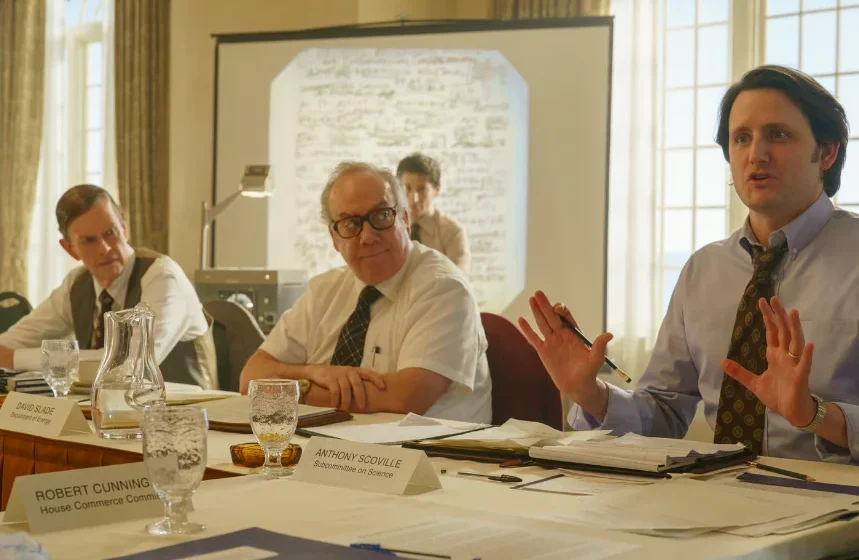
Tom McCarthy, known for his meticulous research and humanistic approach to storytelling in films like Spotlight and The Station Agent, has adapted this dense historical record into a localized, high-tension narrative. The film transposes the global stakes of the book into a claustrophobic, character-driven environment: a beachside resort in Florida, 1980. Over the course of a single weekend, twenty experts gather for a conference that serves as a microcosm of the political and scientific paralysis that would define the following forty years.
Bryce Dessner: A Composer of Global Resonance
The selection of Bryce Dessner to score A Statement underscores the film’s ambition. Dessner has become one of the most sought-after composers in contemporary cinema, bridging the gap between indie-rock sensibilities and rigorous orchestral composition.
Having built a formidable resume with scores for The Two Popes, Cyrano, She Came to Me, and the recent Sing Sing, Dessner’s ability to evoke emotional depth and intellectual unease is well-documented. His work on A Statement is expected to be a departure from his more romantic or character-focused themes, likely requiring a score that captures the encroaching anxiety of 1980s environmental awareness—a soundscape that must balance the idyllic setting of a Florida resort with the existential dread of the impending climate collapse.
Dessner’s recent output, including his work on the Netflix series Monster: The Lizzie Borden Story, proves his versatility in managing complex, multi-layered narratives. His collaboration with McCarthy promises to elevate the tension of the film’s central conference, translating the technical jargon of carbon emissions into a visceral, sonic experience.
The Ensemble: An Actor’s Masterclass
The production value of A Statement is perhaps best reflected in its expansive and formidable cast. McCarthy has assembled a troupe of actors known for their ability to navigate complex, dialogue-heavy scripts:
- Paul Rudd and Evan Peters headline the cast, likely playing the ideological anchors of the conference.
- Paul Giamatti and John Turturro bring gravitas and seasoned intensity, essential for a film dealing with historical power dynamics.
- Amy Ryan, Tatiana Maslany, Nina Arianda, and Zach Woods round out an ensemble that suggests the film will prioritize character dynamics as much as it does its environmental message.
The chemistry between these performers will be the heartbeat of the film. Given the setting—a resort in 1980—the film will likely utilize the aesthetics of the era to highlight the juxtaposition between the luxury of the decade’s excess and the dire warnings being whispered in the conference rooms.
Production Pedigree: A Collaborative Effort
The behind-the-scenes team is as impressive as the onscreen talent. McCarthy co-wrote the screenplay with Thomas Bidegan and Noé Debré. Bidegan, known for his work on A Prophet and Rust and Bone, brings a gritty, continental European sensibility to the script, while Debré’s experience with Stillwater ensures a narrative structure that is both accessible and poignant.
The production is a massive collaborative undertaking involving:
- Slow Pony: Led by Tom McCarthy and Jim Whitaker (Pete’s Dragon, A Wrinkle in Time).
- Anonymous Content: Represented by heavyweights Jonathan King, David Levine, Jonathan Schwartz, Nick Shumaker, and Bard Dorros.
- Aloe Entertainment: Led by Mary Aloe.
This coalition of producers indicates a high-confidence project, with major industry players backing a film that tackles a subject often considered “box office poison”: climate change. By grounding the issue in 1980, the producers are utilizing the “period piece” framework to discuss contemporary issues, a technique that has historically resonated well with both critics and Academy voters.
A Strategic Release: From Festival Circuit to Theaters
The choice of the New York Film Festival for the world premiere is a strategic move by Sony Pictures Classics. The NYFF is widely considered the “filmmaker’s festival,” favoring intellectual rigor and artistic ambition over the populist spectacle of other major fall festivals.
By debuting in New York, the film signals its intention to participate in the awards conversation. Following the premiere, Sony Pictures Classics plans a measured theatrical rollout. This strategy is designed to build critical consensus and word-of-mouth momentum before the film hits wider release, positioning it as a mandatory viewing experience for audiences seeking thoughtful, “prestige” cinema.
Implications: The Climate Narrative in Modern Cinema
The production of A Statement represents a turning point in how Hollywood addresses the climate crisis. For years, the industry has struggled to turn abstract scientific data into compelling narrative drama. By focusing on the history of the failure to act, rather than a futuristic post-apocalyptic survival story, McCarthy is attempting something more subtle and perhaps more devastating: a post-mortem of a missed opportunity.
The film acts as a mirror to our current moment. By revisiting 1980, the audience is invited to witness the moment the alarm was first sounded, knowing full well that the warnings went unheeded. The collaboration between McCarthy’s narrative direction and Dessner’s atmospheric score will be crucial in ensuring that this “history lesson” does not feel like a lecture, but rather a compelling drama of human fallibility.
The Musical Signature
Dessner’s contribution will likely define the film’s "emotional temperature." If his previous works are any indication, audiences can expect a score that uses minimalism to heighten suspense. In a film centered on a conference—essentially people talking in rooms—the music must provide the missing kinetic energy, underscoring the urgency of the conversation.
Future Outlook
As we look toward the 2026 award season, A Statement is already drawing comparisons to political thrillers like All the President’s Men or The Big Short. Its success will depend on its ability to make the audience feel the weight of 1980, a year that, in hindsight, serves as the prologue to the modern climate crisis.
With a score by Bryce Dessner, a script by the team behind A Prophet, and direction by Tom McCarthy, A Statement is not merely a film—it is an event. As the credits roll at the New York Film Festival this weekend, the industry will be watching to see if this statement lands with the gravity required to change the conversation.
Sony Pictures Classics has positioned the film for a fall release, ensuring that when the leaves begin to turn and the awards buzz reaches a fever pitch, A Statement will be at the center of the discourse. Whether it succeeds in galvanizing audiences or merely documenting a tragedy, one thing is certain: it will be one of the most musically and narratively significant cinematic experiences of the year.