A Golden Reunion: The Enduring Legacy of ‘Charlie’s Angels’ at the 78th Emmy Awards

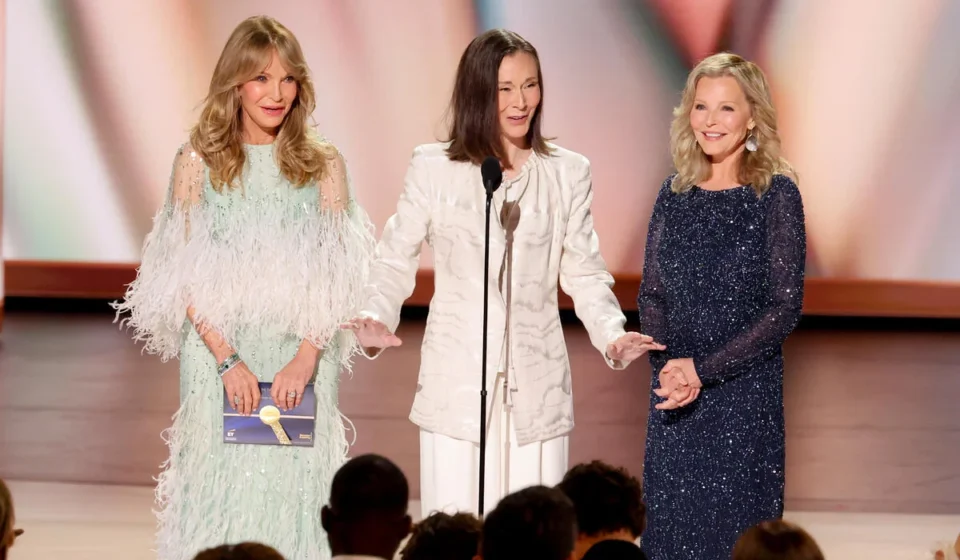
The 78th Emmy Awards became a stage for television history on Monday night as the iconic trio of Kate Jackson, Cheryl Ladd, and Jaclyn Smith reunited to mark the 50th anniversary of the cultural phenomenon Charlie’s Angels. As the three women walked onto the stage, they were met with a resounding, heartfelt standing ovation—a testament to their status as pioneers of the small screen. Their appearance was not merely a ceremonial duty; it was a nostalgic bridge connecting the golden age of 1970s television to the contemporary landscape of high-stakes drama.
The purpose of their appearance was to present the Emmy for Best Drama, which was awarded to The Pitt. However, the weight of the evening shifted perceptibly when the trio took the microphone, transforming a standard awards presentation into a poignant tribute to their late colleague and friend, Farrah Fawcett.
Honoring a Fallen Angel: A Tribute to Farrah Fawcett
The legacy of Charlie’s Angels is inextricably linked to the star power of its original cast, and the absence of Farrah Fawcett, who passed away in 2009, was felt deeply throughout the auditorium. Jaclyn Smith, who played Kelly Garrett, took the lead in honoring her former co-star, speaking with a grace that resonated with the audience.
"As I said many times, she’s here and she’s here with us in everyone’s collective memory," Smith remarked, her voice steady but emotive.
Kate Jackson, who portrayed the sharp-witted Sabrina Duncan, echoed these sentiments, framing Fawcett’s impact in terms that transcended the screen. "She was the shiniest angel of all," Jackson said. "She was loved by millions of people all over the world, and she still is today. They’ll never forget her, and neither will we. And I’m sure you won’t either."
Cheryl Ladd, who joined the series in its second season as Kris Munroe, added a touch of lightheartedness that served to highlight the massive cultural footprint Fawcett left behind. "Her iconic poster lives in the minds and the garages of many a man," Ladd noted, referencing the red swimsuit photograph that became the best-selling poster in history, arguably turning Fawcett into the first true global multimedia superstar of the modern era.
The Genesis of a Phenomenon: From "Alley Cats" to Icons
To understand the magnitude of the Charlie’s Angels reunion, one must look back to the mid-1970s, a time when the television landscape was undergoing a seismic shift. Created by Ivan Goff and Ben Roberts, the show premiered on ABC in 1976 and ran for five seasons, concluding in 1981. Its logline—a mysterious, unseen benefactor named Charlie who directs three beautiful, capable detectives via speakerphone—became one of the most recognizable premises in broadcast history.
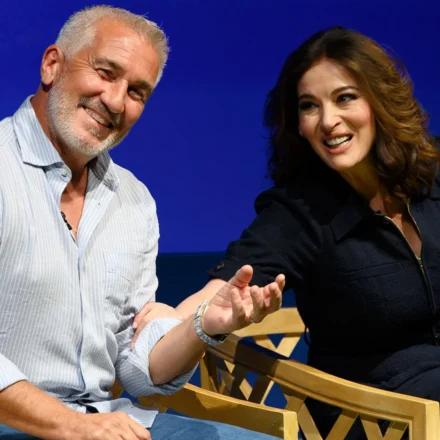
However, the road to success was far from linear. Earlier this year, during a reflective PaleyFest panel in Hollywood, Kate Jackson revealed the humble and somewhat chaotic beginnings of the project. At the time, Jackson was starring in the hit series The Rookies. As that show neared its end, executive producer Leonard Goldberg approached her with a project then titled Alley Cats.
The pitch was, by Jackson’s own admission, less than inspiring. "Len said, ‘It’s available because all three networks have already passed it over,’" Jackson recalled. "That sounds like a real winner! He tells me the story of Alley Cats, and I’m thinking that’s the worst idea I ever heard in my life."
The initial concept involved three women private investigators who, in a bizarre creative choice, were supposed to wear "whips and chains." Jackson’s skepticism was shared by industry executives, but through sheer perseverance and a pivot toward the chemistry of the leads, the project was retooled into the crime-fighting procedural that defined a generation.
Chronology of an Era: The Impact and Nominations
Charlie’s Angels did more than just capture the public’s imagination; it redefined the role of women in television action dramas. Throughout its five-season run, the series received consistent critical attention. In 1977, the show earned four Emmy nominations, including recognition for outstanding achievement in film sound editing, a nomination for David Doyle as a supporting actor, and two consecutive nominations for Kate Jackson as Lead Actress in a Drama Series (1977 and 1978).
The series became a cornerstone of the ABC schedule, anchoring the network’s ratings and spawning a franchise that would eventually include feature films and reboots. Yet, for Jackson, Smith, and Ladd, the true value of the show was the bond they formed on set—a bond that has survived five decades of industry changes.
Supporting Data: Why the Show Still Matters
The enduring appeal of Charlie’s Angels lies in its simplicity and the charisma of its stars. The show provided a blueprint for the "ensemble female" procedural, a format that remains a staple of modern television. When the trio reunited at PaleyFest in 2026, the sold-out crowd served as proof that the brand has not lost its luster.
From an academic perspective, the show represented a pivotal moment in American pop culture. It was one of the first programs to successfully balance "jiggle TV"—a term coined by critics at the time—with genuine, albeit stylized, crime-solving narratives. The show’s ability to remain relevant 50 years later speaks to the strength of its character archetypes. Sabrina was the intellect, Kelly was the sophisticated diplomat, and Kris was the scrappy, athletic foil. These roles provided a template for female characters in action roles that would later be explored in more depth by shows like Buffy the Vampire Slayer and Alias.
Official Perspectives and Behind-the-Scenes Dynamics
The 78th Emmy Awards were a night of reflection, hosted by Mariska Hargitay, who herself is a titan of the genre, having spent decades as the face of Law & Order: SVU. The presence of Jackson, Smith, and Ladd on the same stage as contemporary television royalty highlighted the cyclical nature of Hollywood.
Industry analysts noted that the reunion was not just a ratings grab by the Academy; it was an acknowledgment of the debt current dramas owe to the pioneers of the 1970s. By placing the Angels alongside the cast and crew of The Pitt, the Emmys signaled a recognition of the lineage of the drama series.
For the stars themselves, the reunion was a moment of closure and celebration. In recent interviews, both Smith and Ladd have emphasized that while the industry has become faster and more technologically driven, the core requirements of acting—authenticity, timing, and chemistry—remain exactly the same as they were on the set of Charlie’s Angels in 1976.
Implications for the Future of Television
The reception of the Charlie’s Angels reunion has sparked discussions about the importance of legacy in the current streaming era. As television networks struggle to create long-lasting icons, the 50-year anniversary of the Angels serves as a case study in how to build a brand that withstands the test of time.
There are also murmurs within the industry regarding a potential documentary or revival project that would further explore the untold stories of the series. While nothing has been confirmed, the enthusiasm from the trio during their recent appearances suggests that they are open to sharing more of their history.
As the industry moves toward 2027 and beyond, the influence of the Angels remains palpable. They proved that women could carry a show, command an audience, and maintain their dignity in the face of immense scrutiny. The standing ovation at the Emmys was not just for the past; it was an appreciation for the path they cleared for the generations of actresses who followed them.
In conclusion, the 50th-anniversary celebration of Charlie’s Angels at the 78th Emmy Awards was a poignant reminder that while television shows come and go, true icons remain permanent fixtures in the cultural consciousness. As Kate Jackson noted, the memory of their work—and the presence of their late friend—will continue to resonate long after the cameras stop rolling. The "shiniest angel" may be gone, but the legacy of the mission she helped begin continues to thrive, lighting the way for those who dare to take on the world, one case at a time.