The Alchemy of Artifice: Jesse Eisenberg’s ‘The Debut’ and the Surreal Evolution of Community Theater

Main Facts: A New Chapter in Eisenberg’s Directorial Journey
Following the critical success of his 2022 directorial debut A Real Pain, Jesse Eisenberg returns to the director’s chair with The Debut, a film that defies easy categorization. While his previous work was lauded for its grounded, poignant exploration of trauma and heritage, The Debut ventures into more experimental territory. It is a small-town theater comedy that serves as a Trojan horse for profound existential questions—what the filmmaker describes as the "mystery of existence."
Starring Academy Award winner Julianne Moore and Emmy winner Paul Giamatti, the film explores the high-stakes world of low-budget community theater. Set in a mundane New Jersey suburb, the narrative centers on Mona Friedman (Moore), a repressed homemaker who finds an unlikely, and eventually dangerous, outlet for her stifled identity through a local musical production. Written, directed, and featuring original music by Eisenberg, the film has been described by critics as a "mind-bender" that sits at the intersection of Christopher Guest’s mockumentary style and the Coen brothers’ unhinged surrealism.
Chronology: From Domestic Stagnation to Theatrical Obsession
The narrative arc of The Debut follows a steady descent—or perhaps an ascent—from the beige reality of suburban life into a "Twilight Zone of Sub-Broadway."
The "Stepford Zombie" Phase
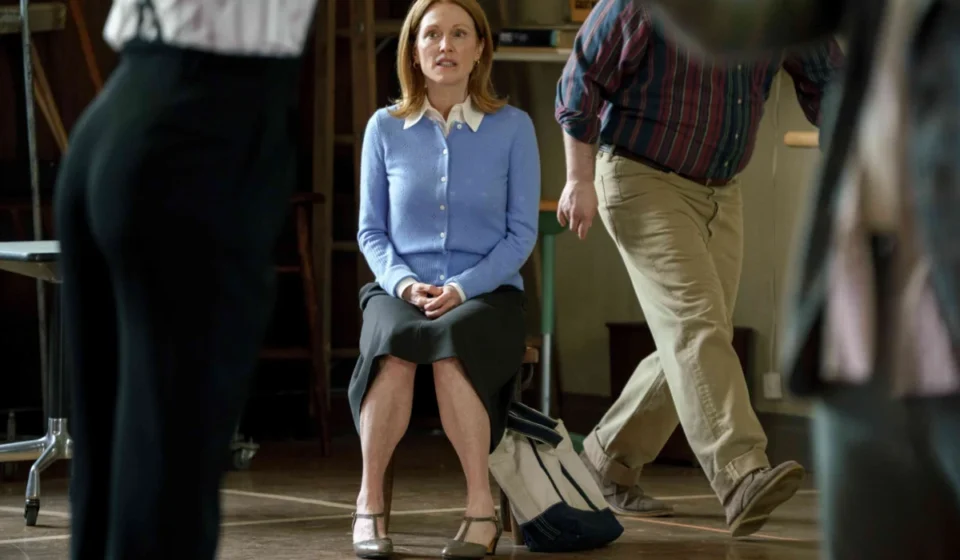
The film opens by establishing the suffocating domesticity of Mona Friedman. Living in New Jersey, Mona is portrayed as a "damaged doll," a passive people-pleaser whose family has largely moved on without her. Her husband, Howard (Patrick Fabian), treats her with the cold indifference reserved for a piece of furniture, while her nearly adult twins, Matty and Maya, treat the home as little more than a dormitory. Mona’s existence is defined by red eyes and translucent skin—a visual shorthand for a woman who has forgotten how to breathe for herself.
The Audition and the Catalyst
Seeking a spark of life, Mona auditions for the Brook Theater’s annual production, a musical titled Nosy Neighbors. Her initial audition is disastrously weak, and the role of "Miss Danielle" (the building superintendent) is initially given to Serena Cherry (Bernadette Peters), a local legend with Broadway aspirations. However, a late-night phone call from the production’s disgruntled director, Jerry (Paul Giamatti), changes everything. When Serena drops out, Mona is brought in as a last-minute replacement, setting the stage for her transformation.
The Radicalization of the Method
The turning point occurs during a "tough-love" private acting session between Jerry and Mona. Frustrated by her timid delivery of the line "Rent’s due!", Jerry subjects Mona to an intensive exercise that mirrors the Sanford Meisner technique but feels more like a psychological interrogation. He forces her to confront her own lack of purpose, leading to a visceral, gut-wrenching monologue about survival and desperation.
From this moment, Mona doesn’t just learn to act; she becomes a "monster" of the Method. She moves out of her home and into a "fleabag hotel" to better understand the grit of her character. She shorts out the hotel’s electricity to experience darkness and adopts a radical new aesthetic—a jarring blend of Camille Paglia’s intellectual severity and Joan Jett’s punk-rock defiance.
Supporting Data: The Craft Behind the Chaos
The Debut is as much a technical achievement as it is a narrative one. Eisenberg’s fingerprints are on every aspect of the production, particularly the film’s "musical within a film."
The "Nosy Neighbors" Score
The songs for Nosy Neighbors were composed by Eisenberg himself. Critics have noted that they perfectly capture the "third-rate hokum" of community theater—sounding like "Jonathan Larson-by-numbers." The songs are intentionally corny yet "oddly sturdy," providing a satirical but affectionate backdrop to the unfolding psychodrama.
Aesthetic and Tone
The film’s visual language shifts as Mona loses her grip on conventional reality. The early scenes are shot with a flat, matter-of-fact realism. As Mona moves into the hotel, the cinematography becomes "dreamy" and "hellish," featuring buzzing electric lights, dripping faucets, and a soundscape of strange noises through thin walls. This transition mirrors Mona’s internal shift from a "Stepford zombie" to a woman who insists that her theatrical performance must be entirely reality-based.
The Ensemble
While Moore and Giamatti carry the emotional weight, the supporting cast provides the necessary comedic "wavelength." The actors playing the song-and-dance troupe (including Eisenberg himself) perform with a "subtle cluelessness" that highlights the absurdity of the production. Patrick Fabian’s portrayal of the "stiff-necked" husband provides the necessary grounded friction to make Mona’s eventual flight into madness feel earned.
Official Responses: Critical Reception and the "Wavelength" Factor
Early reviews suggest that The Debut is a polarizing work that rewards a specific type of viewer. It has been hailed as a "twisted love letter to the glory of community theater," but critics acknowledge it "won’t be for everyone."
The Moore-Giamatti Dynamic
Critics have been unanimous in their praise for Julianne Moore’s performance. Her ability to transition from a "crumpled wallflower" to a "fearless new acting ethos" is cited as the film’s heartbeat. Paul Giamatti’s Jerry is seen as the perfect foil—a "theater romantic" filled with "bone-deep melancholy" and rage. Giamatti acts as the audience’s surrogate, keeping the film from "flying off into the ether" even as the plot enters the surreal.
Comparison to the Greats
The comparison to Waiting for Guffman is inevitable given the subject matter, but reviewers note that Eisenberg’s voice is distinct. Where Christopher Guest leans into the mockumentary and the ridiculous, Eisenberg maintains a "high wire of matter-of-fact satire." The film is being praised for its ability to find "comedy and humanity on the same plate," a rarity in contemporary independent cinema.
Implications: Performance as an Existential Necessity
The Debut raises significant questions about the nature of identity and the price of self-actualization. It suggests that for some, the only way to find "themselves" is through the radical adoption of an artificial role.
The Psychology of the Method
The film serves as a cautionary yet celebratory tale of Method acting. Mona’s journey implies that the barriers between "self" and "character" are more porous than we like to admit. By leaving her "old reality" behind and living in a dingy hotel to play a building super, Mona isn’t just preparing for a play; she is conducting a "one-woman psychodrama" to fill the void left by her family’s neglect.
Eisenberg’s Directorial Evolution
For Jesse Eisenberg, The Debut solidifies his status as a "grounded filmmaker" who isn’t afraid to poke around the "corners" of reality. It demonstrates a growth in his writing, showing a willingness to tackle "big ideas" through a "light and ticklish" tone. The film suggests that Eisenberg is interested in the "mystery of existence"—not as a grand philosophical treatise, but as something found in the mundane, the awkward, and the "sub-Broadway" theaters of the world.
The Future of Community Theater Narratives
Finally, the film reclaims the "community theater" trope from pure mockery. While it mocks the "mechanisms of self-esteem," it ultimately treats the theater as a sacred space for transformation. In Mona’s world, the stage is the only place where a "washout" can become a "tough nut," and where a doormat can finally demand that the "rent is due."
In conclusion, The Debut is a dizzying, hilarious, and ultimately moving exploration of what happens when the mask we wear on stage becomes more real than the life we lead off it. It confirms Julianne Moore’s status as a chameleon of the highest order and marks Jesse Eisenberg as one of the most original voices in modern filmmaking. Through its "Twilight Zone" lens, the film reveals a simple, profound truth: sometimes, you have to act to finally stop pretending.