The VHS Nightmare: Adam Wingard’s ‘Onslaught’ Blends Retro Grit with Modern Paranoia

Adam Wingard’s Onslaught feels less like a contemporary film and more like a long-lost artifact discovered in the dust-caked backroom of a shuttered 1980s video rental store. Set in a version of the present day that feels eerily disconnected from our own, the film serves as both a stylistic love letter to the golden age of action-horror and a cynical meditation on the state of the modern military-industrial complex. With Onslaught, Wingard returns to the visceral, genre-bending roots that defined his early career, delivering a 90-minute, adrenaline-fueled slasher that is as technically proficient as it is ideologically messy.
The Premise: A Relic of Genre Filmmaking
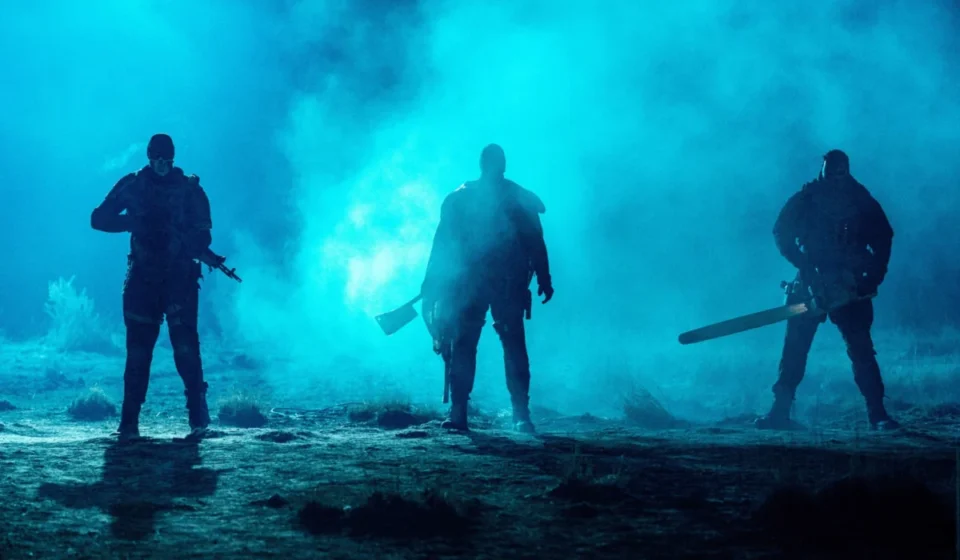
The film follows Celeste, portrayed with gritty, exhausted charisma by Adria Arjona. A former Army sniper now navigating the humdrum, isolating life of a trailer park landlord, Celeste is thrust into a fight for survival when a group of hulking, mute super-soldiers descends upon her home. These antagonists—genetically engineered monsters—are not the Soviet threats of a bygone cinematic era. Instead, they are the creation of a rogue, mad Nazi scientist, funded and sanctioned by the modern U.S. military.
This narrative choice—replacing the "Red Scare" villains of the 80s with domestic state-sponsored terrors—serves as the film’s primary political hook. It suggests a baseline of systemic government distrust that permeates even the pulpiest, most chainsaw-heavy genre exercises. While the film attempts to grapple with these themes, it often feels like a stylistic flourish rather than a fully formed critique, highlighting the divide between Wingard’s visual ambition and the film’s narrative depth.

Chronology of a Production
Wingard’s trajectory as a filmmaker has been a storied one. After breaking out in the independent horror circuit with the claustrophobic brilliance of 2011’s You’re Next and the synth-driven tension of 2014’s The Guest, his career took a turn toward the blockbuster arena. His tenure included the divisive Blair Witch reboot and a lackluster adaptation of the Death Note anime for Netflix. His most recent outings, two massive Godzilla vs. Kong installments, showcased his ability to handle scale, though many critics argued that the spectacle often overshadowed the human elements that made his early work so memorable.
Onslaught, written by his frequent collaborator Simon Barrett, represents a strategic pivot. By stripping away the CGI-heavy spectacle of his recent blockbusters, Wingard leans into a 90-minute, lean-and-mean structure. However, the pacing remains the film’s Achilles’ heel. The first hour is dedicated to a series of tedious, countdown-style interstitials that track the parallel movements of the super-soldiers in their desert compound and Celeste’s domestic struggles. While these scenes are intended to build tension, they frequently result in a narrative "circling of the drain," delaying the inevitable home-invasion carnage that the audience is clearly waiting for.
Supporting Data: Aesthetic and Performance
The film’s aesthetic is its strongest suit. Cinematographer Oren Soffer crafts a visual landscape that is both expansive and claustrophobic. The use of deep, dark blues and high-contrast lighting evokes the distinct style of John Carpenter, a director whose influence is palpable throughout the film. Matthew Pusti’s discordant electronic score further reinforces this homage, echoing the tension-building soundscapes of Assault on Precinct 13.

Adria Arjona, despite being perhaps too polished for the role of a grizzled, war-weary veteran, brings a grounded physicality to the screen. She successfully carries the film’s action sequences, making her transformation into a "mama bear" archetype feel earned through sheer screen presence. Supporting roles from Eric Wareheim and Reginald VelJohnson provide much-needed moments of levity, offering a grounded human connection amidst the high-octane violence.
However, the film’s antagonist, Dr. Hans Kammler (Dan Stevens), falls into a tonal trap. Stevens, who previously shone in The Guest, is tasked with playing a snarling, campy fascist. While he delivers the performance with his signature flair, the character feels like he has wandered in from a different, far more absurd movie. His presence as a "mad scientist" creates a jarring clash with the more grounded, visceral horror of the second act, and he is disposed of far too early to provide any genuine sense of dread. Similarly, Rebecca Hall and Drew Starkey are relegated to minor subplots that feel like unnecessary "muck" added to pad the runtime.
Official Responses and Industry Context
A24, the studio behind the project, has marketed Onslaught as a throwback to the "video nasty" era of the 1980s. Industry analysts note that this release signals a broader trend in independent horror—a movement toward "analog" aesthetics designed to appeal to both nostalgia-hungry Gen X/Millennial audiences and Gen Z viewers drawn to the gritty, non-digital look of the era.

Critically, the reception has been lukewarm but appreciative of the technical execution. The film currently holds a B- grade from major outlets. The consensus is that while the film succeeds as a visceral "good time," it lacks the cohesive political commentary required to elevate it from a homage to a masterpiece. The film’s insistence on focusing on government conspiracy, rather than the immediate terror of the soldiers themselves, has been cited as a primary reason for the film’s uneven tone.
Implications: The Limits of Nostalgia
The most significant implication of Onslaught is the limitation of 80s-inspired genre filmmaking. Wingard is clearly a student of the masters, but in his attempt to emulate John Carpenter, he inadvertently exposes the differences between the two. Carpenter’s films were often rooted in the specific anxieties of his time, using the genre to make sharp, biting observations about society. In contrast, Onslaught uses the aesthetic of the 80s while failing to capture the substance.
The film’s late-game twist, which attempts to link Celeste to the military’s experiments, feels less like a profound revelation and more like an attempt to add depth to a thin premise. It gestures toward a critique of the military-industrial complex—equating modern American authority with the authoritarian regimes of the past—but this is ultimately undermined by the film’s conclusion. Onslaught remains, at its core, a movie that revels in the "rad" nature of firearms and the fantasy of the lone soldier saving the day. It pays lip service to anti-military sentiment while simultaneously indulging in the jingoistic tropes of the era it seeks to honor.

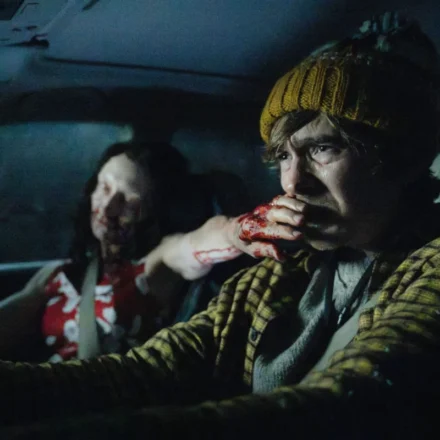
Ultimately, Onslaught succeeds as a display of technical craft. The trailer park shootout is a masterclass in spatial awareness, utilizing the environment to create genuine claustrophobia and tension. The action is crunchy, bloody, and satisfying. But as a commentary on the modern American experience, it falls short. By looking so strictly toward the past, Wingard has created a film that is highly watchable, yet ultimately says very little about the world in which we currently live.
The audience is left with a product that is perfectly serviceable as a piece of Friday night entertainment, but one that fails to leave a lasting impact. As the credits roll, one is left wishing that the "onslaught" of the film had been matched by an "onslaught" of original thought.
Onslaught is set to hit theaters nationwide on Friday, September 4, via A24. It will undoubtedly find its audience among those looking for a slick, blood-drenched throwback, even if it leaves the more demanding cinephile wanting something with a bit more bite.