The Architecture of Erasure: Rafael Manuel’s Filipiñana Exposes the Colonial Ghost in the Machine

Editor’s note: This review was originally published on January 23, 2026, following its premiere at the 2026 Sundance Film Festival. The film is set to open at NYC’s Film Forum on Friday, August 28, with a wider theatrical expansion to follow.
In the lexicon of modern cinema, few settings are as fraught with historical subtext as the golf course. It is, by design, a sprawling garden of solipsism—a place where players compete against themselves while masters of the universe affirm their social standing between holes. Rafael Manuel’s Filipiñana taps into the inherently sinister nature of these manicured landscapes, treating the golf course not merely as a sporting arena, but as a site of profound psychological and political displacement.
The film, which arrives in theaters this August, offers a chillingly precise look at how 150 acres of earth can be mulched, flattened, and terraformed into a peaceful, green veneer—all to ensure that the violent, complex history of the land beneath is forgotten. It is a work that questions the very nature of “progress” in a post-colonial landscape, positioning the golf course as an instrument of collective amnesia.
The Geography of Silence: A Colonial Legacy
To understand Filipiñana, one must first understand the landscape it occupies. While Manuel is intentionally elusive regarding the specific history of the fictional country club at the heart of his film, the setting resonates with the grim realities of the Philippines. Following the American relinquishment of control in 1946, the Philippines saw an explosion of elite country clubs—today, there are between 30 and 40 such facilities in the vicinity of Manila alone.
The history of these spaces is often written in blood. One notable real-world parallel is a golf course constructed directly over a former sugar plantation, the site of a 2004 massacre where 14 striking workers were killed. Manuel captures this specter of violence through a lens of Haneke-esque detachment. Every member, every caddie, and every passing tourist is framed as a conspirator in a larger, unspoken crime. The film suggests that the club’s pristine, artificial beauty is a necessary mask for a history that the current ruling class is desperate to bury.

Chronology of a Languid Uprising
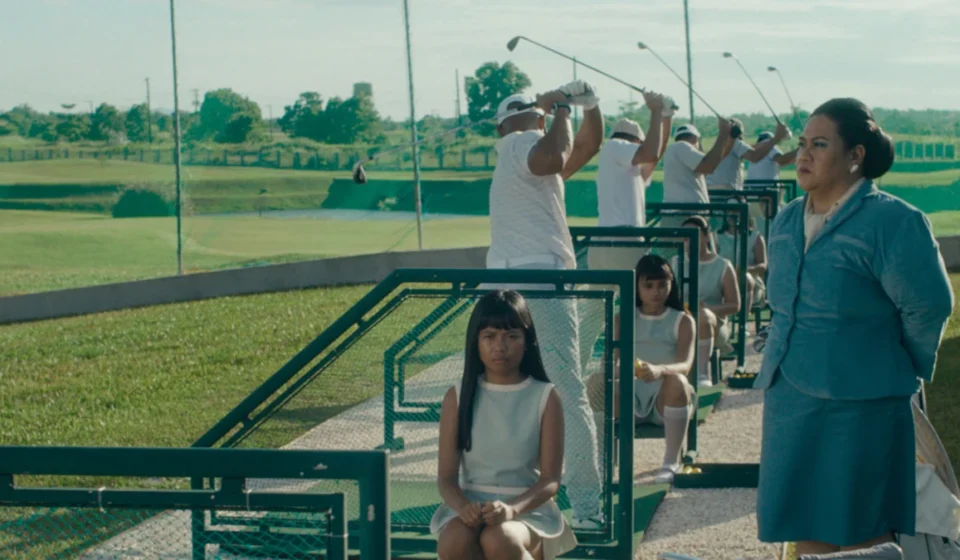
The narrative thread of Filipiñana is woven through the eyes of 17-year-old Isabel (Jorrybell Agoto), a recent arrival from the northern region of Ilokos. Hired as a “tee girl,” she is immediately thrust into the club’s rigid, patriarchal hierarchy. Dressed in turquoise uniforms reminiscent of mid-century flight attendants, Isabel and her peers are treated as disposable fixtures, forced to sit inches from the patrons’ backswings, providing labor that the members—who rarely even care about the sport—view as their birthright.
The film’s pacing is intentionally narcotized. It does not lean into traditional suspense; instead, it invites the audience to experience the crushing, humid heat of Manila. Through the perspective of various characters—the clueless tourists, the skeptical, Western-educated expat Clara (Carmen Castellanos), and finally the observant Isabel—the film charts the slow, steady degradation of the human spirit within these walls.
Isabel’s journey is one of quiet, methodical resistance. She wanders the fairways, prodding fallen mangoes, spying on the club president, Dr. Palanca, and watching the imported pine trees. Every time a tree dies, it is replaced, reflecting the club’s lack of a genuine past. The environment is one of constant, artificial maintenance, a perfect metaphor for the globalist project of forgetting.
Supporting Data: The Aesthetic of Inaction
The brilliance of Filipiñana lies in its structural rigidity. Manuel utilizes a 4:3 aspect ratio to emphasize the social verticality of the club, creating a sense of entrapment. The film is a masterclass in “inaction,” where the primary conflict is the lack of a spark to ignite change.
- The Tati Influence: Manuel cites Jacques Tati as a primary influence, and the influence is visible in the rhythmic, almost choreographic way the golfers swing their clubs in unison.
- The Zhangke Connection: Executive produced by Jia Zhangke, the film shares a preoccupation with how shifting economic landscapes dictate the movement of the marginalized.
- The Satirical Edge: While the tone is often compared to the slow-burn dread of Lucrecia Martel’s La Ciénaga, the satirical barbs are sharp, reminiscent of the biting, uncomfortable humor found in the work of Ruben Östlund.
Every sequence is edited to evoke the lethargy of a hot car on a summer day. The characters seem to lack the lifeforce required to challenge the structural violence keeping them in place. Whether it is a receptionist being harassed or a worker struck by a stray ball, the response is always the same: a profound, terrifying silence.

Official Responses and Critical Reception
Since its debut at the 2026 Sundance Film Festival, Filipiñana has been hailed as one of the most provocative debuts in recent years. While some critics argue that its satire is as unsubtle as a sledgehammer, supporters maintain that this obviousness is a deliberate feature—not a bug. By making the corruption of the country club so glaring, Manuel forces the audience to confront their own complicity in the “colonial torpor” he depicts.
The film does not offer the catharsis of a traditional uprising. Instead, it offers something more unsettling: the realization that the system is designed to absorb and neutralize dissent before it can even be articulated.
Implications: The Final Stroke
The true power of the film is reserved for its final act. Isabel’s quest to return a misplaced club to Dr. Palanca serves as the catalyst for the film’s only true moment of urgency. It is here that the political finally assumes a personal, crushing weight.
However, the film’s most audacious move comes during the closing credits. While the audience expects the film to end, Manuel continues to unfold the story, subverting the traditional grammar of Western cinema to illustrate the total erasure of Isabel’s narrative. It is a bold, final stroke that confirms Manuel as a director of rare, uncompromising vision.
Filipiñana is not a film that provides easy answers or comfortable resolutions. It is a slow, agonizing, and beautiful meditation on the ghosts we allow to inhabit our spaces. By the time the credits roll, the viewer is left with a haunting question: in a world built on the systematic forgetting of the past, what remains of the people who were forced to clear the way?

The film is a must-watch for those who appreciate cinema that lingers, festers, and eventually forces a reckoning with the structures of power that define our modern lives. It is, at its core, a film about the cost of living in a world that has been manicured to perfection, at the expense of its own soul.
Grade: B
Filipiñana is currently scheduled for an August 28th release at Film Forum in New York. For those interested in the deeper critical discourse surrounding the film and its place in the 2026 festival circuit, please subscribe to our weekly newsletter, In Review by David Ehrlich.