
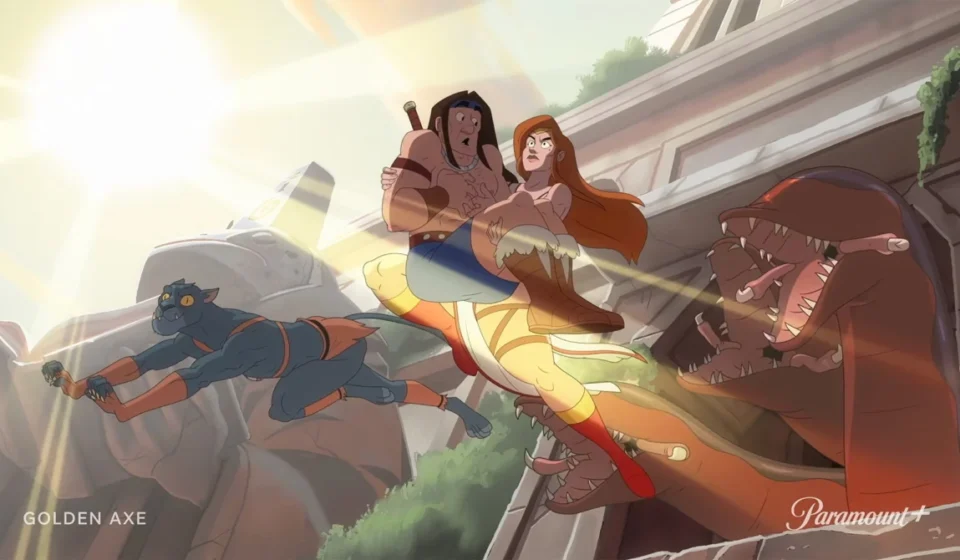
Retro Chaos Reborn: Paramount+ Unveils First Look at the ‘Golden Axe’ Animated Series

By Editorial Staff
August 21, 2026
In a move that has sent shockwaves of nostalgia through the gaming community, Paramount+ has officially pulled back the curtain on its highly anticipated animated adaptation of SEGA’s iconic 1989 arcade classic, Golden Axe. The debut trailer, released this week, confirms that the streaming platform is leaning heavily into the irreverent, high-fantasy absurdity that defined the original side-scrolling beat-’em-up.
With a creative team anchored by heavy hitters in the animation industry and a voice cast that balances prestige drama with comedic timing, Golden Axe aims to carve out a unique space in the crowded landscape of modern streaming. The series is set to premiere on Paramount+ on September 16, 2026.
The Core Premise: A Quest for Vengeance (and Competence)
The narrative of the Golden Axe series remains true to the spirit of the original SEGA title while injecting a modern, self-aware comedic sensibility. The story follows the legendary trio of warriors—Ax Battler, the barbarian; Tyris Flare, the Amazon; and Gilius Thunderhead, the dwarf—as they are forced out of retirement to once again confront the tyrannical giant, Death Adder.
In the source material, Death Adder was a persistent, seemingly unkillable antagonist. The series leans into this "video game logic," acknowledging the repetitive nature of their struggle. "We’re going to do what we do best—face a series of progressively harder enemies until we have a big final battle with Death Adder," the trailer quips, signaling that the show is fully aware of its pixelated roots.

However, the classic dynamic is upended by the introduction of Hampton Squib, an entirely new character. Squib is an inexperienced, wildly underprepared young adventurer whose aspirations of heroism are fundamentally mismatched with his actual combat skills. As the group’s reluctant "fourth wheel," Squib serves as the audience surrogate, forcing the legendary warriors to babysit a novice while navigating a world that—much like the original arcade cabinets—is designed to kill them at every turn.
A Chronological Legacy: From Arcades to Streaming
To understand why Golden Axe is generating such fervent, albeit skeptical, buzz, one must look at the franchise’s historical footprint.
1989: The Arcade Phenomenon
When Golden Axe first debuted on the Sega System 16B hardware in 1989, it was a revolution. It offered a brutal, gritty fantasy world populated by dragons, Gnomes, and the menacing Death Adder. It was one of the first games to successfully translate the visceral satisfaction of a "hack-and-slash" experience into a cooperative multiplayer format.
The 1990s and 2000s: Dormancy and Iteration
Throughout the 90s, the franchise saw several sequels (Golden Axe II, III, and the 3D-heavy Golden Axe: Beast Rider in 2008), but the property largely faded from the mainstream consciousness as the gaming industry pivoted toward more complex, open-world narratives. By the early 2020s, the "Golden Axe" brand was relegated to retro-collection status.
2026: The Animation Renaissance
The announcement of the series represents a major pivot for SEGA, which has been aggressively mining its intellectual property library for film and television adaptations following the massive success of the Sonic the Hedgehog cinematic universe. By selecting a high-fantasy, mature-leaning animated format, SEGA and Paramount are betting that the Golden Axe brand has enough nostalgic cachet to survive in the competitive streaming market.

Production Prowess: Who is Behind the Axe?
The pedigree of the creative team is perhaps the strongest indicator of the show’s potential success. The series is co-created and co-written by Joe Chandler (American Dad) and Mike McMahan. McMahan, in particular, is a titan of modern adult animation, having played pivotal roles in Rick & Morty, Solar Opposites, and Star Trek: Lower Decks.
The involvement of McMahan suggests that the Golden Axe series will likely mirror the "high-concept, low-brow" humor found in his previous works. The animation is being handled by Titmouse, the studio responsible for some of the most visually distinct animated series in the last decade, including The Legend of Vox Machina and Big Mouth.
The Voice Talent
The cast list reflects a deliberate attempt to blend gravitas with comedic rhythm:
- Matthew Rhys (Gilius Thunderhead): Known for his intense dramatic work in The Americans, Rhys brings a veteran’s weight to the dwarf warrior.
- Lisa Gilroy (Tyris Flare): A master of improvisational comedy.
- Danny Pudi (Hampton Squib): Famed for his iconic role as Abed in Community, Pudi is perfectly cast as the over-eager, potentially annoying, but well-meaning Squib.
- Liam McIntyre (Ax Battler): Bringing the necessary action-hero grit.
- Carl Tart (Chronos ‘Evil’ Lait): Adding a layer of absurdity to the ensemble.
Supporting Data: Why Now?
Industry analysts have noted that the 2026 streaming landscape is currently saturated with "prestige" dramas and dark, gritty adaptations. The decision to greenlight Golden Axe—a show that ostensibly functions as a parody of fantasy tropes—is a strategic move to capture the "niche-retro" demographic.
Data from recent successful adaptations, such as Fallout (Amazon) and The Last of Us (HBO), suggest that audiences are hungry for faithful-but-reimagined video game content. However, Golden Axe presents a different challenge: it has very little plot to adapt. Unlike The Last of Us, where the narrative is the primary draw, Golden Axe is defined by its vibe.

Paramount is banking on the "Titmouse Effect"—the idea that high-quality, kinetic, and stylistic animation can carry a show even if the premise is thin. With executive producers including Neal H. Moritz (who has been instrumental in the Fast & Furious and Sonic franchises) and the leadership of SEGA’s own Haruki Satomi and Shuji Utsumi, the production is backed by significant institutional capital.
Official Responses and Creative Direction
In promotional materials and early press junkets, the creators have emphasized that they wanted to honor the "frustration" of the original game.
"We didn’t want to make a serious fantasy show," notes a source close to the production. "If you remember playing the arcade game, it was about dying, throwing another quarter in, and trying again. It was inherently funny because it was so difficult. The series captures that loop—the idea of warriors who are trapped in a world that is fundamentally designed to be a video game."
The trailer itself emphasizes the visual palette of the 80s: vibrant, saturated colors, over-the-top character designs, and a clear distinction between the "cool" legendary heroes and the "pathetic" Hampton Squib. The animation style appears to be a blend of traditional 2D character movement with modern lighting and effects, creating a look that feels both classic and polished.
Implications: Can a 1989 Arcade Game Sustain a Series?
The ultimate question remains: Who is this for?

Critics have pointed out that Golden Axe is a gamble. It is not a household name on the level of Mario or Halo. For the under-30 demographic, it may be perceived as just another fantasy comedy. For the over-40 demographic, it represents a specific, beloved moment in their childhood that could easily be tarnished by a cynical adaptation.
Potential Benefits:
- Genre Diversification: It fills the gap for adult-oriented, comedic fantasy, which is currently underserved on Paramount+.
- IP Synergy: If successful, it proves that SEGA can translate its "B-tier" arcade properties into successful media, unlocking dozens of other potential titles.
- Creative Freedom: Because the source material is so thin, the writers have nearly total creative control to build a world that is consistently funny and engaging.
Potential Risks:
- The "Out of Place" Factor: As some critics have noted, the show looks entirely different from the rest of the Paramount+ library. If it fails to find an audience early, it may be canceled before it has a chance to develop its world.
- Tone Deafness: If the humor leans too hard into the "meta" aspect, it risks becoming repetitive.
- Visual Overload: The aesthetic, while nostalgic, may prove too abrasive for general audiences who are used to the more grounded look of current animated hits.
Final Thoughts: A September Reckoning
As we approach the September 16, 2026, premiere date, the industry will be watching closely. Golden Axe serves as a litmus test for the "Retro-Animation" movement. If it succeeds, we may see a wave of forgotten arcade classics being resurrected for the streaming age. If it fails, it may serve as a reminder that not every pixelated relic belongs in a modern boardroom.
Whatever the outcome, the trailer suggests that for at least a few weeks, we will be treated to the spectacle of a dwarf, a barbarian, an Amazon, and an incompetent sidekick fighting for their lives against a giant who refuses to quit. It is, if nothing else, exactly what it promised to be: a ridiculous, high-energy, and entirely unexpected trip down memory lane.
Whether the audience is ready to follow them into the fray remains to be seen, but one thing is certain: Death Adder is back, and this time, he’s going to be a lot harder to ignore.