
Editor’s note: This review was originally published on March 7, 2025, following the film’s premiere at the 2025 SXSW Film & TV Festival. Neon will release the film in theaters nationwide on Friday, August 21.
In the landscape of contemporary horror, the "liminal space" aesthetic has become a dominant visual language. From the viral internet fascination with the "Backrooms" to the recursive terror of modern survival thrillers, filmmakers are increasingly obsessed with the idea of environments that refuse to terminate. Alexander Ullom’s debut feature, It Ends, leans heavily into this existential dread, posing a deceptively simple question: What happens if you embark on a road trip that never concludes?
While the film offers a masterclass in atmospheric tension and technical ingenuity, it ultimately struggles to bridge the gap between a compelling, high-concept premise and a meaningful emotional payoff. It Ends is a film that demands your attention with the promise of a profound revelation, only to retreat into a nihilistic shrug by the time the credits roll.
The Premise: A Sentient SUV and the Geometry of Dread
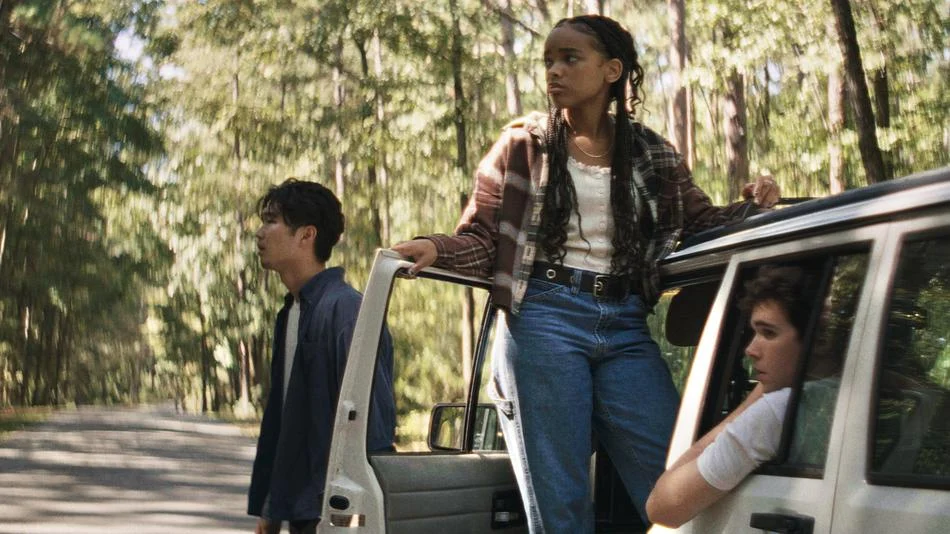
The narrative hook of It Ends is efficient and terrifying. Four college friends—the stoic, military-experienced driver Tyler (Mitchell Cole); the cynical, soon-to-be-employed James (Phinehas Yoon); the artistic, directionless Day (Akira Jackson); and the comic relief, Fisher (Noah Toth)—pile into a white Jeep for what is intended to be a final, post-grad excursion. They are on the precipice of "real life," carrying the familiar, heavy baggage of millennial and Gen Z existential malaise.
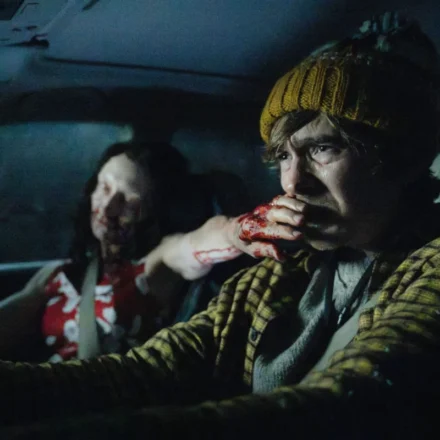
Ullom immediately establishes the vehicle as the film’s fifth character—an claustrophobic, metallic vessel that functions as a sanctuary and a prison. As the group hits a deserted, tree-lined road in the dead of night, the narrative shifts from a standard road-trip drama to something far more sinister. The GPS fails to recalculate; the landmarks repeat with impossible consistency; the road simply refuses to end.
Ullom’s directorial eye is sharpest here. He exploits the mundane features of the modern car—the rhythmic, hypnotic beeping of an unlatched door, the sickly, harsh glow of hazard lights flickering against encroaching forest, and the stark isolation of a cabin interior against an infinite void. In these early sequences, the film is genuinely unnerving, successfully tapping into the primal fear of losing control in a space that should be familiar.
Chronology of the Descent
The film’s structure follows a slow, agonizing descent into psychological fragmentation. The first act serves as the "Establishment of Normalcy," where the group’s banter—while perhaps not as deeply layered as one might hope—functions to ground the viewer in their interpersonal dynamics.
As the second act kicks in, the "Realization Phase" takes hold. The transition from lighthearted travel chatter to mounting terror is handled with a deft, albeit gradual, hand. Ullom forces the characters (and the audience) to confront the impossibility of their situation: they are not just lost; they are caught in a spatial loop.

The third act, or the "Acceptance/Resignation Phase," is where the film begins to lose its momentum. The group establishes a set of arbitrary, supernatural rules to survive. They discover that keeping the car moving prevents fatigue and hunger, while brief stops are allowed only under strict, phone-timed intervals. While these rules provide a veneer of structure, they also invite the audience to begin picking at the threads of the internal logic. Why, for instance, does their internet service remain functional when they are supposedly off the map? Why do the characters never address the physical tolls of their journey beyond the narrative-convenient hunger?
Supporting Data: Character Arcs and Thematic Shortcomings
The core failure of It Ends lies in its character development. For a film that relies so heavily on the psychological unraveling of its protagonists, the foundation is remarkably thin. While Phinehas Yoon delivers a committed performance as James—the character who most desperately clings to the hope of a rational explanation—he is ultimately reduced to a vessel for the film’s "smart" commentary.
The others, unfortunately, remain archetypes. Day’s anxiety about her graphic design career and Fisher’s goofiness provide some necessary texture, but we never truly understand the history of their friendship. In a film that draws inevitable comparisons to Jean-Paul Sartre’s No Exit, the lack of deep-seated character stakes makes the eventual collapse of their sanity feel more like a plot requirement than an emotional inevitability.
Furthermore, the film’s reliance on the "gimmick" of the infinite road creates a sense of monotony that Ullom cannot entirely escape. By the midpoint, the repetition—the very thing intended to represent the "No Exit" theme—begins to work against the pacing. The viewer finds themselves longing for a reveal, a piece of lore, or a shift in the environment that never comes.
Official Responses and Industry Reception
Since its debut at SXSW 2025, the critical reception of It Ends has been polarized. Industry insiders have praised Ullom’s technical capability, specifically noting his ability to create a "contained thriller" that feels expensive despite its singular location.
"Ullom has a knack for visual storytelling that puts him in the same conversation as early-career genre directors who know how to maximize a small budget," noted one festival programmer during the post-screening Q&A. "However, the script leaves a lot to be desired in terms of satisfying the audience’s investment."
Neon’s acquisition of the film suggests they are positioning It Ends as a late-summer sleeper hit, likely targeting the same demographic that flocked to I Saw the TV Glow or other high-concept, indie-horror offerings. Whether the general public will embrace the film’s ambiguous, "gotcha" ending remains to be seen.
Implications: The Nihilism of the "Gotcha" Ending
As It Ends reaches its conclusion, it pivots toward a cynical, almost biting nihilism. Without spoiling the final moments, the film essentially treats the audience’s search for meaning as a joke. There is a sense that the film is "laughing at the viewer" for having invested time and emotional energy into a puzzle that the director never intended to solve.

Is this a bold artistic statement on the purposelessness of modern life, or is it a sign of a screenplay that simply ran out of ideas? The answer likely depends on the viewer’s patience. For those who enjoy the journey more than the destination, It Ends offers enough flashes of brilliance to warrant a watch. But for those who crave a narrative that respects their investment, the film’s conclusion may feel like an insult.
The implication here is a growing trend in contemporary horror: the "anti-climax." We are seeing more films that reject the traditional structure of mystery and resolution, favoring instead a vibe-based, existential terror. While this can be refreshing, it requires a mastery of character and mood that It Ends only partially achieves.
Final Verdict
Alexander Ullom is a filmmaker with a distinct visual language and a clear command of suspense, but It Ends is a debut that shows both his potential and his limitations. It is a stylish, often creepy, and frequently thought-provoking experience that ultimately collapses under the weight of its own lack of resolution.
As a piece of technical craft, it succeeds. As a story, it is frustratingly empty. If you are looking for a film that will keep you guessing until the very last frame, It Ends will certainly provide that—but be warned that the "guess" might be the only thing you walk away with.
Grade: B-
‘It Ends’ is scheduled for theatrical release on August 21, 2025.