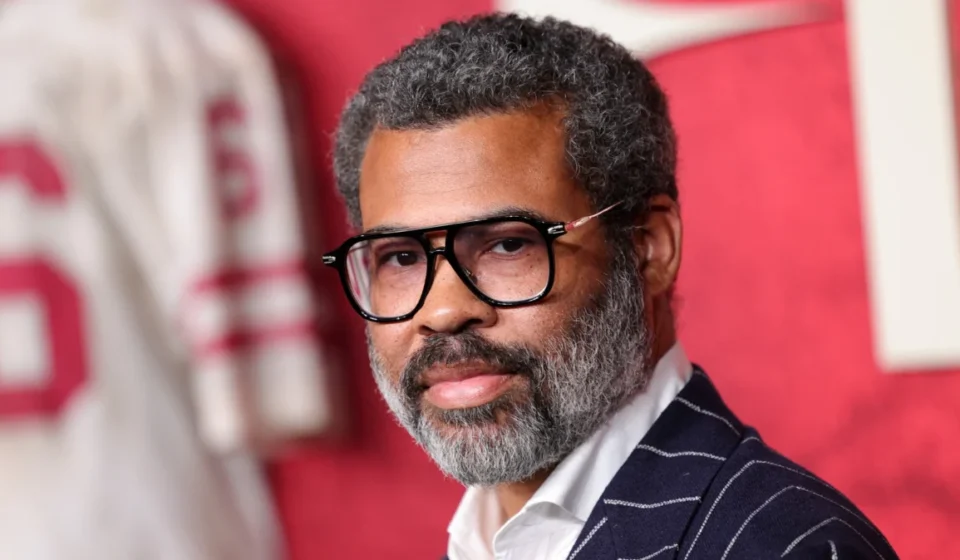

In the landscape of contemporary horror, few voices have resonated with the cultural urgency and psychological depth of Jordan Peele. Once primarily recognized as the comedic force behind the Emmy-winning sketch series Key & Peele, Peele has successfully transitioned into a visionary auteur, redefining the genre for the 21st century. His films are not merely exercises in jump scares or supernatural phenomenon; they are complex, allegorical "social thrillers" that hold a mirror up to the darkest corners of the human experience. At the heart of his artistic philosophy lies a chilling assertion: the true source of horror is not a ghost or a ghoul, but the collective behavior of human beings.
The Evolution of a Modern Master
Jordan Peele’s journey from the improvisational stage to the director’s chair is one of the most unlikely and successful transitions in cinematic history. Raised in New York City by a single mother, Peele’s early career was defined by his comedic timing and sharp cultural satire on shows like Mad TV and his long-running partnership with Keegan-Michael Key.
However, the creative pivot toward horror was not as abrupt as it might appear. After a voice acting stint in The Emoji Movie—an experience he has candidly described as a catalyst for seeking more meaningful creative fulfillment—Peele began crafting his directorial debut, Get Out (2017). The film was an immediate cultural phenomenon. Produced on a modest budget, it became a massive financial success and a critical darling, earning Peele an Academy Award for Best Original Screenplay. By centering his horror on the realities of race relations in post-Obama America, Peele proved that the genre could be a legitimate vehicle for serious social discourse.
Defining the "Scariest Monster"
In early 2017, as Get Out was beginning its historic run, Peele sat down for an interview with The New York Times. When asked to identify the most frightening force in existence, he offered a sentiment that has since become the thesis statement for his entire filmography:
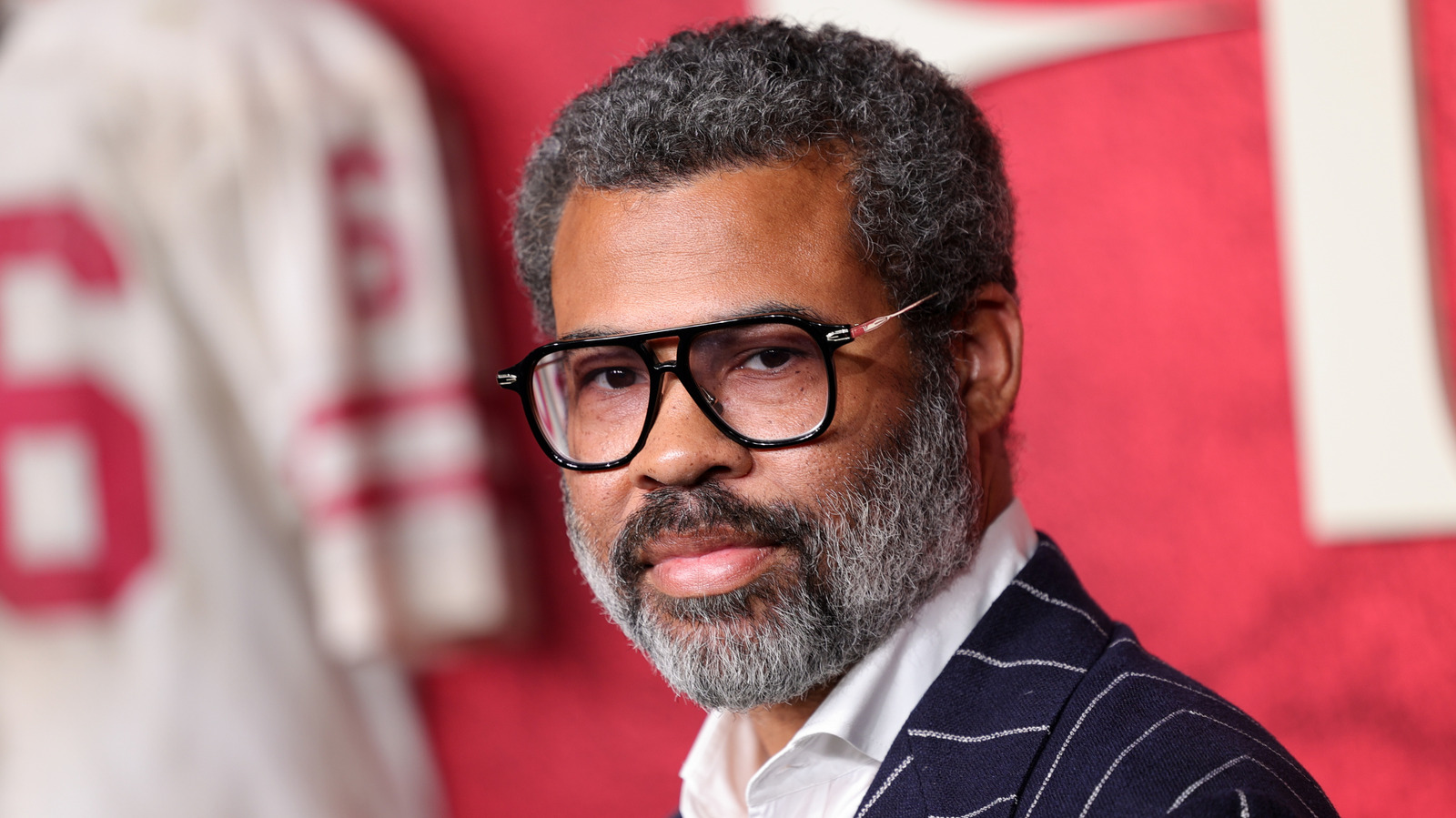
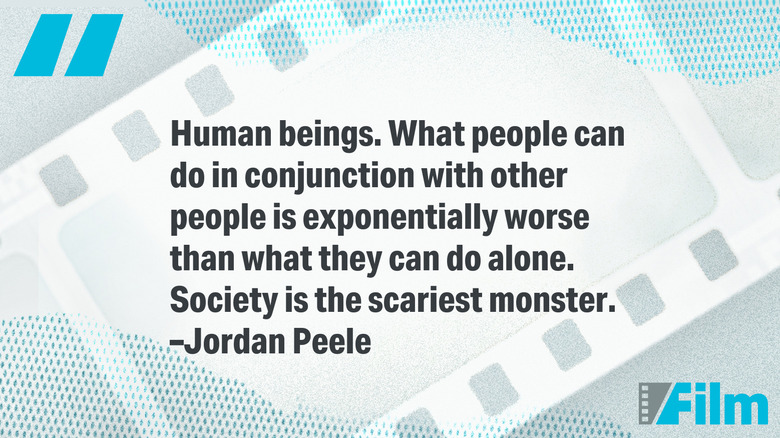
"Human beings. What people can do in conjunction with other people is exponentially worse than what they can do alone. Society is the scariest monster."
This quote provides a master key to understanding Peele’s work. Whether he is exploring the commodification of the Black body, the systemic stratification of the working class, or the dangerous human impulse to turn exploitation into spectacle, Peele’s monsters are almost always symptoms of a broken social contract. His films suggest that the most dangerous environments are not haunted houses, but the systems, traditions, and societal expectations that demand our complicity.
Chronology of Cinematic Terror
Peele’s filmography—Get Out (2017), Us (2019), and Nope (2022)—forms a thematic trilogy centered on the "monstrosity" of the collective.
2017: The commodification of the individual in Get Out
Get Out remains the definitive entry point for this thesis. The film follows Chris Washington, a young Black man visiting the family estate of his white girlfriend. What starts as an exploration of racial microaggressions quickly devolves into a terrifying conspiracy. The antagonists are not chaotic killers, but a suburban community of affluent, self-proclaimed "liberal" individuals who have institutionalized the theft of Black bodies to extend their own lives. Here, the horror is the normalcy—the polite, smiling, garden-party exterior that hides a predatory, systemic evil.
2019: The mirror of inequality in Us
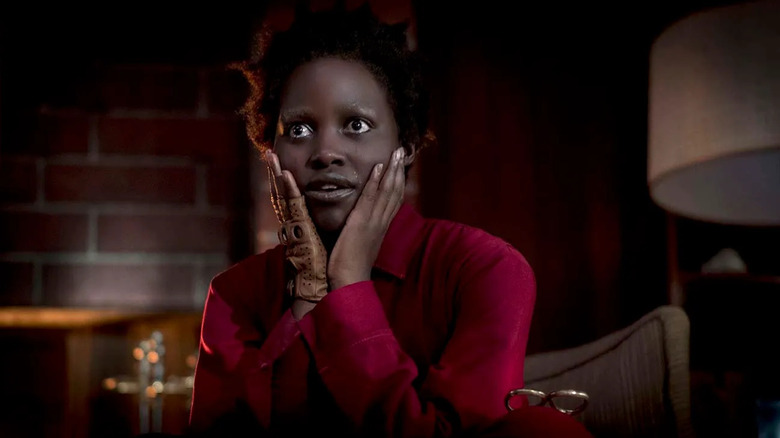
In Us, the scope of the horror widens. The film depicts a family attacked by their own violent doppelgängers, known as "the Tethered." While the film is filled with striking imagery and suspense, the deeper narrative reveals a brutal allegory for social class. The Tethered represent the forgotten, discarded, and underground underclass of society—those who exist to serve the needs of the surface-dwellers but are denied the same humanity. Their uprising is the physical manifestation of a society that chooses to ignore the people it has discarded, until those people finally demand to be seen.
2022: The addiction to exploitation in Nope
Nope moves into the realm of the spectacle. When siblings Otis Jr. and Emerald Haywood encounter a predatory entity in the skies above their California ranch, their initial instinct—mirrored by the behavior of a nearby theme park owner, Ricky "Jupe" Park—is to capture it for fame and fortune. The film critiques the modern obsession with content creation and the "gaze." It highlights how humans, driven by greed and the desire for social validation, will willingly feed themselves to the metaphorical (and literal) beast rather than acknowledge the danger of what they are consuming.
Supporting Data: The Impact of Social Horror
The success of Peele’s work is supported by more than just critical praise; it has fundamentally changed the box office landscape for genre films. Get Out grossed over $255 million worldwide against a $4.5 million budget, proving that audiences were hungry for horror that engaged with intellectual themes.
Academic interest has followed suit. Get Out is now frequently studied in sociology and film theory departments, serving as a primary text for understanding how horror can visualize systemic racism. By moving the "monster" from an external, supernatural threat to an internal, societal one, Peele has empowered other creators to use the genre as a tool for political commentary, leading to a renaissance in what some critics call "elevated" or "social" horror.
Official Responses and Creative Intent
Peele has consistently maintained in interviews that his goal is to make the audience feel the weight of these societal structures. He often points to the "banality of evil"—the idea that people do not necessarily consider themselves villains. In Get Out, the Armitage family believes they are providing a "service" to their victims. In Nope, Jupe believes he can tame an apex predator for the sake of his career.
Peele’s genius lies in his ability to show that the most horrific outcomes are not the result of a single "bad apple," but the result of groups of people aligning their actions toward a perceived, often selfish, "greater good." By focusing on the collective, he shifts the audience’s fear from the "other" (the monster) to the "us" (the society).
The Implications of Peele’s Philosophy
What does it mean for us, the viewers, to accept that "society is the scariest monster"? The implications are profound. If the horror resides in the collective, then the solution is not a silver bullet or a magical ward, but a fundamental reassessment of how we interact with our neighbors, our institutions, and our own complicity in systemic issues.
Peele’s work forces us to ask uncomfortable questions:
- What systems do we participate in that harm others for our convenience?
- How do we look away from the suffering of those below us in the social hierarchy?
- To what extent are we performing our own identities for the "spectacle" of society?
By framing these questions through the lens of horror, Peele makes them impossible to ignore. He strips away the comfort of viewing evil as something that happens "to" us, forcing us to recognize that evil is something we often create, sustain, or allow through our collective silence.
Conclusion: Looking Forward
As Jordan Peele continues his career, his commitment to the "social thriller" remains his strongest calling card. He has effectively transitioned the horror genre from a source of simple adrenaline to a medium for deep introspection. By identifying "society" as the ultimate monster, he has provided a roadmap for future filmmakers to explore the terrors of the real world.
Jordan Peele’s legacy is not just in the scares he creates, but in the questions he leaves behind once the credits roll. He reminds us that the most frightening thing about a monster is not its teeth or its claws, but the fact that it is a reflection of who we are when we act in concert. In a world increasingly defined by digital echo chambers and social polarization, Peele’s warning remains more relevant than ever: the horror is not coming from the shadows—it is coming from within the room.