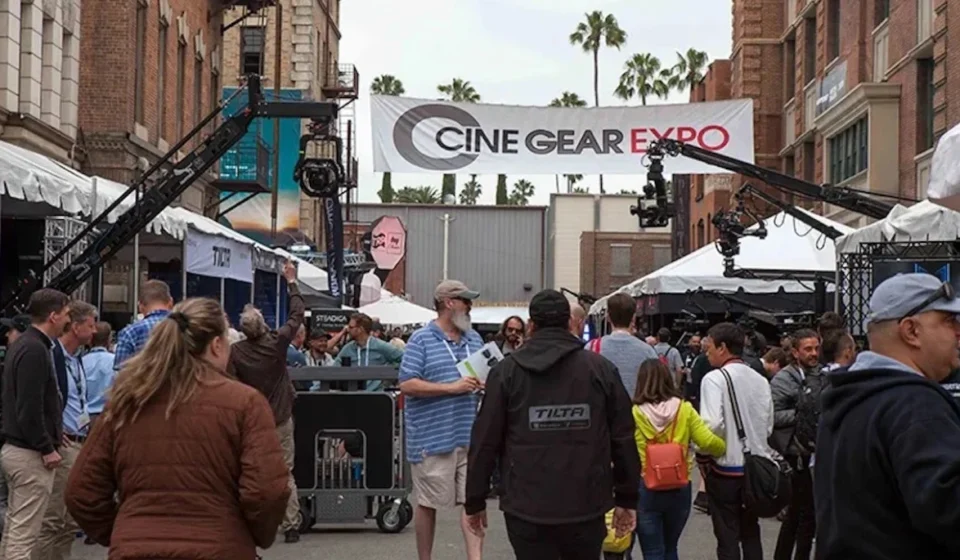

While the annual NAB Show in Las Vegas often triggers a sense of existential dread—forcing a confrontation with the rapid, often cold, industrialization of video production—Cine Gear Expo occupies a fundamentally different emotional space. Set against the storied backdrop of the Universal Studios Lot, the 2026 edition of Cine Gear offered a much-needed injection of optimism. It remains a rare, vital gathering for the Los Angeles film community—a place where cinematographers, gaffers, and lighting technicians converge not just to scan spec sheets, but to reconnect over the shared language of light, lens, and the enduring magic of the moving image.
The Pulse of the Industry: A Shift in Atmosphere
Walking the wide avenues of the Universal backlot, the demographic shift was immediately palpable. Accompanied by Alec Moeller, a filmmaker and member of the 2022 Filmmaker New Faces class, I observed a significant influx of younger attendees. Moeller, who views these events through an ethnographic lens rather than a consumerist one, noted a distinct "energy in the air."
"In the wake of the success of projects like Obsession and Backrooms, there is a palpable hunger among the younger generation to master the craft of atmosphere," Moeller remarked. The Friday crowd, skewing toward film-school undergraduates and emerging freelancers, set a tone of discovery that contrasted sharply with the expected Saturday influx of union-card-carrying veterans. Despite the logistical frustrations of the Universal layout—where long walks between the seminar stages and the vendor-heavy backlot tents often required navigating punishing direct sunlight—the event retained the spirit of a high-energy film festival, complete with the ubiquitous, neon-yellow Insta360 tote bags that became the unofficial uniform of the weekend.
Chronology of a Tech-Forward Weekend
The two-day event was a whirlwind of high-level discourse and hands-on hardware exploration.
Day One: The ASC and the Art of the Craft
The second day kicked off with the highly anticipated American Society of Cinematographers (ASC) panel. Featuring a robust lineup of 15 members—including luminaries such as Jeff Cronenweth, Rachel Morrison, Karl Walter Lindenlaub, and Natasha Braier—the session was a masterclass in professional wisdom. A montage spanning a century of ASC-certified history served as a poignant reminder of the lineage these practitioners uphold.
The panelists, while limited by the sheer volume of contributors, provided invaluable sound bites on the nature of the craft. Steven Fierberg emphasized "body consciousness," noting that the camera’s placement is often an intuitive reaction to the operator’s physical presence on set. Natasha Braier offered a compelling psychological perspective, explaining how her upbringing in Argentina under a military dictatorship—a society defined by subtext and hidden meanings—continues to inform her visual language.
Day Two: The Hardware Frontier
Post-panel, I joined Local 728 gaffers Drew Moe and Jeffrey Taylor, who operate the boutique rental house Canary Yellow, to survey the evolving landscape of lighting. As Moe observed, the pace of innovation in LED technology is staggering compared to the era of tungsten and HMI. "Most of Hollywood’s history was defined by a very slow evolution of light sources," Moe noted. "Now, we are seeing updates to LED chipsets and attachments every year."
We explored the Blackout Lighting Console’s new V3 update, which introduces a fluid, iPad-based visual interface to what was once a purely numerical, data-heavy process. The intuitive nature of the V3 suggests it could redefine industry standards for lighting control, moving away from complex spreadsheets toward a more tactile, creative interface.
Supporting Data: Innovation and Preservation
The intersection of the past and the future was most evident in the specialized booths dotting the lot.
The Cinelux Sixteen Project
Perhaps the most ambitious project on display was the Cinelux Sixteen, a prototype 16mm camera developed by Cinelux Cinema Tools. Chief engineer Caz Voorhees described the device as the first new film camera in years, designed specifically to bridge the gap between celluloid and digital workflows. The camera captures film while simultaneously recording digital proxies with film-emulation LUTs.
"The digital capture was the easy part," Voorhees admitted. "The magazine is the real challenge—moving film through the gate with zero friction in such a tight space." With an open-source ethos, the team hopes to allow users to 3D-print their own magazines in the field, a move that signals a democratization of film production technology that would have been unthinkable a decade ago.
The Rehousing Revolution
Zero Optik, a company that has become synonymous with the "rehousing" movement, showcased how they are rescuing vintage glass from obscurity. Operations manager Alex Baxter explained that many classic lenses—such as the Bausch & Lomb Ultra Baltars favored by Ed Lachman—were essentially relegated to attics because they were incompatible with modern mirror-shuttered cameras. Through precision engineering, Zero Optik is bringing these lenses back into the spotlight. Their work with the ASC to restore the iconic Todd-AO 65mm prime lenses—used on The Sound of Music—highlights a growing industry demand for the "character" of legacy optics in an era of ultra-sharp digital sensors.
Atlas Lens Co. and the Anamorphic Shift
Dan Kanes, cofounder of Atlas Lens Co., shared the company’s trajectory from a garage startup to a Hollywood staple. After his success with Paralinx, Kanes channeled his resources into anamorphic glass. His latest offering, the Kaizen series, aims to solve the "field curvature" issues that plague many vintage anamorphic lenses. By creating a parallel field of focus, Atlas is enabling cinematographers to capture wide, multi-person shots without the focus fall-off that once limited the use of anamorphic glass in complex staging.
Official Perspectives and Industry Implications
The importance of Cine Gear was perhaps best summarized by cinematographer Chapin Hall, who, despite no longer living in Los Angeles, treats the Expo as a mandatory pilgrimage. "It’s the most fun," Hall said. "The community is the real draw. You can get stuck in a hallway for two hours just catching up with peers."
The event concluded with a seminar by M. David Mullen, who provided a clinical, granular breakdown of complex tracking shots from The Marvelous Mrs. Maisel. His ability to deconstruct the technical execution of a four-camera setup provided a stark reminder that beneath all the hardware, the core of the profession remains pedagogical.
The Broader Implications
The overarching theme of Cine Gear 2026 was one of sustainable evolution. The industry is clearly moving toward a hybrid future—one that respects the tactile, chemical history of film while embracing the rapid-fire, intuitive nature of LED lighting and digital control systems.
As I ended the weekend at the ASC Clubhouse barbecue, surrounded by the smell of wood-fired smoke and the sound of shop talk, the "existential crisis" mentioned at the start of the article felt a world away. Whether it is a 3D-printed film magazine, a rehoused 1950s prime lens, or a cutting-edge lighting console, the focus remains on the human element. The equipment is evolving, yes, but the desire to tell stories through the careful manipulation of light and lens remains as human—and as relevant—as ever. Cine Gear Expo 2026 did not just showcase the future; it anchored it firmly in the tradition of the community that builds it.