The Silent Skies of "The Dog Stars": Ridley Scott’s Latest Effort Struggles to Find Altitude

In the expansive, storied career of Ridley Scott—a filmmaker whose name is synonymous with the visceral world-building of Alien, the epic scope of Gladiator, and the meticulous historical tension of The Last Duel—his 30th feature film, The Dog Stars, represents a curious, albeit frustrating, anomaly. Since his 1977 debut, The Duellists, Scott has rarely been accused of being unessential. Yet, as this post-apocalyptic thriller arrives in theaters, it brings with it a haunting, if unintentional, question: Does the world really need another vision of the end of days?
Adapted from Peter Heller’s novel by screenwriter Mark L. Smith, the film presents a dour, introspective look at survival following a global viral pandemic. While it is far from a total misfire, the film suffers from a lethargy that rarely plagues a Scott production, resulting in a project that feels curiously hollow.
A Chronicle of Collapse: The World of "The Dog Stars"
The narrative trajectory of The Dog Stars is a familiar descent into the abyss. We are introduced to Hig, played with a brooding, quiet intensity by Jacob Elordi. Hig is a pilot—a man who once lived a life of mundane joys, kissing his pregnant wife and playing with his dog—now reduced to scavenging for supplies in the skeleton of a McDonald’s, his existence defined by the sharp, metallic tang of survival and the crushing weight of grief.
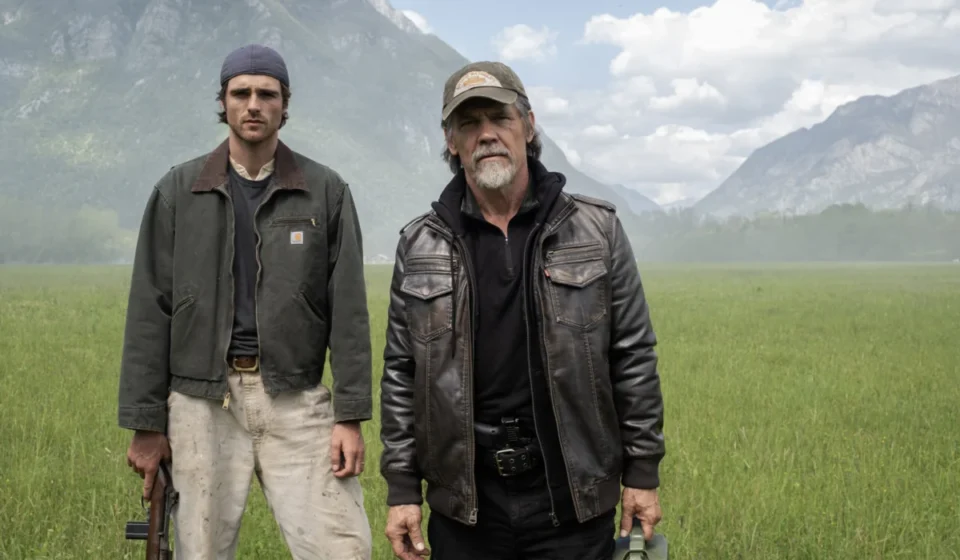
The film follows a deliberate, somber chronology of despair. Following the loss of his wife, Melissa (Sai Bennett), to the plague, Hig finds refuge in an abandoned airplane hangar. His only constant companions are his Australian cattle dog, Jasper, and his heavily armed, misanthropic roommate, Bangley (Josh Brolin). The two men exist in a state of uneasy, paranoid synergy, holding down their Colorado enclave against the threat of roving, unpredictable marauders.

As the plot unfolds, Hig’s internal malaise—manifested in his desire to pilot his yellow Cessna into the oblivion of the Telluride mountains—collides with the external reality of the wasteland. His journey leads him to a mysterious radio signal, which draws him toward a small, isolated camp in the woods. There, he encounters "Pops" (Guy Pearce), a former Navy SEAL, and his daughter, Cima (Margaret Qualley). It is here that the film attempts to pivot from a story of survival to a story of human connection, though the transition is fraught with narrative inconsistencies.
Supporting Data and Production Context
The aesthetic of The Dog Stars is undeniably lush, if emotionally stagnant. Cinematographer Erik Messerschmidt, an Oscar winner for his work on David Fincher’s Mank, captures a Colorado landscape reclaimed by nature—towering grasses and overgrown cityscapes provide a visually arresting backdrop. Composer Harry Gregson-Williams leans into South American-inflected folk textures, attempting to give the score a haunting, organic heartbeat.
However, the technical proficiency of the film often clashes with the thinness of the screenplay. Mark L. Smith, who is also penned the upcoming World War II football drama The Mosquito Bowl for Peter Berg, delivers a script that struggles to balance the high-stakes tension of the "Reapers"—the face-painted, ululating mercenaries who haunt the mountain passes—with the quiet, somber moments of the protagonists.
The casting, while star-studded, faces its own challenges. Elordi, stepping into a role originally earmarked for Paul Mescal, brings a physical presence that is undoubtedly captivating, but he is undermined by a romantic subplot with Qualley that lacks the necessary spark to sustain the film’s supposed emotional stakes. Despite years of living in a post-societal collapse, Qualley’s character appears remarkably untouched by the hardships of her environment, a stylistic choice that further distances the audience from the film’s purported grittiness.

The Problem of Tension: Action and Ambivalence
One of the most jarring aspects of The Dog Stars is its erratic approach to action. For a director who defined the modern cinematic battle sequence, the scenes involving the Reapers feel uncharacteristically disjointed. A night-vision-filtered attack on Bangley’s property serves as the primary example: the sequence feels like a "quickie" gore-fest, a perfunctory inclusion intended to keep the audience awake rather than to advance the character arcs or build genuine, teeth-grinding dread.
The film operates in a vacuum where the absence of government is felt as a haunting, silent presence, yet the political commentary remains merely gestural. When the characters finally reach Grand Junction, the tone shifts again, entering the territory of retro-futurism. Here, they encounter a community managed by a stewardess-turned-leader, Darlene (Allison Janney), and a barkeep who feels plucked directly from the set of The Shining. While this segment offers a brief, intriguing glimpse of how society might attempt to reconstruct itself, it arrives too late to anchor the drifting narrative.
Official Responses and Industry Reception
The film has generated significant discourse regarding the fatigue of the post-apocalyptic genre. Industry analysts have noted that while Ridley Scott’s name carries immense weight, The Dog Stars arrives at a time when audiences are already saturated with bleak, survivalist content—most notably HBO’s The Last of Us.
Unlike the genre’s titans, The Dog Stars lacks the "brain-infected fungus monsters" or the high-octane spectacle that audiences have come to expect. It is a mood piece in a genre that thrives on momentum. Critics have noted that while the film resists many of the genre’s cliches, it fails to replace them with anything substantial, leaving the viewer to wonder if the "heterosexuals will save us" trope that defines the final act is a genuine narrative choice or a cynical concession to traditional storytelling.

Implications for the Future of the Genre
The critical consensus, reflected in the lukewarm reception of the film’s pacing and chemistry, suggests that The Dog Stars may be a rare misstep in Scott’s late-period resurgence. After the muscular, action-heavy success of Gladiator II, this film feels like a step backward in terms of narrative clarity and engagement.
The implications for the film industry are clear: even a master director cannot coast on atmosphere alone. The success of a post-apocalyptic film rests on its ability to make the audience care about the "scraps of a lonely planet." When the emotional current between leads is as choppy as it is here, the film becomes a collection of beautiful, high-definition vignettes rather than a cohesive cinematic experience.
Final Verdict: A Somber, Inert Reflection
Ultimately, The Dog Stars is a film about the desire to be haunted, as Cima tells Hig. It is a film filled with plaintive, platitudinous reflections on the "days gone by," but it fails to provide a reason for us to look toward the future.
The film’s greatest tragedy is not the plague, the starvation, or the roving mercenaries—it is the waste of its own potential. Jacob Elordi gives a fine, nuanced performance, and his eyes carry the weight of a thousand lost worlds, but even the towering sadness of his silhouette cannot rescue material that is so fundamentally inert.

While the film offers moments of visual splendor and a few sequences of genuine, if isolated, intrigue, it remains a "phoned-in" effort that struggles to justify its own existence. For the casual viewer, it may pass as a competent, albeit slow, thriller. For the dedicated cinephile, it serves as a reminder that even the most visionary directors can occasionally lose their way in the tall, overgrown grasses of the apocalypse.
Grade: C
20th Century Studios will release "The Dog Stars" in theaters nationwide starting Friday, August 28.