The Digital Ghost in the Machine: Sandra Wollner’s "Everytime" Redefines the Architecture of Grief

Review by [Author Name]
Originally published September 10, 2026. Updated for theatrical release November 6, 2026.
In the digital age, death is no longer a final exit; it is a transition into a persistent, lingering data state. We store the raw binary code of our loved ones in the cloud, encoding their existence into the very fabric of our daily interaction. For the modern human, the dead do not merely inhabit our memories; they haunt our notification centers, our social media feeds, and the algorithmic feedback loops that define our reality. Austrian writer-director Sandra Wollner explores this uncomfortable new paradigm in her latest feature, Everytime, a mystical, profoundly unsettling meditation on how we navigate loss when the past refuses to stay in the rearview mirror.
The Evolution of Absence: A New Digital Afterlife
I do not believe in a traditional afterlife. Yet, as the digital landscape expands, I find myself surrounded by the "ever-present" dead. My father, born in 1939—the same year the first binary computer was conceptualized—passed away in 2014. For years, I felt the phantom limb of his presence every time I reached for my smartphone, a device that once served as a bridge to his voice.
Today, that bridge has grown into a sprawling, complex network of digital remains. The emergence of artificial intelligence has birthed ghoulish attempts at resurrection, from chatbots trained on Facebook archives to deepfake recreations of historical figures. However, these spectacles overlook a more fundamental reality: we are all being immortalized, whether we consent to it or not. Every photograph uploaded, every text message sent, and every interaction tracked contributes to a "Pollock-like splotch" of data that persists long after our physical bodies return to the earth. Everytime captures this phenomenon with haunting precision, illustrating how the past now runs parallel to—and often interferes with—the present.
Chronology of a Masterpiece
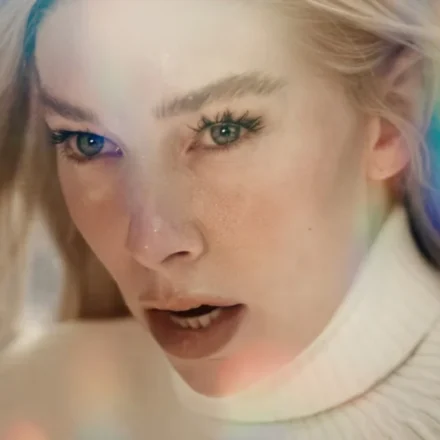
Wollner’s Everytime is a patient, atmospheric experience. Its first 70 minutes are grounded in the mundane, utilizing long, observant takes to capture the rhythm of a family unit. We are introduced to Ella (Brigit Minichmayr), a single mother living in a sun-drenched, hazy Berlin, and her two daughters, Jessie and Melli.

The film’s cinematography, handled by Gregory Oke—who also lensed the celebrated Aftersun—is marked by a voyeuristic, almost painful intimacy. The voices in the film are often close, yet the bodies feel distant, creating an atmosphere of impending tragedy. The narrative pivots on a sudden, jarring event: after a night of youthful hedonism in a Berlin club, the teenage Jessie falls from a rooftop while filming a seagull on her iPhone.
The tragedy is not a loud, dramatic crescendo; it is treated with a terrifying, matter-of-fact silence. The camera turns to the trees; the city moves on. This is where Everytime shifts from a domestic drama into a meta-modern exploration of the surreal. We transition from the tactile reality of Berlin into the digital purgatory of Jessie’s Minecraft world, descending through the rendered landscape into the cold, unfeeling code that lies beneath.
Supporting Data: The Mechanics of Modern Mourning
The final act of Everytime is a cosmic puzzle. As the family travels to Tenerife—a location heavy with the weight of unfulfilled plans—the film abandons traditional temporal linearity. The "math of the universe" begins to contradict itself.
Wollner utilizes the digital detritus left by the deceased—the unread WhatsApp messages, the saved voice notes, the pixelated images on a smartphone—as a form of modern séance. These tools are no longer just records of the past; they become active agents in the present. The film asks: If a computer screen glows with an unnatural light, is it a glitch in the hardware, or is it the lingering echo of a consciousness that hasn’t fully detached from our network?
While the film remains abstract, it is anchored by the performances of its leads. Brigit Minichmayr delivers a masterclass in suppressed grief, her face a map of "tightly bottled pain and lingering disbelief." Opposite her, Lotte Shirin Keiling’s portrayal of the younger sister, Melli, perfectly captures the vulnerability of childhood, existing on the precipice between a world that is malleable and one that is becoming dangerously rigid.

Official Context and Distribution
Everytime arrives with significant critical momentum, following its premiere at the 2026 Toronto International Film Festival. The film represents a significant maturation of Wollner’s style, building upon the thematic foundations of her previous work, The Trouble with Being Born. While that earlier film faced challenges in securing American distribution due to its controversial subject matter, Everytime has been acquired by 1-2 Special, which is positioning the film for a limited release starting November 6, 2026, with a wider rollout scheduled for February 2027.
The production team has noted that the film was intended to challenge the "branding" of death. In an era where digital legacy is a commodified service, Everytime serves as a stark reminder of the "uncertain space" that exists between physical reality and digital simulation.
Implications: Cinema as a Portal
The brilliance of Everytime lies in its refusal to offer easy answers. It does not explicitly condemn technology, nor does it pine for a pre-digital past. Instead, it observes the "radical effect" that technology exerts on our perception of time and space.
Cinema itself, once a medium of celluloid and light, has transformed into a medium of pixels and chips. Wollner’s film engages in a "thrilling and increasingly contested negotiation" between these formats. By pulling at the tug-of-war between 35mm film stock and digital video, the film creates a liminal space large enough for the audience to inhabit.
As parents in the 21st century, we are constantly curating our children’s lives in digital storage. We capture their "cuteness" in high-definition, scrolling through these images at night like a digital rosary. These two-dimensional captures become the "real" children in our minds—the ones we mourn as they inevitably grow and change.

Conclusion: A New Era of Remembrance
Everytime is a staggering achievement that asks us to confront the uncomfortable truth: we have built a world that guarantees our loved ones never truly leave. Is this a comfort, or a cage? Wollner leaves that for the viewer to decide, but her film succeeds in making us question the nature of the "after images" we carry in our own dreams.
By the time the credits roll, the audience is left with the sensation that they have not just watched a film, but witnessed a transformation of the human experience. It is a work of "analog poetry" wrapped in the cold logic of a server farm—a must-see for anyone who has ever stared at a screen and felt, however briefly, that someone was staring back.
Grade: A
“Everytime” is currently screening at the 2026 Toronto International Film Festival. 1-2 Special will release the film in limited theaters starting November 6, 2026.