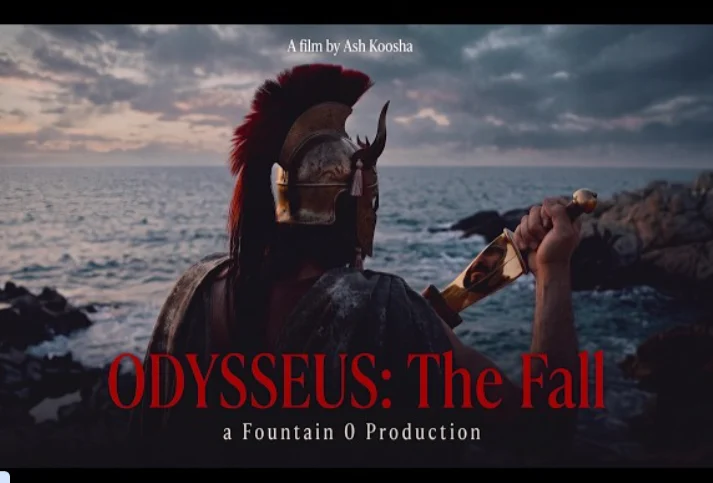
The AI Provocateur: How Ash Koosha’s ‘Odysseus’ Is Challenging the Cinematic Hegemony

In the summer of 2026, the cinematic landscape has become a battleground. On one side stands Christopher Nolan, the titan of analog spectacle, whose $250 million adaptation of The Odyssey serves as the definitive blockbuster of the year. On the other stands a disruptive newcomer: Ash Koosha, an Iran-born, England-raised engineer and filmmaker who has ignited a firestorm of controversy by announcing his own 135-minute, AI-generated adaptation of the same Homeric epic.
While the film industry grapples with the existential threat of artificial intelligence, Koosha’s project, titled Odysseus: The Fall, has moved beyond simple technical curiosity to become a lightning rod for the industry’s deepest anxieties. Produced for a mere fraction of the cost of a traditional Hollywood production and featuring no human actors, the film represents a potential paradigm shift in how stories are conceived, funded, and distributed.
A Chronology of the Disruption
The friction began in mid-2026, a year already defined by the high-stakes debate between Christopher Nolan and his lead actor, Matt Damon. During the press circuit for their Odyssey, Damon lamented that their production might represent the "last chance" to witness large-scale, celluloid-driven filmmaking. Nolan, in a characteristically defiant retort, dismissed such talk as "defeatist," cementing the narrative that the film was a final, glorious stand for traditional cinema.
Into this tense atmosphere stepped Koosha. Having recently garnered critical acclaim at the Tribeca Film Festival for Dreams of Violet—a haunting, AI-driven exploration of the Iranian democracy protests—Koosha was already on the industry’s radar. However, his pivot to the Odyssey material, coming in the immediate wake of Nolan’s hype, was viewed by many as a calculated, if not hostile, act of provocation.
As the backlash mounted, Koosha and his production banner, Fountain 0—a venture co-founded with CNBC founder Tom Rogers and his brother, Pooya Koosha—opted to delay the film’s release. They insist the pause is not a retreat, but a strategic decision to allow the public discourse to breathe before unveiling their vision.
The Philosophical Divide: "Tangential Filmmaking"
To understand Koosha’s project, one must understand his nomenclature. He does not view his work as a "knockoff" or a derivative piece of content. Instead, he calls it "tangential filmmaking."
"Before these AI tools, if I had a theory about Odysseus, I could write a Substack about him," Koosha explains. "Some people would read it, but how many? Now, I can put my take into a film. I can paint my opinion with images, sound, and light. It’s a discourse vehicle."
This perspective attempts to decouple the medium of film from the necessity of massive capital. For over a century, cinema has been synonymous with industry—the aggregation of budgets, union labor, logistical coordination, and global marketing machines. Koosha argues that AI collapses this barrier, allowing the "long tail" of creative expression to enter the cinematic arena.
"We’re not going against Christopher Nolan," Koosha says. "He’s doing what he’s doing in the old world of cinema. He does it brilliantly. But there is room for something in the new world."
Supporting Data: The Economics of the Infinite
The implications of the Fountain 0 model are staggering. If a single filmmaker, armed with a powerful suite of AI tools, can produce a 135-minute feature film for a few thousand dollars, the traditional gatekeeping mechanisms of Hollywood begin to erode.
In the 20th century, the barrier to entry for feature-length narrative was the budget. In the 21st century, that barrier has become the ability to curate and prompt. By removing the financial risk of production, Koosha claims that filmmakers are liberated from the need to appeal to the "lowest common denominator" of a global audience.
However, critics argue that this "democratization" creates a flood of content that lacks the soul of human performance. They point to the "uncanny valley" and the narrative incoherence that often plagues early-stage AI video generation. Tom Rogers, however, counters this skepticism with a pragmatic defense of the technology’s trajectory.
"Obviously, it’s hard to be in the same arena as Christopher Nolan," Rogers acknowledges. "Everyone agrees his Odyssey is the superior film. But we want people to see that film, and hopefully, they see ours too. We’re just trying to show what’s possible when you don’t have to worry about budgets. We want people to see it’s not all ‘slop.’"
Official Responses and the Future of the Industry
The response from the establishment has been largely guarded. While some high-level executives view the "tangential filmmaking" movement as a passing fad, others are observing the Fountain 0 experiment with genuine alarm. If the audience begins to accept AI-generated features as valid alternative perspectives, the value of the "blockbuster" as a singular cultural touchstone may be fundamentally altered.
When asked about the future of human actors in this new landscape, the Fountain 0 team offers a surprisingly traditionalist view.
"I think this will make actors more valuable," Rogers asserts. "Whether it’s in an old-world movie or live theater, people will want to see them—maybe even more than they do now."
This creates a vision of a bifurcated future: one where the high-art, human-centric spectacle remains a premium commodity, and another where the digital-native, "tangential" cinema provides a rapid, opinionated, and highly specific alternative.
Implications: The Web Moment for Cinema
The most accurate parallel for Koosha’s work is not the history of Hollywood, but the history of the Internet. In the late 1990s, when independent bloggers began to challenge the supremacy of established news outlets, critics asked, "Why would you want to read anything that isn’t from a professional news organization?"
The answer, as it turned out, was that people valued the specific, the niche, and the immediate. The internet did not destroy professional journalism; it forced it to evolve, while simultaneously creating a new ecosystem of decentralized information.
Koosha believes cinema is currently standing on that same precipice. "The concentration of revenue became a barrier to entry," he says. "All of that is going to go away. That’s what we’re trying to bring about."
As the release date for Odysseus: The Fall approaches later this summer, the industry will have a rare opportunity to witness the collision of these two worlds. Will audiences embrace a version of The Odyssey that is born of an algorithm but informed by a personal, immigrant perspective? Or will the film serve as a warning of a future where the human element of storytelling is drowned out by the sheer volume of synthetic production?
Whatever the outcome, the genie cannot be put back in the bottle. Ash Koosha and Fountain 0 have successfully moved the goalposts. The question is no longer whether we can make a movie with AI, but whether, in doing so, we are fundamentally redefining what a "movie" is.
As Pooya Koosha notes, "We hope a lot of other people come in and do this. This is about something very broad and democratic." If the history of the digital age is any indicator, the democratization of production is rarely a clean or quiet process. It is, by nature, messy, chaotic, and transformative. Whether Odysseus: The Fall is a masterpiece or a cautionary tale, it is undoubtedly the start of a new, more contentious chapter in the history of the moving image.