
Introduction: The New Guard of NYC Sketch Comedy
The trajectory of independent comedy in the digital age has often been defined by the leap from short-form, algorithm-friendly content to the structured demands of feature filmmaking. For the NYC-based sketch comedy quartet known as Simple Town, this transition is not merely a career milestone but a subversive deconstruction of the "big break" itself. Comprised of Caroline Yost, Felipe Di Poi, Will Niedemann, and Sam Lanier, the group has spent the last decade cultivating a niche but fervent following through live performances and surreal online shorts.
Their feature-film debut, titled Big Break, serves as both a literal and metaphorical manifestation of their journey. Directed by Ian Faria, the film is an amusing, genre-bending foray that blends the anxieties of Gen Y social dynamics with the visceral tropes of the horror-slasher. By ostensibly playing versions of themselves, Simple Town explores the toxic undercurrents of creative collaboration, the resentment of the "left-behind," and the absurdity of mainstream success in a landscape where "selling out" looks like writing a movie about gummy bears.
Main Facts: A Convergence of Satire and Slasher
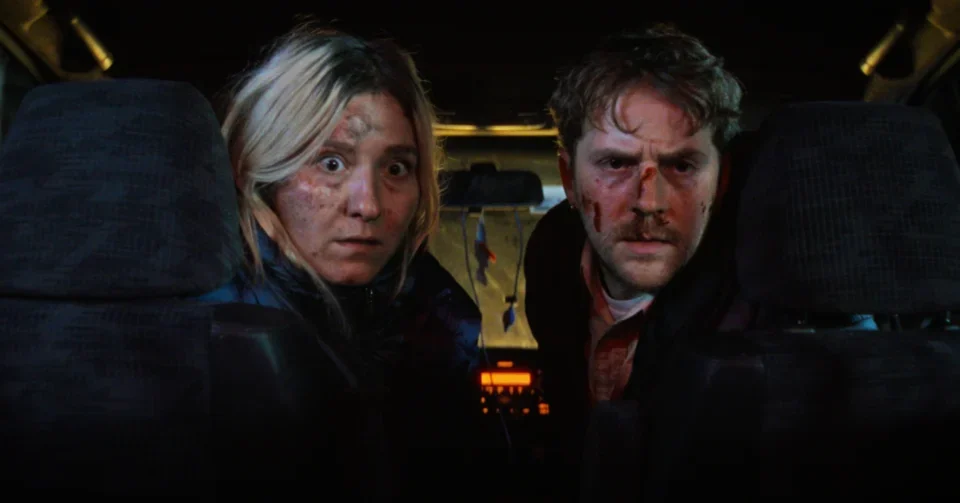
At its core, Big Break is a meta-textual examination of the quartet’s own internal dynamics, projected through a lens of extreme cynicism. The film follows three members of the group—Caro (Caroline Yost), Felipe (Felipe Di Poi), and Will (Will Niedemann)—as they travel two hours outside of Manhattan to a lavish country estate. The host is their former collaborator, Sam (Sam Lanier), who has achieved the kind of astronomical wealth and industry clout that the others only dream of.
The source of Sam’s fortune is "The Gummy Bear Movie," a fictional animated blockbuster that serves as the film’s primary satirical target. The tension arises from a shared history: much of the material that made the animated film a success was originally "group property," conceived during the quartet’s early days of collaborative struggle but utilized by Sam without attribution or financial compensation.
However, the narrative takes a sharp turn into the macabre. Success has not only alienated Sam from his friends; it has unhinged him. Unbeknownst to the visitors, Sam has developed a penchant for serial murder, maintaining a torture dungeon on the premises. The arrival of his old friends coincides with the escape of a captive (played by Yellowstone’s Jefferson White), leading to a chaotic, blood-soaked misunderstanding where the lines between victim and perpetrator become fatally blurred.
Chronology: The Decade-Long Road to the Feature
To understand the significance of Big Break, one must look at the chronological development of Simple Town as a creative entity:
- The Formation (Early 2010s): The quartet began as a live act in the New York City underground comedy scene, performing in basement theaters and DIY spaces. Their style was characterized early on by a rejection of traditional punchlines in favor of "vibe-based" humor and social awkwardness.
- The Digital Expansion (Mid-2010s to 2020): Simple Town transitioned into online shorts, gaining traction on platforms like YouTube and Vimeo. Their work often parodied the self-absorption of Millennials and the specific neuroses of the creative class in Brooklyn and Manhattan.
- The Pivot to Long-Form (2021-2023): After years of short-form success, the group collaborated with director Ian Faria to develop a script that could maintain their signature "anti-comedy" rhythm while sustaining a 90-minute narrative.
- Production and Premiere (2024): Big Break was produced as a lean, resourceful indie project. It utilized the group’s real-life chemistry to anchor a plot that required both comedic timing and high-stakes tension. The film has since begun its rollout, garnering attention for its polished aesthetic despite its modest budget.
Supporting Data: Analyzing the Simple Town Aesthetic
The humor of Simple Town is a specific brand of "cringe-comedy" that relies on a well-oiled ensemble dynamic. Unlike traditional sketch troupes that rely on sight gags or "Who’s on First" wordplay, Simple Town focuses on the passive-aggressive competition inherent in modern friendships.
The "Gen Y" Satire
The film’s dialogue is a masterclass in the language of self-justification. The characters of Caro, Felipe, and Will are not presented as heroes, but as "covetous, anxious, and seething with resentment." Their primary motivation isn’t to reconnect with a friend, but to "arm-twist their way into a slice of the future-career pie." This honesty about the transactional nature of some modern friendships provides the film’s strongest comedic engine.
Technical Execution
Director Ian Faria’s debut is notable for its fast-paced, "jittery yet unobtrusive" rhythm.
- Editing: Handled by Caroline Yost, the editing mirrors the neurotic energy of the characters, using quick cuts to emphasize social discomfort.
- Cinematography: The film juxtaposes the sterile, high-end luxury of Sam’s estate with the gritty, handheld chaos of the horror sequences.
- Soundtrack: The use of Helmet’s 1992 alt-metal single "Get It" during the closing credits serves as a thematic punctuation mark, echoing the aggressive, "get-what’s-yours" mentality of the protagonists.
Horror Conventions
Big Break playfully exploits classic horror tropes:
- The Doomed Hiker: The introduction of Jefferson White’s character follows the "fleeing through the woods" archetype.
- The Secret Basement: The discovery of the torture dungeon is handled with a mix of genuine dread and the group’s characteristic bickering.
- The Armed Panic: The climax involves a "spotty eavesdropping" incident that leads the escaped captive to believe the entire group is a homicidal cult, leading to a comedy of errors involving lethal weapons.
Official Responses and Critical Reception
While Big Break has not yet reached the wide-scale distribution of the "Gummy Bear Movie" it mocks, the critical response from industry outlets like Variety has been largely positive, albeit nuanced.
Critics have noted that while the film "is seldom all that inspired even as it playfully exploits horror conventions," it remains "fun and reasonably funny throughout." The consensus highlights the "astutely self-deprecating cast turns" as the highlight of the production. There is a recognition that the "Simple Town" formula—one that avoids huge, belly-laugh punchlines in favor of a sustained atmosphere of awkwardness—successfully makes the leap to the feature format.
The screenplay, credited to Sam Lanier, has been praised for its "quasi-spontaneity," suggesting a high degree of improvisational input from the cast. This indicates that the group’s decade of live performance has translated into a shorthand that feels more authentic than many highly-scripted studio comedies.
Implications: The Future of Indie Comedy and Digital Creators
The release of Big Break carries several significant implications for the broader entertainment industry:
1. The Decentralization of the "Big Break"
The film’s title is a direct irony. In the modern era, a "big break" is no longer a single moment of discovery by a talent scout, but a grueling decade-long marathon of self-produced content. Simple Town’s success in completing a feature film suggests that the path to Hollywood now runs through independent digital creation rather than traditional gatekeepers.
2. The Rise of the "Genre-Mashup" for Alt-Comedy
Pure comedy features have struggled at the box office and on streaming platforms in recent years. However, "horror-comedies" or "thriller-comedies" (such as Bodies Bodies Bodies or The Menu) have found significant audiences. By wrapping their social satire in a slasher framework, Simple Town and Ian Faria have found a "Trojan Horse" to deliver their specific brand of humor to a wider audience.
3. The Sustainability of the Sketch Troupe Model
In an era where solo influencers dominate the digital landscape, Simple Town proves that the "quartet" or "troupe" model is still viable. The chemistry and history between Yost, Di Poi, Niedemann, and Lanier provide a depth of character interaction that is difficult to replicate with a cast of strangers.
4. Authenticity vs. Attribution
The film’s subplot regarding the "stolen" ideas for the "Gummy Bear Movie" reflects a real-world anxiety among digital creators regarding intellectual property. As small-scale creators see their "bits" or "vibes" co-opted by major corporations or larger influencers, Big Break serves as a cathartic, albeit violent, exploration of that frustration.
Conclusion
Big Break is a testament to the persistence of the New York indie spirit. It is a film that refuses to pander to the audience with easy laughs, opting instead for a cynical, polished, and ultimately rewarding look at the dark side of ambition. For Simple Town, this feature debut isn’t just a movie; it’s a declaration that they have arrived, even if they had to kill (metaphorically and literally) to get there. As the credits roll to the heavy riffs of Helmet, it is clear that while the characters in the film might be in an "armed panic," the creators behind the scenes are in total control of their craft.