
The landscape of contemporary Japanese cinema is often characterized by its quietude—the "shomingeki" tradition of domestic dramas that find beauty in the mundane. However, every few years, a filmmaker emerges who is determined to shatter those conventions with a sledgehammer of visual bravado. Kisin Saito, an accomplished cinematographer turned director, has done exactly that with his debut feature, Kefi. Premiering in the prestigious and increasingly competitive Nippon Cinema Now strand at the Tokyo International Film Festival, Kefi is a genre-fluid kaleidoscope that defies easy categorization, blending grounded family tragedy with aliens, prehistoric fossils, and identity-altering narcotics.
At its core, the film is a meditation on the "flow" of life and cinema. Late in the narrative, the youngest of the film’s three central sisters justifies a spontaneous hook-up with a stranger by noting that the encounter felt "really cinematic." It is a meta-commentary that serves as the mission statement for the entire film: a work that frequently skirts the borders of narrative incoherence, only to be rescued by Saito’s assured command of aesthetic language and technical bravado.
Main Facts: A Genre-Defying Family Reunion
Kefi centers on three estranged sisters who return to their childhood home in Fukui Prefecture following the death of their father. While this premise suggests a traditional family drama in the vein of Hirokazu Kore-eda, Saito quickly pivots into the surreal. The narrative is punctuated by the presence of Russian-born extra-terrestrials, a drug that allows for metaphysical body-swapping, and a rampaging woman obsessed with dinosaur models.
The film is structured into four distinct chapters: Human, Triangle, Punishment, and Reunion. This formalist approach allows Saito to explore different facets of grief and identity through varying cinematic styles. The production is elevated by the cinematography of Sigma Sudo, which oscillates between lush, vivid color palettes and stark, high-contrast monochrome, reflecting the shifting psychological states of the protagonists.
The title itself, Kefi, refers to an experimental drug within the film’s universe, but it also serves as a metaphor for the intoxicating, reality-bending nature of the cinematic experience. By weaving together disparate threads of Americana, traditional Japanese crafts, and science fiction, Saito announces himself as a filmmaker who prioritizes sensory impact and "the flow" over traditional linear logic.
Chronology: Four Chapters of Grief and Absurdity
The narrative architecture of Kefi is essential to understanding its chaotic energy. Saito uses a non-linear, chapter-based approach to dissect the lives of the three sisters before bringing them together for a climactic encounter.
Prologue and ‘Human’
The film begins with a haunting prologue narrated from beyond the grave by the sisters’ deceased father. He introduces his daughters with a mixture of fondness and detachment. We meet Asumi (Riho Takada), the eldest, who has remained in the ancestral home in Fukui; Kyo (Mari Iriki), the middle child and a free spirit whom we first encounter in a moment of intense, isolated intimacy in a hotel room; and Kino (Konatsu Kato), the youngest, who maintains a connection to her father’s memory through modern updates. The chapter concludes with the abrupt announcement of the father’s death, setting the plot in motion.
‘Triangle’ and the Extra-Terrestrial Element
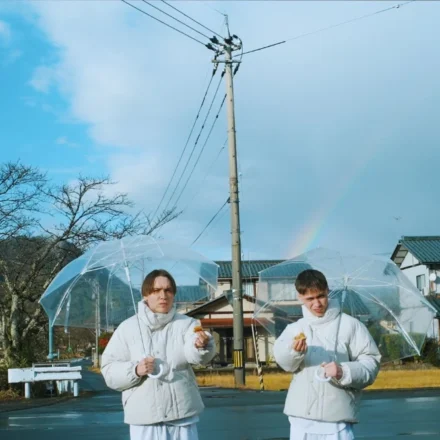
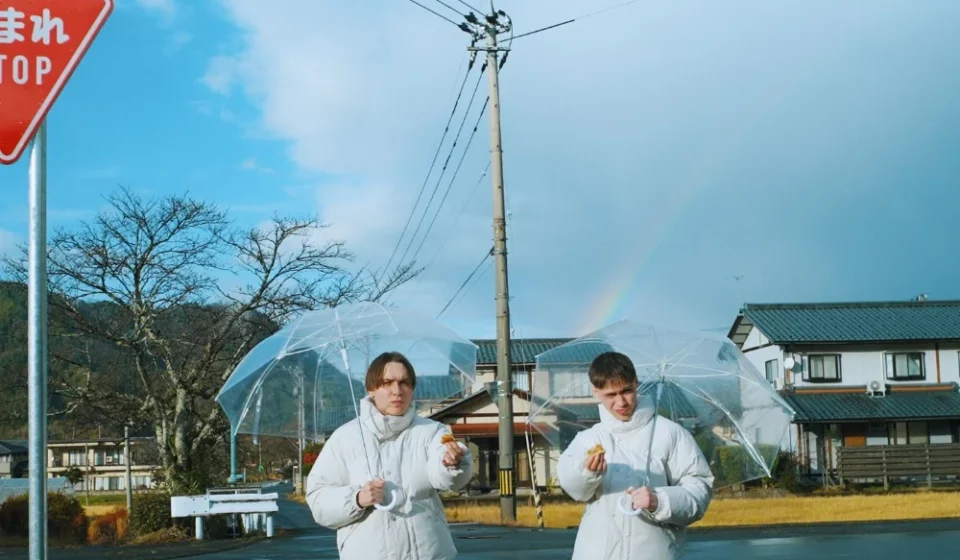
As the sisters converge on their hometown, the film introduces its most bizarre elements. Kyo is revealed to be in league with a pair of "aliens"—identical Caucasian humanoids (played by Russian skateboarders and influencers Nikita and Danil) who wear silver puffer jackets and bowl cuts. These beings possess a craving for "tacky Americana," specifically cheeseburgers, and provide Kyo with the drug "Kefi." Under their influence, Kyo engages in body-switching with her sexual partners, a surreal method of experiencing the male perspective and escaping the weight of her own identity.
‘Punishment’ and the Shared Dream Space
The third chapter focuses on Kino and her doting boyfriend, Kai (Tone Kaiya). While exploring the Fukui woods—a region famous for its prehistoric fossils—Kai discovers a flyer for a clinic promising to help individuals "Find your true self." This clinic is, in fact, the sisters’ childhood home, where Asumi operates as an in-house counselor. The narrative takes a Lynchian turn when Asumi’s assistant drugs Kai, leading to a shared dream sequence between doctor and patient that blurs the lines between memory and hallucination.
‘Reunion’
The final chapter attempts to reconcile these wild narrative diversions. The sisters finally confront one another in the space where they grew up. While the film does not offer a traditional "neat" resolution to the alien subplots or the drug-induced visions, it lands on a moment of authentic emotional resonance. The sisters’ interaction in the final moments feels honest, suggesting that while the world around them is chaotic and inexplicable, the bond of shared history remains a grounding force.
Supporting Data: Technical Prowess and Regional Context
The effectiveness of Kefi relies heavily on its technical execution, a testament to Kisin Saito’s background as a celebrated cinematographer. Before directing, Saito built a reputation for his visual storytelling, and he brings that expertise to every frame of his debut.
Visual Aesthetics and Cinematography
Sigma Sudo’s cinematography is perhaps the film’s strongest asset. By switching between monochrome and vivid color, Sudo creates a visual representation of the "shared dream space" and the mundane reality of Fukui. The use of wide-angle lenses during the forest sequences emphasizes the prehistoric, "unburied" nature of the setting, while the tight, neon-lit hotel rooms highlight Kyo’s isolation.
Setting: The Significance of Fukui
The choice of Fukui Prefecture is not incidental. Known for its fossil excavations and historic temples, the location serves as a metaphor for the characters’ internal lives. The "secrets of the past" are literally baked into the ground. The presence of dinosaur imagery throughout the film—including a character, Rin (Koto Ishikawa), who screams at dinosaur models—suggests a world where the ancient and the modern are in constant, jarring friction.
Soundtrack and Score
The film’s energy is propelled by a diverse, eclectic score featuring electro beats and indie tracks from artists such as Alberg, The Bawdies, and bzn_trip. The music acts as a connective tissue between the film’s disparate genres, moving from high-energy electronic sequences during the drug-induced "trips" to more somber, acoustic arrangements during the family’s moments of reflection.
Official Responses and Critical Reception
Since its premiere at the Tokyo International Film Festival, Kefi has sparked significant debate among critics and audiences. The film’s refusal to adhere to a singular tone has made it a polarizing work, though most agree on Saito’s talent.
Comparisons to the Masters
Critics have noted that while the setup mimics Hirokazu Kore-eda’s Our Little Sister, the execution is far more aligned with Kore-eda’s 1998 masterpiece After Life, which also dealt with the processing of memory in a liminal space. Others have drawn parallels to Gen Sekiguchi’s cult classic Survive Style 5+, citing the "anarchic effervescence" and the inclusion of seemingly random, brightly colored subplots (like the Russian aliens).
The "Washi" Sequence Controversy
One of the most discussed segments of the film involves a traditional washi paper-maker, played by So Takei. This segment transitions from a documentary-like observation of an archaic craft to a shocking, unprovoked sexual assault. Critics have questioned the necessity of this scene, with some viewing it as an unnecessary provocation and others seeing it as an exploration of the "randomness of violence" in a world losing its grip on tradition.
Director’s Statement
Saito has been open about the personal nature of the project. He lost his own father in 2024, and Kefi served as a vessel for his grief. He has stated that the film’s wild tonal shifts reflect the "unreliable nature of emotion" during times of loss. For Saito, the film isn’t about a logical progression of mourning, but about the "chaotic flow" of trying to find oneself after a foundational pillar has been removed.
Implications: A New Voice in Japanese Cinema
The arrival of Kefi suggests a shift in the "boutique" sector of Japanese filmmaking. As international distributors look for the "next big thing" from Asia, Saito’s work offers a blend of high-concept genre elements and deep emotional stakes that is ripe for the festival circuit.
For Genre Festivals and Distributors
With its "ballsies" approach to storytelling, Kefi is expected to become a staple at adventurous genre festivals like Sitges or Fantasia. Its mix of body-switching, aliens, and high-end aesthetics makes it an attractive prospect for boutique distributors who specialize in "elevated genre" or avant-garde world cinema.
The Future of Kisin Saito
As a debut, Kefi is a statement of intent. It proves that Saito is not content with being "just" a cinematographer; he is a director with a singular, if occasionally perplexing, vision. While the film may be too abstract for mainstream audiences, it establishes a framework for a career defined by technical bravado and an refusal to be "boring."
Conclusion: The "Flow" Remains
Ultimately, Kefi is a film that demands to be felt rather than fully understood. It is a work of "visual bombast" that captures the disorientation of grief. By the time the final credits roll over the eclectic soundtrack, the viewer may be left with many questions—about the aliens, the drug, and the dinosaurs—but the emotional core of the three sisters remains intact. Kisin Saito has landed with a bang, and the cinematic world will be watching closely to see where his "flow" takes him next.