A Seasonal Disconnect: The Critical and Narrative Failure of ‘Christmas at the Kringles’

The intersection of holiday cheer and cinematic horror is a notoriously difficult needle to thread. To succeed, a film must balance the warmth of the season with the chilling tropes of the genre, often while maintaining a satirical or comedic edge. When it works, you get a cult classic like Krampus or Rare Exports. When it fails, however, the result is often a jarring, cynical mess. Unfortunately, director Kevin Lewis’s latest outing, Christmas at the Kringles, falls firmly into the latter category. Despite a pedigree of seasoned comedic talent and a director coming off a minor cult success, the film emerges as a "gift-wrapped box with nothing inside"—a cinematic fruitcake that is as stale as it is indigestible.
Main Facts: A Pedigree of Wasted Talent
On paper, Christmas at the Kringles possesses all the ingredients for a subversive holiday hit. The film features a cast of stalwart "joke-makers" and character actors who have defined modern American comedy. The ensemble includes Ron Livingston (Office Space, The Flash), Rachel Bilson (The O.C.), Thomas Lennon (Reno 911!), Rob Riggle (21 Jump Street), Donald Faison (Scrubs), and Arden Myrin (Insatiable). Behind the camera is Kevin Lewis, who recently garnered attention for the Nicolas Cage-led Willy’s Wonderland, a film that succeeded largely due to its commitment to a singular, bizarre conceit.
Written by Zack Imbrogno, the film attempts to deconstruct the "perfect" suburban Christmas by introducing a family—the Kringles—whose devotion to the holiday crosses the line into homicidal mania. However, the production is plagued by a fundamental lack of identity. It is neither scary enough to satisfy horror aficionados nor funny enough to engage fans of its comedic cast. Instead, it relies on derivative visual styles and a script that feels like a patchwork of better films, failing to establish a coherent tone or a compelling reason for the audience to invest in its characters.
Chronology: From Suburban Hope to Yuletide Terror
The narrative structure of Christmas at the Kringles is divided into two distinct phases: the arrival and the realization.
The Move to the Suburbs
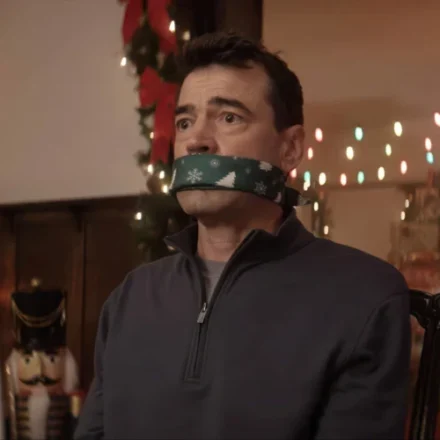
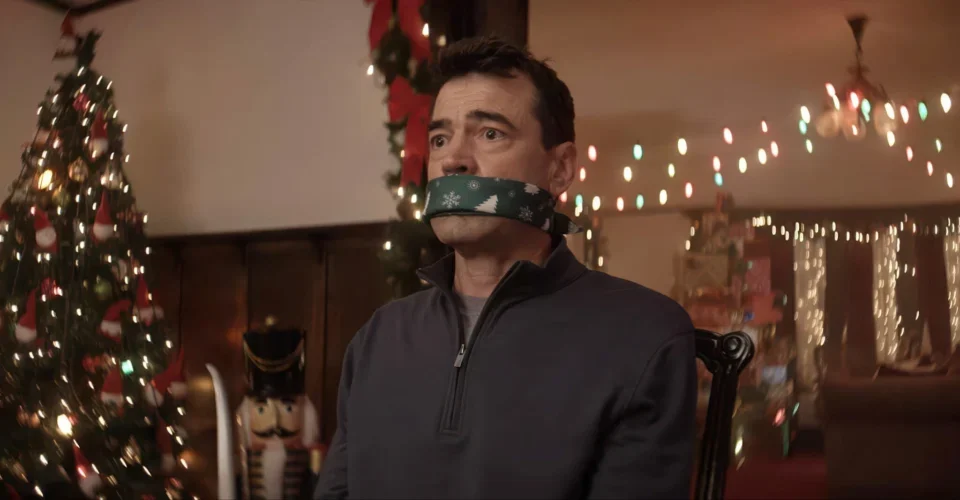
The story begins with Mark Severson (Ron Livingston), a high-strung, workaholic stock trader whose marriage to Julie (Rachel Bilson) is on the brink of collapse. In a desperate attempt to salvage their family unit, the couple moves with their young son, Bobby (Jack Jewkes), to a picturesque small town just one week before Christmas. Mark is portrayed as a man entirely disconnected from his domestic life, viewing the move as a transactional "band-aid" rather than a genuine emotional pivot.
During their first week, the Seversons encounter their neighbors, the Kringles. Nick (Thomas Lennon) and Carol (Arden Myrin) are the antithesis of the jaded Mark; they are a family that celebrates Christmas 365 days a year. Their home is a permanent winter wonderland, and their enthusiasm is infectious—at least to the desperate-for-connection Julie. Despite his initial big-city skepticism, Mark agrees to a Christmas Eve dinner at the Kringles’ house. Surprisingly, the evening is a success, momentarily convincing Mark that perhaps this radical change of scenery was what the family needed.
The Valentine’s Day Pivot
The film then takes a chronological leap forward two months to February. The "magic" of the move has clearly worn off. Mark has regressed into his workaholic habits, ignoring Julie’s desire for a meaningful Valentine’s Day. The domestic tension is interrupted when Carol Kringle invites Julie and Bobby over for dinner. Mark, relieved to have his family occupied while he works, initially encourages the visit.
However, the tone shifts abruptly when Mark is approached by another neighbor, Daryl (Donald Faison). Daryl provides the first crack in the Kringles’ wholesome facade, warning Mark that the family is not what they seem. This warning triggers a frantic search for the truth. When Mark finds himself locked out of the Kringle residence, he and Daryl seek help from an unlikely source: a local mall Santa (Rob Riggle). This Santa, it is revealed, is part of a clandestine network of "mirth-bringers" who have been tracking the Kringles, identifying them as dangerous, cult-like maniacs who have left a trail of disappearances in their wake.
The Final Siege
The film’s climax involves a botched rescue mission. When the mall Santa fails to appear as backup, Mark and Daryl are forced to infiltrate the Kringle house alone. The final act transforms into a home-invasion horror scenario where the Seversons must fight to avoid being "permanently put on the naughty list."
Supporting Data: Performance Analysis and Technical Execution
To understand why Christmas at the Kringles fails to resonate, one must look at the disconnect between the performances and the direction.
Characterization and Performance
The most glaring issue lies in the protagonist. Ron Livingston plays Mark Severson with a level of detachment that makes him nearly impossible to root for. Unlike his previous roles where he balanced cynicism with a certain "everyman" charm, here he is portrayed as a "jaded, unhappy dick." The script offers little room for him to develop humanity, and even when he enters "hero mode" to save his family, he remains alarmingly ineffectual. Critics have noted that the role might have been better suited for someone like Vince Vaughn, who specializes in making abrasive characters likable.
Rachel Bilson’s Julie is equally underserved by the script. Her character is written as a one-dimensional portrait of suburban longing. While Bilson attempts to inject nuance into Julie’s desire for community, the character exists primarily as a plot device to be endangered.
Conversely, Thomas Lennon and Arden Myrin lean heavily into the "unhinged wholesomeness" of the Kringles. Lennon, known for his commitment to absurdist bits, plays Nick Kringle with a zealot-like intensity. While entertaining in short bursts, the performance lacks the genuine menace required to make the horror elements of the film land. The Kringles feel more like a rejected Saturday Night Live sketch than a legitimate threat.
Direction and Visual Style
Director Kevin Lewis attempts to mask the script’s deficiencies by employing a hyper-kinetic visual style. The film is filled with quick-cut montages and "whip-pans" that clearly "pilfer from the playbooks" of directors like Edgar Wright. However, where Wright uses these techniques to enhance storytelling and rhythm, Lewis uses them as a distraction.
The editing, handled by Ryan Leibert, is notably disjointed. The film opens with a "cold-open" chase scene that ignores basic rules of spatial geography and visual continuity. This lack of technical polish persists throughout the film, making the transition from suburban drama to slasher-horror feel clunky rather than shocking.
Official Responses and Critical Context
While official box office data for such niche releases is often obscured by streaming deals, the critical consensus has been overwhelmingly negative. The film currently sits as a cautionary tale within the "Holiday Horror" subgenre.
Industry analysts point out that the film suffers from a "cynicism gap." While horror-comedies like The Menu or Ready or Not use their cynical tone to make a point about class or society, Christmas at the Kringles feels cynical about its own audience. It assumes that simply placing a "Santa suit" on a murderer or showing a "Christmas gimp" (a bizarre and unexplained plot point in the Kringle basement) is enough to satisfy genre fans.
Furthermore, the "explanation" for the Kringles’ behavior has been widely panned by critics as nonsensical. The film leaves several gaping plot holes:
- The status of the children in the Kringle home (are they biological or kidnapped?).
- The complete lack of police intervention despite a pattern of disappearances.
- The logistical reality of a family maintaining a high-budget holiday lifestyle year-round without any apparent source of income.
Implications: The State of the Holiday Horror Genre
The failure of Christmas at the Kringles serves as a significant case study for the current state of independent genre filmmaking.
1. The Limitations of "Stunt Casting"
The film proves that a high-quality cast cannot save a low-quality script. By hiring actors known for their comedic timing (Lennon, Faison, Riggle), the production set an expectation for a "laugh-out-loud" experience. When the script failed to provide actual jokes, these talented performers were left stranded in a tonal vacuum.
2. The Over-Reliance on Homage
Kevin Lewis’s reliance on Edgar Wright-style editing highlights a growing trend in indie cinema: the confusion of "style" with "substance." Visual flourishes are only effective when they serve the narrative. In this case, the flashy editing served only to highlight the emptiness of the scenes they were meant to "zhuzh up."
3. The Forgiveness of Horror Fans
The horror community is famously one of the most forgiving audiences in cinema. Fans are often willing to overlook low budgets or questionable acting if a film offers a unique concept or visceral thrills. However, Christmas at the Kringles fails because it offers neither. It lacks the "joy" of the holidays and the "thrill" of horror, leaving it in a cinematic no-man’s-land.
Conclusion
In the final analysis, Christmas at the Kringles is a missed opportunity of significant proportions. It wastes a stellar cast and a proven director on a script that is both derivative and logically unsound. For viewers looking for a holiday-themed scare or a dark comedy to brighten the winter months, this film is a reminder that some gifts are better left unopened. As the credits roll, the only feeling of "holiday joy" the audience is likely to experience is the relief that the experience is finally over.