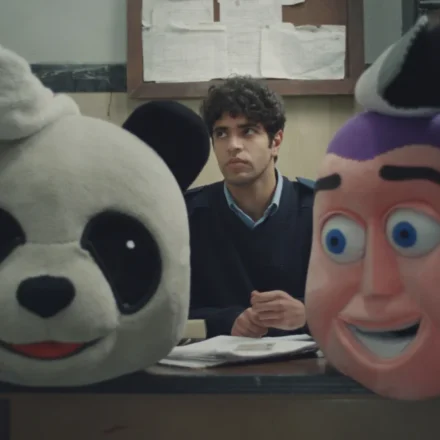
The Architecture of Despair: Mohammed Hammad’s ‘Safe Exit’ and the Anatomy of Egyptian Marginalization

The term "minimalism" in cinema often conjures images of cold detachment or intellectual distance. However, in the hands of Mohammed Hammad, the Egyptian auteur who first stunned critics with his 2016 debut Withered Green, brevity is not an absence of emotion but a distillation of it. His sophomore feature, Safe Exit, which premiered in the Panorama section of the 74th Berlin International Film Festival (Berlinale), serves as a haunting, virtuosic exploration of the human condition under the crushing weight of trauma, poverty, and religious tension.
By eschewing the melodramatic flourishes common in regional cinema, Hammad crafts a narrative that is as rigorous as it is heartbreaking. Safe Exit is a film that demands attention not through loud proclamations, but through the quiet, suffocating reality of its characters—outsiders in a Cairo that offers no sanctuary.
Main Facts: A Triumphant Return to the Global Stage
Safe Exit arrives eight years after Hammad’s debut, marking a significant milestone for the "New Wave" of Egyptian independent cinema. The film’s selection for the Berlinale Panorama program solidified Hammad’s status as a leading voice in North African filmmaking.
At its core, the film is a character study of two individuals living on the absolute periphery of society. Samaan (Marwan Waleed) is a Coptic Christian security guard haunted by a past encounter with ISIS, while Fatimah (Noha Foad) is an undocumented Muslim woman battling a terminal illness. Their intersection within the confines of a dilapidated Cairo apartment building provides the framework for a story that critiques the Egyptian healthcare system, the legal limbo of its citizens, and the lingering scars of extremist violence.
Despite its international acclaim, the film has faced a tumultuous path domestically. Due to its sensitive themes—including religious identity, terrorism, and the failings of state institutions—the Egyptian censorship board has restricted its screenings, allowing it to appear only at the El Gouna Film Festival. This tension between international celebration and domestic restriction highlights the provocative nature of Hammad’s vision.
Chronology: A Descent into the Cairo Underworld
The narrative of Safe Exit unfolds with a deliberate, rhythmic pacing that mirrors the monotonous yet high-stakes life of its protagonist.
The Trauma of the Past
The story introduces Samaan, a young man whose social awkwardness is a symptom of deep-seated PTSD. Through a sparse yet effective voice-over—Samaan reading from his journal—the audience learns of his childhood trauma. He was part of a group of Coptic families kidnapped by ISIS in Libya. While his father was murdered, Samaan was inexplicably released, leaving him with a debilitating case of survivor’s guilt. This backstory is not presented through flashbacks but through the internal monologue of a man who feels he has already died.
The Microcosm of the Apartment Building
Samaan works the night shift at a Cairo apartment complex. Hammad uses this setting as a microcosm of Egypt’s class and economic disparity. The building features a cold, imposing lobby for the wealthy residents, while the roof is a "rabbit-warren" of illegal, makeshift constructions where Samaan lives.
To fund a lawyer for his brother—who is detained following a street altercation—Samaan enters into a dangerous moral compromise. He agrees to help a resident, Um Abdullah (Magda Mounir), hide her son Abdullah (Hazem Essam), a wanted terrorist. Samaan acts as a lookout, signaling the arrival of police so Abdullah can hide in a rooftop water tank. The irony is palpable: a Christian victim of terrorism is now the protector of a terrorist out of sheer economic necessity.
The Arrival of Fatimah
The status quo is disrupted by the arrival of Fatimah, an illiterate, undocumented woman suffering from severe seizures. Seeking help at a doctor’s office within the building, she is turned away because she lacks papers and money. After a desperate encounter with the daytime guard, Amm Araby, Samaan reluctantly allows her to stay in his rooftop shack.
The film then tracks the burgeoning, fragile relationship between these two outcasts. As Fatimah’s health declines—eventually diagnosed as an operable but untreated brain tumor—the two find a brief, desperate solace in one another. However, the "Safe Exit" promised by the title proves to be an illusion, culminating in a climax where panic and systemic cruelty collide.
Supporting Data: The Technical Mastery of Hammad and El Sharqawy
The emotional impact of Safe Exit is inseparable from its technical execution. Hammad’s "spare" style is supported by the meticulous cinematography of Mohammed El Sharqawy.
Visual Language
The film is characterized by a "fixed camera" approach. There are almost no handheld shots; instead, the camera remains a silent observer, using occasional slow zooms to heighten intimacy. The use of "oblique walls"—where the camera captures two rooms simultaneously—creates a sense of claustrophobia and voyeurism. The lighting is heavily directional, emphasizing the "chiaroscuro" of Cairo’s nights, where bright, neon-lit interiors contrast with the pitch-black uncertainty of the streets outside.
Performance and Physicality
The film’s power rests on the shoulders of Marwan Waleed and Noha Foad.
- Marwan Waleed (Samaan): Waleed delivers a masterclass in internal acting. His performance is defined by "tense body movements and a downcast tilt to his head," perfectly capturing a man who is physically trying to shrink away from the world.
- Noha Foad (Fatimah): Foad provides a counterpoint to Waleed’s stillness. Her portrayal of Fatimah is one of "flinty self-protection." She uses her physicality—a mix of sensuality and frailty—to navigate a world that views her as disposable. A standout scene involves a close-up of Fatimah berating a medallion of the Virgin Mary for "abandoning her," a moment that bridges the religious divide through shared suffering.
Scripting and Symbolism
Hammad’s script is "ultra-tight," avoiding the didacticism often found in social realism. He uses symbols—such as Samaan’s unpublished novel Who Am I? and a flashing, garish picture of the Virgin Mary—to illustrate the characters’ search for identity and divine protection in a secular, indifferent world.
Official Responses: The Censorship Conundrum
The reception of Safe Exit has been a tale of two worlds.
International Acclaim
At the Berlinale, critics praised the film for its "rigorous form" and "emotional power." It was hailed as a sophisticated evolution of Hammad’s style, proving that his debut was not a fluke. International distributors have noted the film’s ability to translate specific Egyptian socio-political issues into a universal story of marginalization.
Domestic Restriction
In Egypt, the response from official bodies has been far more guarded. The Egyptian Censorship Board has a history of sensitivity regarding depictions of religious tension and the internal workings of the state’s security apparatus. By portraying a Christian man protecting a terrorist and highlighting the total failure of state healthcare for the undocumented, Safe Exit touches on several "third rails" of Egyptian public discourse.
The film’s exclusion from wide theatrical release in Egypt, restricted only to the festival circuit like El Gouna, has sparked debate among Egyptian intellectuals and filmmakers about the limits of creative expression in the current political climate.
Implications: What ‘Safe Exit’ Says About Modern Egypt
The implications of Safe Exit extend far beyond the cinema screen. The film serves as a bleak diagnostic report on the state of the "social contract" in modern Egypt.
The Crisis of Identity and Documentation
Fatimah’s character highlights the plight of the "invisible" Egyptian—citizens who, due to illiteracy or administrative failures, lack the national ID cards required for basic human rights like healthcare. In a country with a burgeoning population, the film suggests that many are falling through the cracks of a crumbling bureaucracy.
The Economic Drivers of Radicalism and Complicity
By showing Samaan—a victim of ISIS—helping a terrorist for money, Hammad makes a profound point about the eroding effects of poverty. When survival is at stake, ideological and religious allegiances become secondary to the need for "lawyer fees" and "rent." The film suggests that the "terrorist threat" is not just an ideological battle, but one inextricably linked to economic desperation.
The "New Wave" of Realism
Mohammed Hammad’s work signals a shift in Egyptian cinema toward a more "virtuosic control" of style. Moving away from the sprawling epics of the past, this new generation of filmmakers uses minimalism to probe deeper into the psychological state of the nation. Safe Exit suggests that for many in Cairo, there is no "safe" way out of the current socioeconomic labyrinth; there is only the endurance of the present.
In conclusion, Safe Exit is a haunting achievement. It is a film that refuses to offer easy answers or "warmth" in the traditional sense, instead offering the warmth of a director who truly sees his characters in all their flawed, tragic humanity. As it continues its journey through the international festival circuit, it remains a potent reminder of the power of cinema to witness what the state would rather ignore.