The Hollow Echo of True Crime: A Critical Post-Mortem of ‘Monster: The Lizzie Borden Story’

The Ryan Murphy-produced Monster anthology on Netflix, which began as a lightning-in-a-bottle examination of Jeffrey Dahmer, has officially devolved into a repetitive, listless exercise in historical reenactment. With the release of its fourth season, Monster: The Lizzie Borden Story, the franchise has reached a creative nadir, signaling that the "prestige true crime" subgenre may finally be running on fumes.
What was once a platform for interrogating the dark corners of the American psyche has, by this latest installment, become a self-referential loop that seems wholly disinterested in its own existence. While previous seasons at least attempted to grapple with the media frenzy surrounding their subjects, The Lizzie Borden Story relies on superficial tropes and a disjointed meta-narrative that leaves the viewer with little more than a headache and a sense of profound déjà vu.
The Evolution of an Anthology: From Dahmer to Borden
The Monster franchise was retroactively and somewhat awkwardly dubbed as such to establish a surprise hit as the foundation of a broader, thematic anthology. After the massive cultural footprint of Dahmer — Monster: The Jeffrey Dahmer Story, the show’s creators sought to broaden the lens to include other American icons of infamy. John Wayne Gacy and Ed Gein were folded into the narrative, and the second season, Monsters: The Lyle and Erik Menendez Story, pivoted toward the L.A.-centered media obsession of the 1990s.
By the time the franchise reached its third and fourth iterations, the ambition had shifted from psychological depth to a sort of "serial killer cinematic universe." Season 3, which focused on Ed Gein, even flirted with a meta-narrative featuring iconic horror figures like Norman Bates, Buffalo Bill, and Leatherface. The inclusion of Aileen Wuornos in the fourth season—played by Sarah Paulson—feels like the final, desperate attempt to bind these disparate stories together under a thin, feminist-coded veneer.

Chronology of a Failed Narrative
The narrative structure of The Lizzie Borden Story is, by design, fractured. It attempts to weave together the 19th-century tale of Lizzie Borden with the 20th-century story of Aileen Wuornos, while also making room for historical "special guest stars" like the Hungarian aristocrat Elizabeth Báthory.
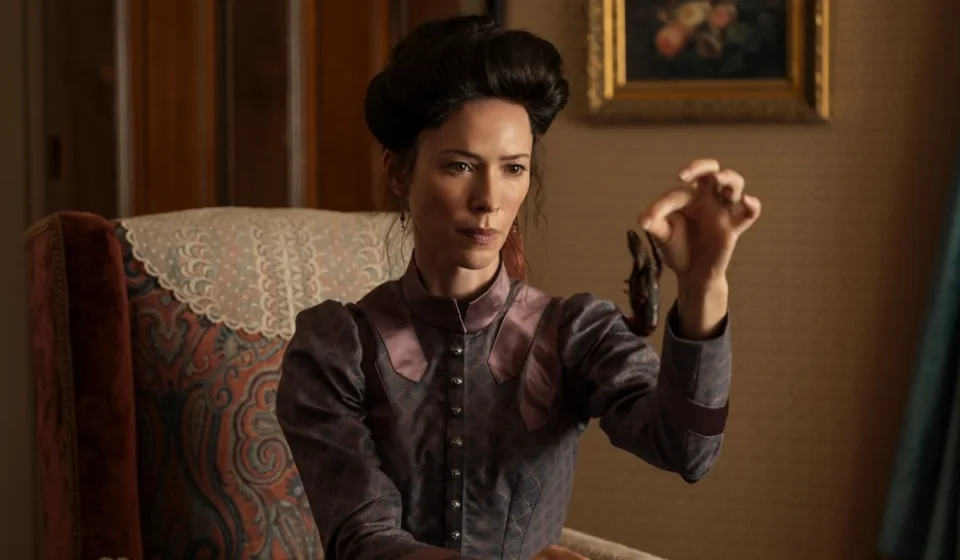
The story focuses on the suffocating household of Andrew (Charlie Hunnam) and Abby Borden (Rebecca Hall). Andrew is presented as a quintessential villain: a funeral parlor owner who profits from the misery of the bereaved and harbors a bizarre obsession with fitting cadavers into undersized caskets. Abby, meanwhile, is a caricature of domestic malice—throwing boiling soup at servants and demeaning her step-daughter with a cold, articulate cruelty.
The show introduces the "Aileen Wuornos" thread in the fourth episode, where the serial killer is portrayed as a devotee of the Borden legend. She is shown reading about Lizzie, communing with her spirit in an attic, and viewing her as a "soul sister" who succeeded where Wuornos failed: by literally getting away with murder. This connection is not rooted in history—there is no evidence that Wuornos ever considered Borden a muse—but rather in the showrunners’ desire to force a thematic link between female rage across different centuries.
Supporting Data and Production Values
Despite its thematic shortcomings, the show boasts high production values and a cast that is largely wasted on the script. Rebecca Hall’s performance as Abby Borden is arguably the season’s only saving grace. Her portrayal of a domestic tyrant is cartoonish yet compelling, providing a rare moment of dark, campy levity in an otherwise dreary slog. When a poisoned bowl of seafood leads to a sequence of projectile vomiting, the show briefly flirts with the kind of grotesque, black-humored brilliance that made earlier seasons of Ryan Murphy’s work so memorable.

However, Ella Beatty’s performance as Lizzie is notably blank, and Charlie Hunnam’s Andrew is too archetypal to evoke any real menace. The decision to cast Vicky Krieps as both the maid, Bridget, and the 16th-century "Blood Countess" Elizabeth Báthory creates a confusing visual shorthand that the script never bothers to fully explain or justify.
The historical parallels drawn by the series are, at best, clumsy. By equating the systemic oppression faced by a Victorian-era socialite with the desperate, violent survivalism of a modern-day sex worker, the show flattens the nuance of both.
Official Responses and Creative Intent
The creative team, led by Ian Brennan, has maintained that the Monster franchise is intended to be an investigation into the "why" of murder, rather than a mere glorification of the acts themselves. In interviews surrounding the release, the production team highlighted the systemic failures—of justice, of gender, and of class—that define the lives of these killers.
Yet, there is a disconnect between this stated intent and the product on screen. Where the 2003 film Monster, starring Charlize Theron, achieved an "embodiment" of Aileen Wuornos that invited empathy without excusing violence, this series feels like a shallow, "bug-eyed" impression of that same work. The show repeats the arguments of twenty years ago without adding anything new to the conversation, resulting in a product that feels less like a historical investigation and more like a retread of better, more sensitive art.

The Implications of "True Crime" Fatigue
The primary failure of The Lizzie Borden Story is its reliance on the rhetorical question: "Who is the real monster here?" It is a question the show has asked with diminishing returns in every season. By this fourth entry, the question has become a shield for lazy writing.
The implications for the true-crime genre are significant. As streaming services continue to churn out dramatizations of real-world atrocities, the audience is increasingly left to grapple with the ethics of "entertainment-fying" suffering. When a series like Monster uses real trauma to fuel its narrative, it has an obligation to provide more than just aestheticized violence or superficial commentary on the patriarchy.
The show’s attempt to frame Lizzie Borden as a proto-feminist icon—using her acquittal as a vehicle to discuss suffrage and independence—is, at best, a radical distortion of history and, at worst, an insulting take on the feminist movement. It implies that the ultimate form of female empowerment is the ability to kill one’s abusers, a reductionist view that feels particularly hollow given the complexities of the real-life cases.
Conclusion: The Verdict
Monster: The Lizzie Borden Story is a D+ effort that marks a low point for the franchise. It is a show that can no longer justify its own existence through the lens of social commentary or character study. It has become an impression of its own former self—a stylistic exercise that lacks the heart, the bite, or the intellectual rigor of its predecessors.

For those interested in the complexities of female rage and the true-crime genre, there are better, more incisive works to explore. Furious, for instance, provides a much sharper, more modern take on the themes Monster attempts to tackle but ultimately fails to grasp.
As for Monster, it is perhaps time for the anthology to return to the shadows. After four seasons, the monster has been stripped of its mystique, leaving behind only the wreckage of a story that, quite frankly, didn’t need to be told this way.
Grade: D+
Monster: The Lizzie Borden Story is currently available to stream on Netflix.