The Architecture of Malice: How ‘A Talent for Murder’ Reinvents the Psychological Thriller

In the current cinematic landscape, the "whodunnit" has undergone a spectacular renaissance. Thanks to the meticulous craftsmanship of filmmakers like Rian Johnson and Kenneth Branagh, audiences have been reminded of the visceral joy found in a tightly wound mystery—a narrative machine that clicks into place with a satisfying, logical conclusion. We crave the reveal: the “who,” the “how,” and the “why.”
Yet, there is a more insidious, enduring pleasure found in the subgenre’s darker cousin: the “whydunnit.” No one mastered this dark art quite like the late, iconic novelist Patricia Highsmith. For Highsmith, the identity of the killer was a triviality; the true horror lay in the architecture of the human psyche. Her most famous creation, the amoral chameleon Tom Ripley, didn’t care about being caught—he cared about the aesthetic and psychological necessity of his actions.
This spirit of profound moral ambiguity finds a new, terrifying vessel in Anton Corbijn’s A Talent for Murder. Adapted by playwright Joanna Murray-Smith from her acclaimed stage play Switzerland, the film serves as a meta-textual exploration of the creative process, trauma, and the blurred lines between an author and her monstrous creations.
The Genesis of the Bunker: Facts and Fiction
The film’s narrative foundation is built upon the sparse, jagged facts of Highsmith’s final years. A notoriously prickly recluse, the author spent the twilight of her life in a Swiss home that local lore affectionately—and somewhat ominously—dubbed "the bunker." It was a place of solitude, cigarettes, and deep-seated suspicion.
Murray-Smith takes these historical scraps and weaves a taut, psychological drama that feels less like a biography and more like a fever dream. Starring the legendary Dame Helen Mirren as a fictionalized version of Highsmith, the film transforms the author’s isolation into a stage for a high-stakes power struggle.
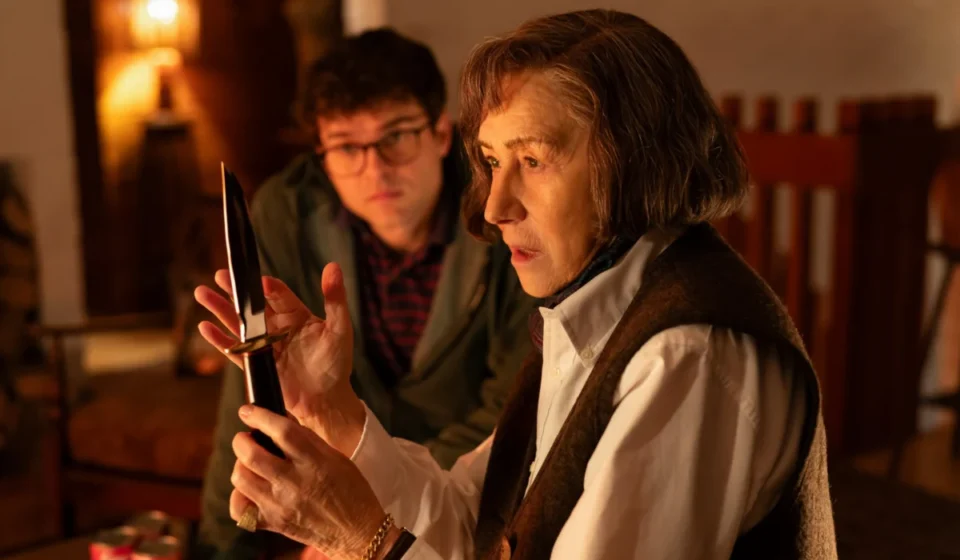
The story begins with a classic disruption: Edward Ridgeway (Alden Ehrenreich), a young, slightly disheveled editor, arrives at the bunker. He has been dispatched by a publisher desperate to squeeze one final Tom Ripley novel out of the aging, recalcitrant author. The stakes are clear: if Edward fails to secure the contract, he will be professionally ruined. It is an impossible task, and from the moment he steps into the sterile, menacing confines of Highsmith’s home, it is clear that he is a lamb wandering into a wolf’s den.

A Chronology of Deception
The tension in A Talent for Murder does not stem from external threats, but from the shifting power dynamics between its two leads. The film’s progression can be mapped through the evolution of the cat-and-mouse game between Mirren’s Highsmith and Ehrenreich’s Ridgeway:
- The Arrival (Act I): Edward arrives in Switzerland, bearing the weight of his publisher’s expectations. He is the classic “outsider” archetype, seemingly ill-equipped for the psychological warfare he is about to endure.
- The Testing (Act II): Highsmith treats Edward with a mixture of disdain and curiosity. As they engage in dialogue, the film’s atmosphere thickens with the threat of violence. The bunker is populated with lethal artifacts: poisons in the pantry, firearms on the wall, and an aquarium filled with snails—a nod to the author’s own peculiar fascinations.
- The Collaborative Unraveling (Act III): As Edward proves himself more resilient than expected, the dynamic shifts. The pair begins to co-author a new Ripley novel, blurring the lines between their reality and the fiction they are creating.
- The Meta-Climax: The narrative fractures, with the film showing scenes of the fictionalized Ripley (played by Ehrenreich) and his mark, Clementine (Olivia Cooke), running through Rome. These sequences act as a dark mirror to the reality of the bunker, forcing the audience to question which version of Edward is the “true” one.
Supporting Data: The Craft of the Meta-Thriller
The brilliance of A Talent for Murder lies in its visual and narrative economy. Director Anton Corbijn, known for his stark, atmospheric aesthetic, utilizes production designer Dimitri Capuani to turn the bunker into a character in its own right. Every prop—from the typewriter that serves as Highsmith’s weapon of choice to the items in Edward’s bag—is loaded with narrative significance.
The inclusion of the “strangers on a train” motif, manifested through Edward’s chance encounter with the enigmatic Clementine, serves as both a wink to the Highsmith faithful and a functional plot device. Olivia Cooke’s performance adds a layer of allure that balances Edward’s nerdy, nervous energy. As Ehrenreich shifts between the bumbling editor and the cold, calculated persona of Tom Ripley, the audience is treated to a masterclass in character performance. He is not just playing a man; he is playing a man who is learning how to be a villain.
Official Responses and Industry Reception
The film, which premiered at the 2026 Toronto International Film Festival, has been met with critical acclaim, particularly regarding the chemistry between Mirren and Ehrenreich. While some critics have noted that the film loses a degree of its tension when it pivots away from the two-hander format of the bunker, the general consensus is that the film represents a bold, intelligent expansion of the thriller genre.
Bleecker Street, which has acquired the distribution rights, views the film as a prestige entry for the fall season. "It is a rare film that manages to be both a tribute to a literary giant and a subversion of the genre she helped define," one studio executive noted. The film’s release on October 23 is timed to capitalize on the autumnal appetite for cerebral, darker-toned mysteries.
Implications: The Enduring Allure of the Mystery
What does A Talent for Murder tell us about our current obsession with the "whodunnit"? Perhaps it is that we are no longer satisfied with simple puzzles. In an era of infinite information, we are increasingly drawn to the "why"—the motive behind the malice.

Highsmith’s legacy was built on the idea that evil is not a deviation from the human experience, but a potential within it. By placing a fictionalized version of her in a room with a young man who is desperate enough to become her pupil, Corbijn and Murray-Smith ask us to consider the cost of our own stories. Do we own the characters we create, or do they eventually consume us?
The film offers no easy answers. It concludes with the same ambiguity that characterized Highsmith’s own work. There is no tidy bow, no final arrest, and no absolute moral judgment. Instead, we are left with the lingering, unsettling sensation that in the search for the truth, we might just be creating a more elaborate lie.
In the final analysis, A Talent for Murder earns its grade of B. It is an imperfect, occasionally over-ambitious work, yet it succeeds where it matters most: it captures the dangerous, seductive thrill of the creative mind. Whether or not all the pieces of the puzzle fit together is ultimately secondary to the pleasure of watching the machine run, sparks flying, in the dark.
For those who enjoy their mysteries served with a side of existential dread and a dash of meta-textual wit, the bunker doors are open. Just be careful what you reveal to the person holding the pen.