
The history of cinema is often written in the margins, preserved in the basements of studios or the forgotten cupboards of its creators. For over three decades, a collection of film canisters sat undisturbed, containing what many cinephiles would consider the "Holy Grail" of the New Queer Cinema movement. These were the behind-the-scenes rushes captured by a then-fledgling cinematographer named Seamus McGarvey during the 1991 production of Derek Jarman’s seminal work, Edward II.
Now, through the directorial vision of Theo Rollason, this footage has been resurrected in the documentary Queer Edward II. The film is more than a mere "making-of" featurette; it is a temporal bridge, a vibrant, 97-minute immersion into a pivotal moment in British socio-political history and a poignant tribute to one of cinema’s most unapologetic visionaries.
Main Facts: A Trove of Radical History
At the heart of Queer Edward II is the extraordinary footage shot by Seamus McGarvey, who would go on to earn Oscar nominations for his work on Atonement and Anna Karenina. In 1991, however, he was a young observer on the set of Jarman’s stylized adaptation of Christopher Marlowe’s Elizabethan play. McGarvey’s lens captured a world that was simultaneously a professional film set and a site of radical political resistance.
The documentary, directed by Theo Rollason and co-edited by Nicole Hálová with the guidance of legendary editor Joe Bini, opts for an immersive archival approach. Breaking away from the traditional documentary format, Rollason eschews modern-day "talking head" interviews. There are no elderly luminaries looking back with the benefit of hindsight. Instead, the film relies entirely on the raw energy of the 1991 footage, supplemented by contemporaneous news reports, talk show clips, and activist recordings.
The result is a portrait of Derek Jarman that feels remarkably present. We see Jarman not as a distant historical figure, but as a "puckish, charming, and proudly queer Aslan," navigating the logistical nightmares of independent filmmaking while leading a cultural revolution.
Chronology: From Marlowe to the Modern Day
1592–1991: The Evolution of a Text
The journey begins with Christopher Marlowe’s Edward II, a play that depicts the tragic downfall of a king whose downfall is precipitated by his love for another man, Piers Gaveston. In 1991, Jarman saw this 400-year-old text as the perfect vehicle to address the "draconian" atmosphere of Thatcherite and post-Thatcherite Britain.
1991: The Summer of Discontent
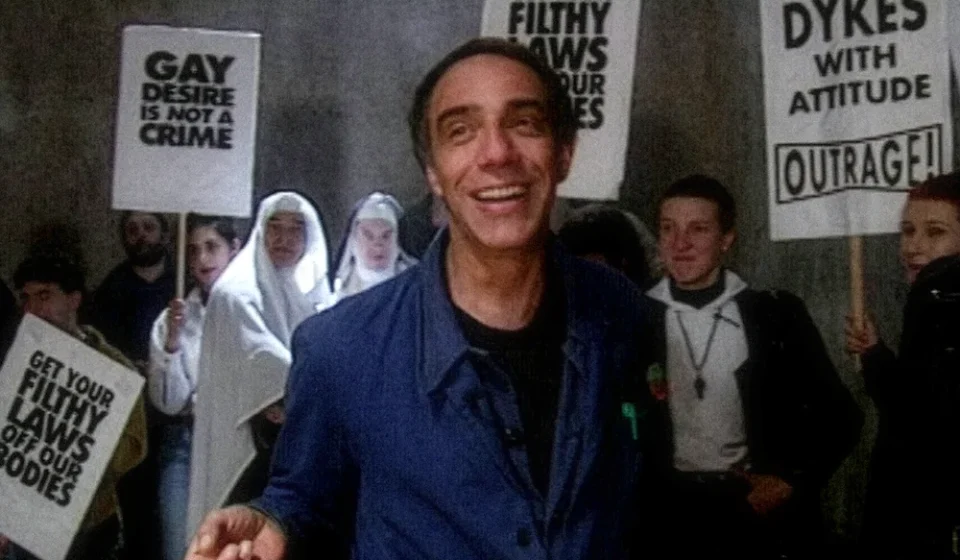
The production of Edward II took place against a backdrop of intense political hostility. The UK was grappling with the legacy of Section 28—a piece of legislation that prohibited the "promotion" of homosexuality by local authorities—and the devastating height of the HIV/AIDS crisis. Jarman, who had been diagnosed with HIV in 1986, was acutely aware that his time was limited. He used the film set as a recruitment ground for activists, specifically members of the group OutRage!, who appeared as extras in the film’s stylized riot scenes.
1994–2023: The Long Silence
Following Jarman’s death in 1994, much of the ephemeral material surrounding his productions was scattered or archived. McGarvey’s behind-the-scenes footage remained in a "closet" for over 30 years, surviving the transition from analogue to digital.
2024: The Premiere of ‘Queer Edward II’
The discovery of the footage led Theo Rollason to assemble a team capable of honoring Jarman’s aesthetic. The documentary premiered as a testament to the endurance of queer art, offering a "wormhole" to a time when the boundaries between art and life were non-existent.
Supporting Data: The Anatomy of a Low-Budget Masterpiece
The documentary provides a fascinating look at the "make-do-and-mend" philosophy of early 1990s British independent cinema. Despite the involvement of the BBC and the presence of burgeoning stars, the budget for Edward II was far from lavish.
The Cast and Crew: Nascent Stars
One of the documentary’s primary joys is the sighting of future icons in their youth.
- Tilda Swinton: Jarman’s muse and the film’s Queen Isabella. The footage captures her "regal radiance" even in the most unglamorous settings—such as a dingy makeup room in Berkshire where damp tights are seen hanging from wire coat hangers in the window.
- Sandy Powell: Now a multi-Oscar-winning costume designer, she is seen as a young professional hovering in the background, shaping the film’s distinctive "arch and stylized" look.
- Annie Lennox: The documentary features a full, uncut recording of Lennox performing Cole Porter’s "Ev’ry Time We Say Goodbye." The scene is captured with the entire crew gathered behind the camera, transforming a film set into an intimate, impromptu concert.
The Activist Intersection
The documentary reveals the extent to which Jarman integrated real-world protest into his art. Rollason brilliantly intersperses McGarvey’s footage of the film’s "riot" scenes with actual news footage of gay rights protests occurring in London at the time. This "meta-on-meta" layer illustrates how Jarman didn’t just depict history; he was actively attempting to bend the arc of the present.
Official Responses and Cultural Context
The documentary has been met with praise for its refusal to sentimentalize Jarman. By avoiding modern interviews, Rollason allows Jarman’s own voice—often heard in contemporaneous talk shows—to speak for itself.
The Jarman Paradox
In the archival clips, Jarman is shown appearing on magazine talk shows and arts programs of the era. These segments are often painful to watch for modern audiences; the hosts frequently display a level of condescension and outright hostility that "sets one’s modern teeth on edge." Yet, Jarman remains unfailingly polite and charming, a "Saint Derek" who uses his intellect as both a shield and a sword.
The Outing Controversy
The film does not shy away from the more controversial aspects of Jarman’s activism. It documents the moment when OutRage! activists—including the Sisters of Perpetual Indulgence, a group of "gay male nuns"—invaded the studio next door to the Edward II set. They were there to protest against singer Cliff Richard, who was recording an album, demanding he "come out."
Jarman’s offhanded support for "outing" celebrities is one of the few elements of the documentary that feels dated. While modern queer activism often rejects the forced disclosure of identity, the documentary contextualizes Jarman’s "mild militancy" as a desperate response to a government that seemed content to let a generation of gay men die in silence.
Implications: The Legacy of Irreverence
Queer Edward II serves as a vital "aide-memoire" for today’s activists and filmmakers. Its implications stretch far beyond the niche of film history, offering lessons in the endurance of the human spirit.
1. The Preservation of Queer Memory
The documentary highlights the fragility of queer history. Had McGarvey’s footage not been preserved, a significant chapter of the "New Queer Cinema" movement would have been lost to time. It underscores the importance of archiving the "scraps" of production—the rushes, the rehearsals, and the candid moments—that often contain the true soul of a movement.
2. Art as a Tool for Resistance
Jarman’s work suggests that art does not need to be "polite" to be effective. By modernizing Marlowe and infusing it with the grit of 1990s London, Jarman proved that classical texts could be reclaimed to fight contemporary battles. Rollason’s film reminds us that one can be a "profoundly influential political figure" and a visionary artist without losing a sense of joy or "puckish" irreverence.
3. A Model for Modern Activism
The film’s ultimate message is one of optimism in the face of oppression. Jarman was living with a terminal diagnosis and fighting a hostile government, yet the footage shows a man who was "so very alive." For current LGBTQ+ activists facing a new wave of legislative and social challenges, Queer Edward II offers a blueprint for how to resist injustice without losing one’s humanity.
4. The "Jarmanesque" Aesthetic
Finally, the documentary re-validates the aesthetic of the analogue era. In an age of digital perfection, the "chunky beige telephones," the grain of 16mm film, and the "make-do-and-mend" sets of Jarman’s world offer a tactile, raw beauty that continues to inspire new generations of filmmakers.
Conclusion
Derek Jarman passed away in 1994, just two years after the release of Edward II. He left behind a void in British cinema that has never quite been filled. However, Queer Edward II does not function as a eulogy. It does not "erect a statue" to a dead man. Instead, Theo Rollason has succeeded in something much more difficult: he has given Jarman back to the world, vibrant and unbowed. For 97 minutes, the "Saint of Dungeness" is once again at work, reminding us that no battle—against a government, an organization, or a disease—is ever a reason to give up on a "good struggle."