The Uncanny Synchronicity of Werner Herzog: Inside the Making of "Bucking Fastard"

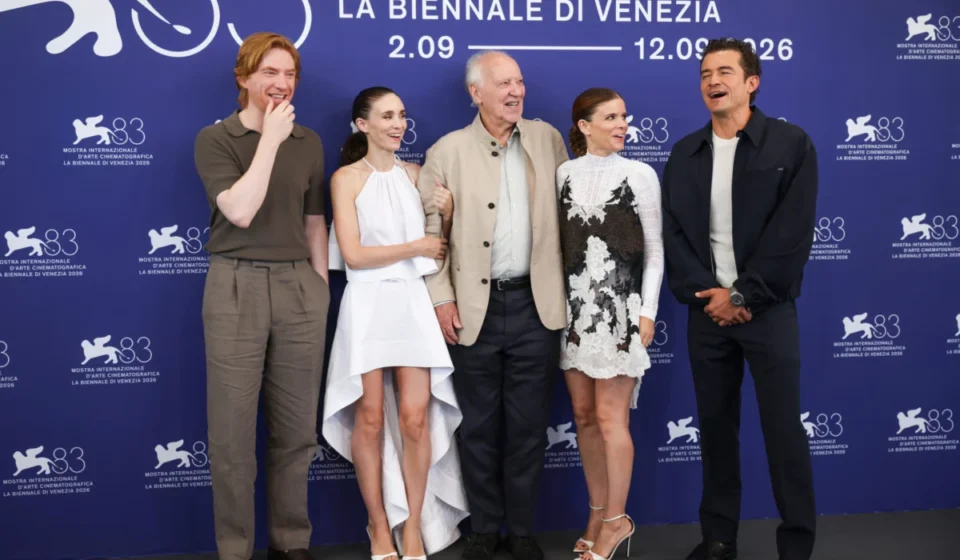
At the 2026 Venice Film Festival, the Lido was gripped by a peculiar, existential fervor. The center of this storm was legendary filmmaker Werner Herzog, who celebrated his 84th birthday while navigating the high-stakes world of festival promotion. His latest feature, the provocatively titled Bucking Fastard, has emerged as one of the most discussed and debated entries in recent memory. A genre-defying cocktail of bawdy sex comedy, picaresque adventure, and Herzog’s signature philosophical inquiry, the film marks a daring new chapter in the director’s storied career.
The Core Concept: A Two-Headed Odyssey
At the heart of Bucking Fastard lie real-life sisters Kate and Rooney Mara, cast as nearly identical twins, Joan and Jean Holbrooke. The film is built upon a premise that is as unsettling as it is mesmerizing: the twins function as a single entity, moving, speaking, and desiring in absolute lockstep. They share not only their dreams but also a romantic entanglement with a rakish charmer played by Orlando Bloom.
For audiences accustomed to the linear narratives of mainstream cinema, the film offers an experience that is decidedly "acquired." Yet, for those willing to lean into the surreal, it serves as a masterclass in performance. Herzog, ever the provocateur, has crafted a film that feels less like a traditional narrative and more like a fever dream of human connection, shot against the lush landscapes of Ireland and the subterranean, otherworldly vistas of a famed tourist-cave in Slovenia.
Chronology of an Eccentric Production
The gestation of Bucking Fastard was unconventional from its inception. Filming took place in February 2025, a period defined by the director’s rigorous demands for authenticity and his unique process of extracting performances from his leads.

The film’s festival journey has been equally deliberate. Originally courted by the Cannes Film Festival for an out-of-competition slot, Herzog made a bold, career-defining gamble: he rejected the offer. His reasoning was rooted in his protective stance toward his cast; he wanted to ensure that Kate and Rooney Mara would be eligible for Best Actress consideration at a festival that offered them a competitive platform. This move led the project to the Venice Film Festival, where it has since become a focal point of the event, with further screenings slated for Telluride, Toronto, and New York.
The Pursuit of Synchronicity
One of the most striking aspects of the film is the seamless, almost supernatural synchronization between the Mara sisters. Herzog, known for his hands-on approach, initially attempted to guide this process through traditional rehearsals, but quickly abandoned them upon realizing the intuitive depth the sisters had already achieved.
"Normally, it would be done through synchronizing your breathing," Herzog explained in an exclusive interview with IndieWire. "Like in the stages of ancient Greek tragedies, you have the chorus that speaks in unison… It didn’t work with Kate and Rooney, but what worked—they discovered it by singing their earliest childhood song."
Herzog describes the experience of directing them as being physically intimate, often standing so close to the actors that he could feel the rhythm of their hums before calling the slate. This proximity allowed him to capture a level of performance he claims has never been seen on screen before. "They are really in the flow," he noted. "They are so like one soul in two bodies. And they are ingenious."

Professional Perspectives and Industry Dynamics
The film’s reception in Venice has been polarized, a hallmark of Herzog’s filmography. From the hypnotic performances in Heart of Glass to the visceral intensity of Bad Lieutenant: Port of Call New Orleans, Herzog has consistently pushed the boundaries of what is acceptable or expected in cinema.
When asked about his history with festival directors, specifically regarding the "snub" from Cannes, Herzog was pragmatic rather than bitter. He views the festival circuit as a thankless, grueling bureaucracy. "They have 3,000 films applying and they take 20," he remarked. "No, no, it’s a difficult, very, very difficult task. I don’t mind at all."
His relationship with fellow luminaries also remains a point of public fascination. The film is dedicated to the late David Lynch, a filmmaker with whom Herzog shared a deep, albeit complicated, mutual respect. Herzog reflected on their final interactions, noting that while they often discussed collaborating—specifically on the project My Son, My Son, What Have Ye Done—their paths diverged as Lynch became increasingly immersed in transcendental meditation.
The Implications of AI and the Future of Storytelling
Beyond the immediate buzz of his new film, Herzog remains a fierce critic of the encroaching influence of Artificial Intelligence in the arts. When asked about a recent AI-generated film that attempted to mimic his unique directorial voice, his response was characteristically blunt.

"It is such a stupid idea. It’s phenomenally, abysmally stupid," Herzog declared. He views AI-generated content as a form of "mimicry" that lacks the soul of human storytelling. For Herzog, AI is a tool best suited for "replacing all the idiots" who rely on derivative, repetitive patterns. He maintains that true storytelling requires the visceral, human element—the kind he continues to pursue even at 84.
Looking Ahead: A Legacy in Motion
Despite his age, Herzog shows no signs of slowing down. He is currently finalizing his next project and overseeing the production of a massive retrospective book with Taschen, documenting the photography of his nearly 80 films.
His philosophy on filmmaking is simple: it is a source of pure joy. Even as he acknowledges the physical limitations that come with age—such as his decision to delegate field production on his recent documentary Ghost Elephants to his trusted producer, Ariel Isacovitch—his creative spirit remains undimmed.
"I try to finish one after the other," he said of his ongoing work. Whether he is in the bush of Namibia or the caves of Slovenia, Herzog continues to operate as an explorer of the human condition. Bucking Fastard is merely the latest manifestation of this lifelong expedition, a film that challenges the viewer to look closer, breathe in rhythm, and perhaps, for a fleeting moment, see the world through the eyes of a two-headed consciousness.

As the industry looks toward the North American distribution of Bucking Fastard, one thing remains clear: Werner Herzog has no interest in repeating himself. He is, as ever, looking for the next unprecedented image, the next impossible rhythm, and the next way to get the very best out of both his actors and his audience. In a landscape increasingly dominated by standardized content, the erratic, brilliant, and utterly singular vision of Herzog remains an essential, if challenging, tonic.