
By [Your Name/Journalist Persona]
September 2, 2026
The Venice Film Festival has long served as a launchpad for prestige cinema, but this year, the Lido is buzzing with something far more visceral: the return of Danny Boyle to his gritty, kinetic roots. With his latest feature, Ink, the visionary director behind Trainspotting and 28 Days Later has crafted what critics are calling "Trainspotting for the newspaper industry." Adapted by James Graham from his own celebrated 2017 stage play, Ink is a high-octane, neon-soaked, and deeply unsettling exploration of the birth of modern British tabloid culture.
The Genesis of Sensationalism: A Story of Fleet Street
At its core, Ink is an origin story—not of a superhero, but of an industry’s moral erosion. Set against the backdrop of late 1960s and 1970s London, the film chronicles the hostile takeover and subsequent transformation of The Sun newspaper.
The narrative centers on a triumvirate of power: the ambitious, Yorkshire-born editor Larry Lamb (played with magnetic intensity by Jack O’Connell), the enigmatic media mogul Rupert Murdoch (Guy Pearce), and the trailblazing, yet marginalized, reporter Jules Davies (Claire Foy). Together, they embark on a scorched-earth campaign to dismantle the dominance of The Daily Mirror, redefining the landscape of British journalism in the process.
Chronology of a Media Revolution
The film tracks the evolution of the news cycle through three distinct phases:
- The Inception (1969): The arrival of Rupert Murdoch in London. The film captures the raw, industrial energy of Fleet Street—a world of heavy lead type, massive printing presses, and the constant smell of ink and stale tobacco. Murdoch’s goal is simple: capture the working class by giving them exactly what they didn’t know they craved.
- The Ascent (The 1970s): The team begins to abandon the "fit to print" standard. The film depicts the frantic editorial meetings where the criteria for a front-page story shifts from national importance to visceral, often base, entertainment value. Crime, celebrity gossip, and manufactured outrage become the primary commodities.
- The Aftermath: By the final act, Boyle bridges the gap between the 1970s and the present day. He masterfully draws a direct, chilling line from the editorial choices made in those grimy offices to the "idiotic hellscape" of the modern, post-truth digital age.
The Stylistic Vision: Boyle’s Return to Grit
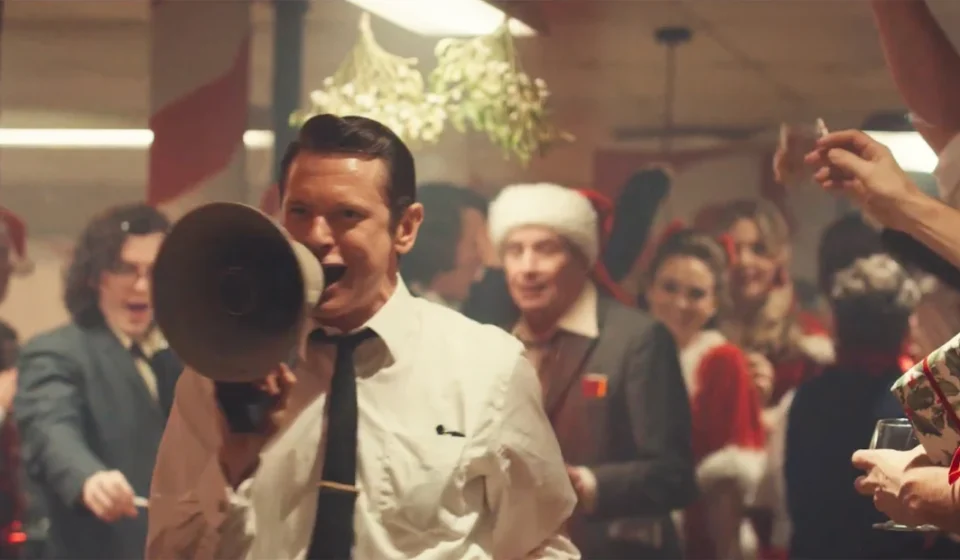
Danny Boyle is a master of rhythm, and Ink functions like a percussive, high-tempo thriller. Much like The Wolf of Wall Street—to which the film is frequently compared—Boyle adopts an aesthetic of gleeful hedonism. The offices of The Sun are presented as a pressure cooker of ambition, where the layout staff and reporters operate with the frantic energy of addicts.
The cinematography is claustrophobic and tactile. Viewers can almost feel the grease of the printing presses and the oppressive weight of the deadlines. Boyle punctuates the chaos with a razor-sharp soundtrack of 1970s rock and early punk, mirroring the disruptive nature of the editorial shift occurring on screen.
Character Dynamics: O’Connell, Pearce, and Foy
The film’s success rests on its performances. Jack O’Connell’s portrayal of Larry Lamb is a study in calculated charisma; he is the engine of the paper, a man who knows exactly how to manipulate the public pulse.
Guy Pearce’s Rupert Murdoch is a fascinating, if unconventional, choice. Boyle avoids the temptation to paint him as a mustache-twirling villain. Instead, Pearce plays him as a man of singular, terrifying focus. He is not interested in ideology; he is interested in numbers. His obsession is the bottom line, and his detachment from the human cost of his sensationalism makes his character all the more chilling.
Claire Foy provides the moral anchor as Jules Davies. As one of the few women in a hyper-masculine, testosterone-fueled newsroom, her character serves as the audience’s surrogate—the voice of reason in an environment that has collectively decided that truth is a secondary concern to circulation figures.

Supporting Data: The Mechanics of "Fake News"
While the film is a drama, it is grounded in the historical reality of the Fleet Street wars. Ink meticulously reconstructs the process of manufacturing a "non-story." Through sharp, witty dialogue and frantic pacing, the film exposes the mechanics of the tabloid cycle: the way a dull story is inflated, the way a private scandal is weaponized, and the way the "average reader" is groomed to prefer shock over substance.
The film argues that the "news machine" does not respond to the public’s desire for information; it creates a dependency. By the end of the second act, the characters are no longer reporting on the world—they are curating a fiction that reinforces the reader’s worst fears and most basic impulses.
Official Responses and Industry Context
The release of Ink has already sparked intense debate within the journalism community. Early screenings at the Venice Film Festival have been met with a mixture of critical acclaim and uneasy reflection. Veteran editors have noted that the film’s depiction of the "anything goes" era of the 1970s feels remarkably relevant to the current crisis in media ethics.
"Boyle isn’t just making a period piece," noted one critic during the post-screening press conference. "He is holding up a mirror to the industry, and he’s asking if we can ever return to a time before the toothpaste was squeezed out of the tube."
While representatives for the organizations depicted have remained largely silent, the film’s implication—that we have reached a point of no return in our relationship with media—has become the central topic of the festival’s fringe discussions.
Implications: The Legacy of Sensationalism
The most profound question Ink leaves with the audience is whether the current state of digital discourse is merely the inevitable conclusion of the path laid down in the 1970s. By prioritizing "sell, sell, sell" over the public good, the characters in the film essentially built the architecture of the modern attention economy.
Boyle’s film does not offer a solution, nor does it moralize in a traditional sense. In fact, some critics have pointed to the film’s lack of explicit moral judgment as a point of contention—similar to the criticism leveled at The Wolf of Wall Street. Does the film glamorize the corruption it depicts? Or does it merely force us to confront our own role as consumers in this cycle?
As the credits roll, the message is clear: the news cycle is no longer a tool for enlightenment; it is a closed loop of consumption. We are all complicit, and we are all addicted.
Conclusion: A Must-Watch Assessment
Ink is a 8/10 masterpiece of modern cinema. It is a film that is as entertaining as it is deeply, profoundly uncomfortable. Danny Boyle has returned to his gritty, stylistic roots to deliver a warning that is impossible to ignore. Whether or not it will change how we consume the news remains to be seen, but as a piece of visceral storytelling, it is unparalleled.
In an era where "fake news" and "sensationalism" have become buzzwords, Ink reminds us that this is not a new phenomenon. It is a legacy, one that was forged in the dark, inky caverns of Fleet Street, and one that we are still living with today. For anyone who has ever wondered how we ended up in our current information hellscape, this film is essential viewing. It is a loud, chaotic, and brilliant portrait of how the world lost its truth—and why, for better or worse, we can’t seem to look away.