The Labyrinth and the Highlands: Marc Turtletaub’s ‘Borges and Me’ Reimagines a Literary Legend

The intersection of myth and memory has always been the playground of Jorge Luis Borges, the blind Argentine titan of 20th-century literature. It is fitting, then, that a film based on an extraordinary—and perhaps slightly embellished—episode from his life should debut at the Edinburgh Film Festival, a stone’s throw from the rugged landscapes where the story unfolds. Borges and Me, directed by Marc Turtletaub and adapted from Jay Parini’s 2020 memoir, Borges and Me: An Encounter, offers a cinematic window into a journey that is as much about the discovery of self as it is about the eccentricity of genius.
Main Facts: A Transatlantic Literary Road Trip
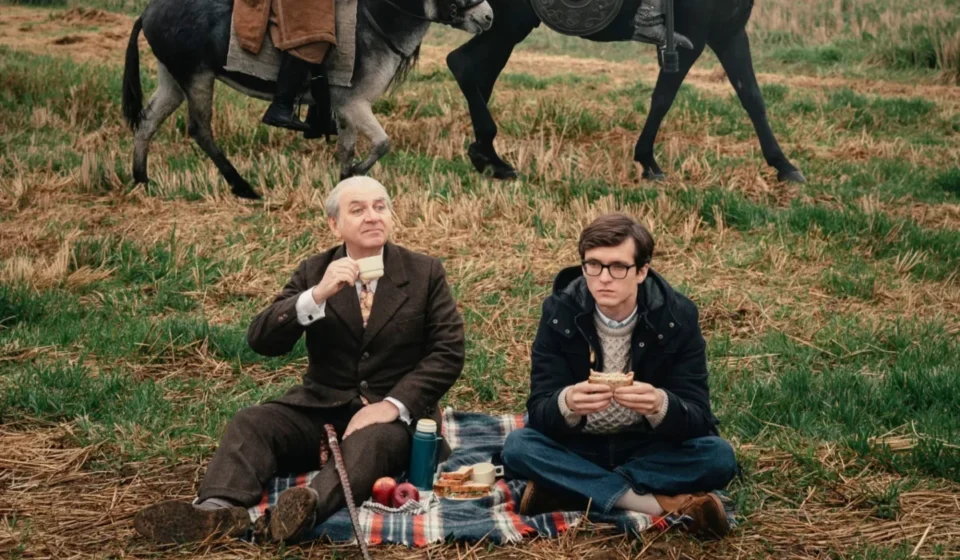
At its core, Borges and Me is a "mismatched buddy" road movie, but one populated by the ghosts of literary giants and the mist-shrouded peaks of the Scottish Highlands. The film recounts a week in the 1970s when Jay Parini (played by Fionn Whitehead), then a timid American doctoral student at the University of St. Andrews, found himself the unlikely chauffeur and caretaker for Jorge Luis Borges (Luis Gnecco).
The production is a transatlantic collaboration, blending British, South American, and North American talent. Directed by Marc Turtletaub—known for his work as a producer on Little Miss Sunshine and The Farewell—the film leans into the "arthouse-crossover" genre. It aims to bridge the gap between high-concept literary biography and the crowd-pleasing warmth of a traditional road trip narrative.
The film’s narrative engine is fueled by a series of detours. Parini, who is ostensibly driving north to interview the hermetic Scottish poet George Mackay Brown (Peter Mullan), finds his plans derailed by the whims of Borges. Despite his blindness, the septuagenarian author possesses an insatiable appetite for the world, demanding lyrical descriptions of the scenery and involving his young "minder" in everything from bumbling boat trips on Loch Ness to hallucinatory visits to ancient battlefields.
Chronology: From 1970s Reality to 2024 Screen
The journey of Borges and Me from a real-life encounter to a feature film spans over half a century, reflecting the slow-burn maturation of its source material.
- The Encounter (Early 1970s): The events took place while Jay Parini was studying at St. Andrews. Parini, who would go on to become a celebrated biographer of figures like Leo Tolstoy and Robert Frost, was introduced to Borges through the poet Alastair Reid. Reid, a primary translator of Borges, was the catalyst for the trip.
- The Anecdote (1970s–2010s): For decades, the story of "driving Borges through Scotland" was a legendary anecdote in literary circles. Parini often recounted the tale of the blind genius demanding to see the "wildness" of the Highlands.
- The Memoir (2020): Parini finally committed the story to paper in Borges and Me: An Encounter. The book was hailed for its charm and its portrayal of Borges not just as a writer, but as a "Character" with a capital C—mischievous, difficult, and profoundly insightful.
- Film Development (2021–2023): Shortly after the memoir’s release, production began on a screen adaptation. Screenwriter Oren Moverman (known for The Messenger and Love & Mercy) worked with Parini and Ross Clarke to condense the episodic nature of the book into a structured narrative.
- The Premiere (2024): The film saw its world premiere at the Edinburgh Film Festival, chosen for its "home-turf" connection to the locations and the Scottish literary figures portrayed in the script.
Supporting Data: Casting, Cinematography, and Themes
The strength of Borges and Me lies in its textures—both visual and emotional. Much of the film’s "mellow, quietly sentimental" atmosphere is credited to Director of Photography Christopher Norr. Norr captures the Scottish Highlands with an autumnal crispness, utilizing a palette of tawny browns and dewy greens that mirrors the "knowledge-gathering naivety" of Parini’s youth.
The Casting Dynamic
The film relies heavily on the chemistry between its two leads:
- Luis Gnecco as Jorge Luis Borges: The Chilean veteran, famous for his role in Neruda, avoids the trap of a dry, hagiographic portrayal. Gnecco’s Borges is a man of "impish wisdom and earthy vulgarity." He fills the silence with constant chatter, portraying a man who, though sightless, is more "present" than the sighted people around him.
- Fionn Whitehead as Jay Parini: Whitehead, known for his breakout role in Christopher Nolan’s Dunkirk, portrays the young Parini with an "upright Englishness" that contrasts with his character’s American roots. His performance provides the necessary "stillness" to anchor Gnecco’s more flamboyant mannerisms, preventing the film from sliding into caricature.
The Supporting Cast
The ensemble is rounded out by notable performances that ground the film in its 1970s setting:
- Alan Cumming plays Alastair Reid with his signature bohemian flair, serving as the bridge between the academic world and Borges’s magical-realist reality.
- Peter Mullan offers a "mischievous extended cameo" as the poet George Mackay Brown, representing the rugged, hermetic soul of Scottish literature.
- Freya Mavor plays Ailith, a pub worker who provides the young Parini with a romantic awakening, serving as a foil to the stifling academic pressures he faces.
Interiority and the Vietnam Subplot
While the film is ostensibly about Borges, it finds its emotional depth in Parini’s internal anxieties. A significant subplot involves Parini’s brother, a soldier serving in the Vietnam War. This contrast—the ethereal, timeless world of European and South American poetry versus the brutal, immediate reality of the American conflict—adds a layer of gravity to Parini’s character development. It frames the road trip not just as a vacation, but as a desperate search for meaning in a fractured world.
Official Responses and Critical Reception
Initial reactions from the Edinburgh Film Festival have been largely positive, though critics have noted the film’s specific niche. The consensus suggests that Borges and Me is a "good-natured" adaptation that captures the charm of the memoir, even if it occasionally feels "extended beyond its natural capacity."
Critical Highlights:
- Variety: The review praised the film’s "warm feeling and fuzzy nostalgia," noting that it treats Borges as a "buoyant, heavily imagined spirit rather than a historical subject."
- Festival Circuit Impact: Critics anticipate that the film will be a staple on the international festival circuit, particularly in regions with strong ties to the subjects, such as South America and the UK.
- The "Tall Story" Critique: Some reviewers have pointed out that the film feels "both a tall story and a thin one." This refers to the way the narrative stretches a single anecdote into a 90-minute feature, sometimes relying on "oddball mannerisms" to fill the gaps. However, most agree that the film’s "arthouse-crossover" appeal remains intact.
Implications: The Legacy of Borges and the Arthouse Market
The release of Borges and Me has broader implications for how we consume literary biography in the 21st century.
1. The "Fictionalized Truth" Trend
The film leans into the Borgesian theme that reality and fiction are often indistinguishable. By portraying Borges as a "Character" rather than a strictly historical figure, Turtletaub and Moverman honor the author’s own philosophy of "magical realism." This reflects a growing trend in cinema (seen in films like Spencer or Jackie) where the emotional truth of a person is prioritized over chronological accuracy.
2. A Tale of Two Borgeses
The film’s release coincides with the announcement of an upcoming five-hour documentary titled Life of Jorge Luis Borges. This creates a unique dichotomy in the marketplace: one film offers a "buoyant, imagined" snapshot of the man, while the other provides a comprehensive historical record. Industry analysts suggest a "complementary release strategy" could benefit both, allowing audiences to choose between the myth and the man.
3. The Future of Arthouse Crossover
For distributors, Borges and Me represents a safe yet sophisticated bet. It combines "prestige" subject matter with a "feel-good" road trip structure. In an era where mid-budget films often struggle to find a theatrical audience, the combination of a known literary icon, a scenic setting, and a recognizable cast (Cumming, Whitehead, Mullan) makes it an ideal candidate for global distribution.
4. Educational and Literary Re-engagement
The film is expected to spark a renewed interest in the works of both Jorge Luis Borges and Jay Parini. By presenting Borges as an accessible, "twinkly" genius rather than a dusty academic subject, the film may introduce his labyrinths and mirrors to a younger generation of readers who are more accustomed to visual storytelling.
In conclusion, Borges and Me is more than just a road trip through the Scottish Highlands; it is a meditation on the influence of mentors and the "porous naivety" of youth. While it may be a "thin" story in terms of plot, it is rich in atmosphere and heart, standing as a fitting tribute to the man who famously said, "I have always imagined that Paradise will be a kind of library." In Turtletaub’s vision, that paradise looks very much like a winding road in Scotland, shared with a friend.