
The Paradox of Prestige: Robert De Niro and the Mediocrity of "The Whisper Man"

Robert De Niro’s career has entered a fascinating, if occasionally frustrating, phase of bifurcation. The two-time Academy Award winner has not lost the technical brilliance that defined his ascent in the 1970s and 80s; rather, he has become profoundly selective about when he chooses to deploy it. For every visceral, career-defining performance like his turn in Martin Scorsese’s Killers of the Flower Moon, there is an inevitable counterweight: a string of projects like About My Father or The War with Grandpa where his performance suggests a man physically present on set but mentally scouting the exit route.
This dichotomy makes his latest venture, the Netflix thriller The Whisper Man, a confounding piece of cinema. Produced by the Russo brothers and directed by James Ashcroft, the film lands in the precarious space between a prestige drama and a disposable streaming algorithm filler. Yet, through a stroke of casting genius, the film manages to transcend its own narrative shortcomings, proving that even when a legend is operating at 60% capacity, he remains more compelling than the material surrounding him.
The Narrative Architecture: A Case Reopened
Based on Alex North’s bestselling novel, The Whisper Man attempts to weave a gothic, atmospheric mystery into the framework of a modern police procedural. The plot begins decades after the original case of "The Whisper Man"—a serial killer who utilized a haunting, Freddy Krueger-esque nursery rhyme to lure children to their windows—was supposedly solved.
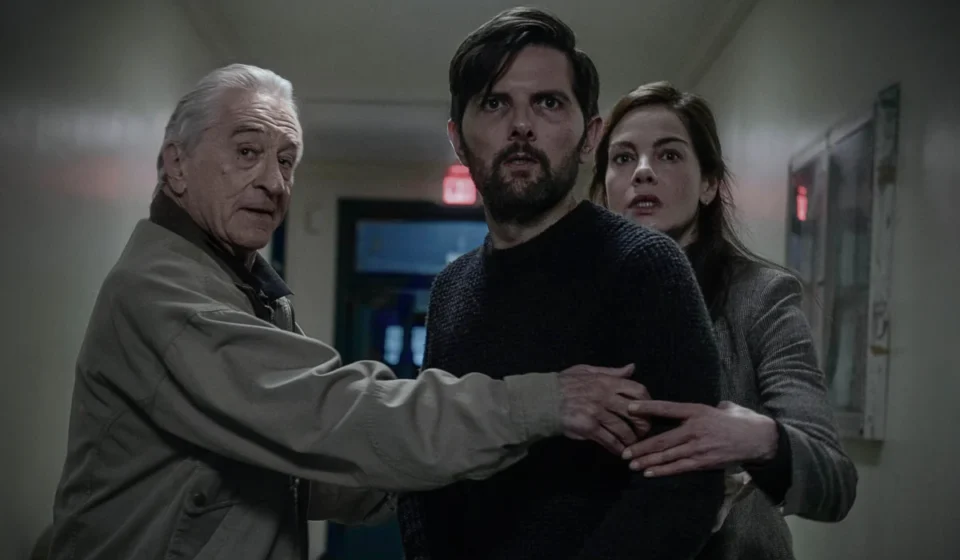
Frank Carter, the perpetrator, has been behind bars for twenty-five years, leaving the lead investigator, Pete Willis (Robert De Niro), to retire into a life of quiet, simmering resentment. Willis is a man defined by the one victim he never found, a cold case that serves as a permanent anchor to his past. His personal life is equally fractured; he is estranged from his son, Tom (Adam Scott), a crime novelist who committed the cardinal sin of mining their dysfunctional family history for his own literary gain.
The status quo is shattered when Tom, recently widowed, returns to their childhood home with his young son, Jake (Acston Luca Porto), in tow. Predictably, the past refuses to stay buried. A new disappearance, mirroring the specific modus operandi of the long-imprisoned Carter, forces Detective Amanda Beck (Michelle Monaghan) to solicit the help of the retired Willis. Despite his initial, perfunctory protests that he is "out of the game," the kidnapping of his own grandson provides the requisite stakes to pull him back into a labyrinthine investigation that feels far more personal—and dangerous—than the original hunt.
Chronology of a Cliche
The film’s structure follows a rigid, almost mathematical progression of genre tropes. Screenwriters Ben Jacoby and Chase Palmer, while faithful to the source material, struggle to transcend the gravity of the procedural sub-genre. The beats are familiar: the reluctant mentor, the skeptical but determined new lead, the "shitty father" confrontation in an atmospheric diner, and the discovery of a conspiracy that reaches into the heart of the local police department.
The pacing, while technically competent, lacks the urgency required for a high-stakes thriller. For the first act, the audience is treated to a series of moody, blue-tinted sequences that establish the "icy" aesthetic favored by director James Ashcroft. While this visual language distinguishes The Whisper Man from the vibrant, over-saturated palette of many Netflix originals, it often serves to mask the thinness of the character development.

The middle act shifts into a predictable dance of investigation. As Willis and Beck trace the connections between the old case and the new, the script relies heavily on the "troubled genius" archetype. Unfortunately, the execution of these sequences—particularly a clumsy, ham-fisted attempt to depict back-alley fentanyl deals—undermines the tension. It is here that the film loses its sense of immersion, reminding the viewer that they are watching a constructed product rather than a lived-in world.
Supporting Data: Casting as a Structural Support
Despite the script’s reliance on pastiche, the film’s saving grace is its cast. Adam Scott, playing against his usual comedic type, delivers a "concerned father" performance that is earnest and grounded, even when the dialogue forces him into melodrama. Michelle Monaghan provides a necessary foil to De Niro, serving as the bridge between the old-school intuition of Willis and the modern, evidence-based reality of the current police force.
However, the most significant element—and perhaps the most controversial—is the performance of the primary antagonist. In a move that has sparked minor debate among critics, Netflix has requested that the actor portraying the villain remain unnamed in reviews to preserve the "mystery" of the film’s twist. While this feels like a marketing gimmick, the performance itself is undeniably chilling. The actor brings a level of nuance to the villainy that is rarely seen in streaming thrillers, elevating the stakes and providing a genuine sense of threat that the film otherwise lacks.
The De Niro Factor: Feigned Boredom or Method Acting?
The most compelling aspect of The Whisper Man is the central performance of Robert De Niro. As a retired detective who is fundamentally disinterested in being "back on the job," the character’s emotional state mirrors De Niro’s own apparent detachment. It is a meta-textual masterstroke: when Willis looks annoyed or tired during a high-stakes interrogation, the audience is left questioning whether the character is simply world-weary or if the actor is signaling his own impatience with the script’s derivative nature.
This ambiguity lends the character a strange, unintentional gravitas. De Niro carries the weight of the film on his shoulders, turning in a performance that is far better than the screenplay deserves. He treats the character with a level of seriousness that elevates the "forgettable" aspects of the story, proving that even a disinterested De Niro can command the screen with a single, weary glance.
Implications: The Streaming Economy and the "Watchable" Thriller
The release of The Whisper Man highlights a growing trend in the streaming era: the "competent but forgettable" thriller. Platforms like Netflix are increasingly reliant on high-wattage star power to anchor projects that might otherwise be relegated to VOD obscurity. In this economy, a film does not necessarily need to be a masterpiece; it only needs to be "watchable" enough to hold an audience’s attention for two hours.
The Whisper Man succeeds in this narrow, commercially driven objective. It is technically proficient, featuring a moody atmosphere, a solid (if unoriginal) score, and a cast that is punching significantly above its weight class. However, the implication for the future of the thriller genre is clear: as streaming services prioritize consistency and content volume, the opportunity for genuine subversion is diminishing. We are entering an age where the "genre film" is becoming a product of optimization rather than artistic exploration.

Final Assessment: Is It Worth the Stream?
For the dedicated fan of police procedurals—the viewer who has exhausted the Netflix algorithm’s recommendations and still craves the familiar rhythm of detectives, suspects, and dark secrets—The Whisper Man will provide a satisfying, if unchallenging, experience. It hits all the marks: it has a brooding lead, a sinister villain, and a mystery that keeps the plot moving forward.
However, for those looking for innovation or a fresh take on the serial killer narrative, the film offers little beyond its star-studded veneer. It is a testament to the talent of its lead that the film is watchable at all; without De Niro’s presence, the production would likely be entirely invisible.
Ultimately, The Whisper Man sits comfortably in the middle of the road. It is neither a disaster nor a triumph, settling instead for a respectable "C+" grade. It is the perfect film to watch on a rainy Sunday evening when you want something that requires little mental effort but offers enough professional polish to justify the time. Whether or not that is enough in an era of prestige television and auteur-driven streaming content is a question the audience will have to answer for themselves.
Grade: C+
“The Whisper Man” is currently available for streaming on Netflix.