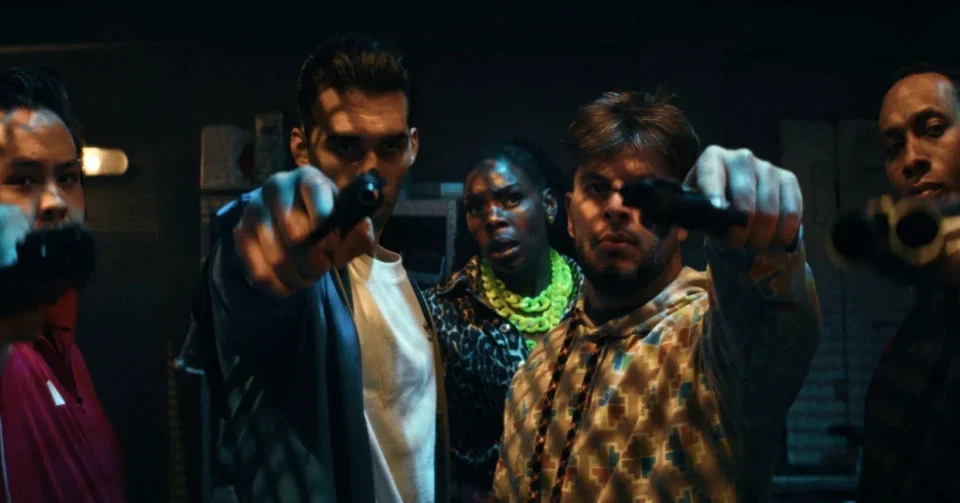

The landscape of European action cinema is undergoing a seismic shift, moving away from traditional police procedurals toward high-octane, culturally resonant genre pieces. At the forefront of this transformation is Attack on Paradise, a film that serves as both a visceral adrenaline rush and a deeply personal manifesto for its star and co-creator, Saïd Boumazoughe. Directed by Bob Colaers, the film is more than just a Belgian entry into the "tower defense" subgenre; it is a vivid reflection of Antwerp’s multicultural reality, wrapped in the neon-soaked aesthetics of a modern thriller.
Main Facts: A Personal Vision Realized
Attack on Paradise is a project defined by its authorship. While Bob Colaers sits in the director’s chair, the "created by" credit prominently featuring Saïd Boumazoughe signals that this is a "star vehicle" in the truest sense. Boumazoughe, a Belgian-Moroccan actor who has gained significant traction through his roles in gritty dramas like Mocro Maffia, has used this project to carve out a space for a new kind of European hero—one who is lanky, hoody-clad, and deeply rooted in the immigrant experience of the Benelux region.
The film draws heavy inspiration from the "siege" blueprints laid down by classics such as John Carpenter’s Assault on Precinct 13 and John McTiernan’s Die Hard. However, it infuses these Western tropes with the claustrophobic verticality of J.G. Ballard’s High Rise and the kinetic energy of Gareth Evans’ The Raid.
Production Profile
- Director: Bob Colaers (marking his second feature after the horror-comedy Trizombie).
- Lead Actor/Creator: Saïd Boumazoughe.
- Screenplay: Sven Huybrechts, Saïd Boumazoughe, and Salahdine Ibnou Kacemi.
- Cinematography: Steven Vanvolsem.
- Score: Maxim Lany and Jonas Nuttin.
- Core Setting: A 17-story social housing project in Antwerp.
Chronology: From Wrongful Arrest to Urban Warfare
The narrative structure of Attack on Paradise follows a classic "prodigal son" arc, but one twisted by the systemic realities of modern urban Europe.
The Catalyst
The story begins seven years prior to the main events. Suleyman (Boumazoughe) is a young man walking home when a near-collision with an unmarked vehicle leads to a confrontation with aggressive plainclothes officers. The encounter escalates quickly; Suleyman’s refusal to be intimidated by the officers’ racial profiling leads to his arrest on fabricated charges. This prologue establishes the foundational resentment between the protagonist and the state, setting the stage for the uneasy alliances to come.
The Return
Upon his release from a seven-year prison sentence, Suleyman returns to his childhood home: a massive, decaying housing project in Antwerp. His primary motivation is the care of his infirm mother, Fatma (Fatima Khanfour). Their reunion is a mixture of pathos and comedy, as Fatma oscillates between the joy of seeing her son and the "slap-happy" fury of a mother who feels abandoned.
The Siege Begins
The peace is short-lived. In Suleyman’s absence, the housing project has been transformed. An international fugitive known as "Prince" (Achmed Akkabi) has turned the 17-story building into his personal fortress and underworld headquarters. The police, who have long avoided the building as a "no-go zone," choose this specific day to launch a massive, scorched-earth raid.
Suleyman finds himself trapped in the basement retrieving old belongings just as the tactical units breach the perimeter. The building becomes a vertical battlefield. As the police SWAT teams are systematically decimated by Prince’s heavily armed mercenaries, Suleyman is forced into an alliance of necessity with Yasmine (Clara Claymans), the sole surviving officer of her unit.
The Ascent
The bulk of the film follows Suleyman and Yasmine’s attempt to ascend the 17 stories. They must fight through a gauntlet of Prince’s lieutenants, each representing a different facet of the globalized criminal underworld:
- The Lion (Jamal Ben Saddik): A brutish professional boxer.
- Minza (Rudy Mukendi): A former Congolese child soldier with lethal tactical skills.
- Tchuko (Soroush Helali): An Albanian gun runner.
- Nikita (Imanuelle Grives): A drug overseer and Suleyman’s former flame, adding a layer of personal betrayal to the violence.
Supporting Data: Technical Execution and Cultural Texture
The film’s effectiveness is bolstered by a technical team that prioritizes style and atmosphere over raw realism.
Visual and Auditory Identity
Cinematographer Steven Vanvolsem eschews the "shaky-cam" grit common in European crime dramas in favor of "candied hues." The housing project is bathed in neon pinks, deep blues, and saturated oranges, giving the film a graphic-novel quality. This aesthetic choice elevates the film from a standard police thriller to a stylized action fantasy.
The score, composed by Maxim Lany and Jonas Nuttin, mirrors this transition. It begins with ominous, traditional horns but evolves into pulsing electronica as the body count rises. Notably, the score incorporates motifs reminiscent of the Islamic call to prayer, subtly highlighting Suleyman’s Muslim faith without making it a didactic plot point.
The Action Choreography
Editor Brian Ent focuses on a "messy" style of action. Unlike the "Gun Fu" of John Wick, the combat in Attack on Paradise feels desperate and unpolished. Suleyman is not a superhero; he is a "beleaguered" survivor. The film includes offbeat details—such as a knife fight on a waterbed and the inexplicable presence of goats in the apartment complex—to maintain a sense of dark humor and prevent the "macho monotony" that often plagues the genre.
Official Responses and Industry Context
While official box office data for Belgian genre films often lags behind Hollywood blockbusters, the industry response to Attack on Paradise has been one of cautious optimism for the "Belgian Action" brand.
The "Adil & Bilall" Influence
Industry analysts point to the success of directors Adil El Arbi and Bilall Fallah (who transitioned from Belgian crime films like Black to Hollywood hits like Bad Boys for Life) as the catalyst for projects like Attack on Paradise. There is an emerging "Antwerp School" of filmmaking that blends American genre tropes with North African and European sensibilities.
Critical Consensus
Early critical reviews highlight that while the script (co-written by Sven Huybrechts) may be "routine" and the climax slightly underwhelming, the film succeeds on the strength of its charisma. Critics have praised Boumazoughe’s "air of resourceful exhaustion," noting that he carries the film through its more predictable narrative beats. The film is being positioned as a "highly enjoyable, good-humored effort" that serves as a calling card for Belgian talent on the international stage.
Implications: The Evolution of Belgian Action Cinema
The release of Attack on Paradise carries several significant implications for the European film industry.
1. The Democratization of Action
For decades, European action was the domain of French "Luc Besson" productions or gritty British gangster flicks. Attack on Paradise proves that smaller markets like Belgium can produce high-value genre content that resonates globally. By embracing the multicultural reality of cities like Antwerp, these films offer a fresh perspective that sets them apart from the homogeneity of American action cinema.
2. Representation and the "No-Go Zone" Narrative
The film navigates the controversial trope of the "no-go zone"—urban areas supposedly beyond the reach of the law. However, by centering the story on Suleyman (a victim of police malpractice) and his mother, the film humanizes the residents of these housing projects. It reframes the "raid" not as a heroic liberation, but as a chaotic collision between two equally destructive forces (the police and the mob), with the innocent residents caught in the middle.
3. Career Trajectory for Saïd Boumazoughe
This film cements Saïd Boumazoughe’s status as a leading man. By taking a "created by" credit, he has signaled his intention to move beyond being a "character actor" in crime series to being a creative force who can package and sell his own vision. If Attack on Paradise makes significant headway abroad, it could lead to a broader international career for Boumazoughe, similar to the path taken by Matthias Schoenaerts.
4. Future of the Genre
The success of Attack on Paradise suggests a template for future European productions: high-concept premises, diverse casting, and a strong emphasis on visual style over massive budgets. As streaming platforms look for localized content with global appeal, the "Belgian Action" wave is well-positioned to become a staple of international cinema.
In conclusion, Attack on Paradise is a loud, colorful, and unapologetic entry into the action canon. It may not reinvent the wheel, but it spins it with such vigor and style that it becomes impossible to ignore. For Belgian cinema, it is a bold step forward; for Saïd Boumazoughe, it is a triumphant realization of a personal fantasy.