The Literary Lens: Assessing the Cinematic Adaptation of ‘Reading Lolita in Tehran’

The impulse to categorize a film centered on the systemic oppression of women in 20th-century Iran as a "feel-good" story is, perhaps, a symptom of a modern media landscape saturated with reductive analysis. Yet, as one sits through Eran Riklis’ adaptation of Azar Nafisi’s seminal memoir, Reading Lolita in Tehran, the film frequently slips into the aesthetic of an earnest, if somewhat sanitized, after-school special. While the project is clearly fueled by a sincere reverence for the transformative power of literature, its execution leaves much to be desired, ultimately struggling to translate the intellectual depth of its source material into a compelling cinematic experience.
The Narrative Architecture: A Dual-Timeline Approach
At the heart of the film lies the story of Azar Nafisi, a literary scholar and professor who found herself at a crossroads during the seismic political shifts in late 1970s Iran. Riklis structures the film around two distinct timelines, a choice that attempts to provide historical context for the personal liberation Nafisi eventually facilitates.
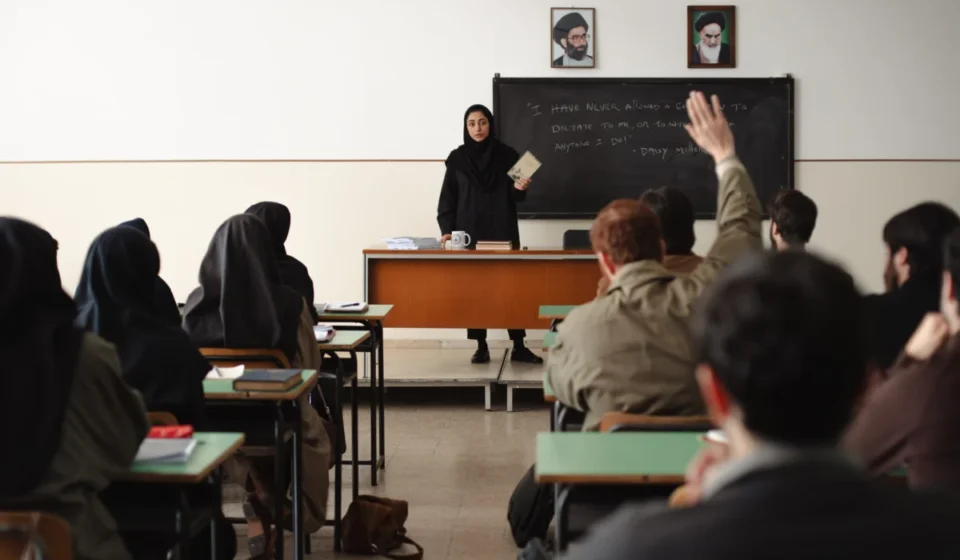
In the first timeline, we see a younger Nafisi navigating the increasingly hostile environment of the University of Tehran. As the theocratic grip on the nation tightened, her classrooms—once hubs of liberal academic inquiry—became battlegrounds. We witness her enduring harassment from both male colleagues and ideologically driven students who view Western classics, such as F. Scott Fitzgerald’s The Great Gatsby, not as literature, but as moral decay.
The second, and more prominent, timeline finds Nafisi in the mid-1990s as an academic exile. Having been forced out of her institutional position for refusing to comply with the regime’s strict mandates, she pivots to a more clandestine form of pedagogy. She invites a small, select group of female students into the safety of her home to discuss banned books. It is here that the film earns its title, as the act of reading becomes an act of rebellion.
The Power of the Page: Literary Analysis on Screen
The brilliance of the original memoir lies in how Nafisi uses these classic texts to mirror the internal lives of her students. The film makes a concerted effort to replicate this. Through their discussions of Vladimir Nabokov’s Lolita, the women begin to deconstruct the male gaze and the tendency of a patriarchal society to treat women as "blank canvases."
Similarly, the inclusion of Jane Austen’s Pride and Prejudice serves as a bridge, allowing the women to identify the universalities of courtship rituals and the societal cages built around women across centuries and cultures. The film’s most successful moments occur during these intimate apartment sessions. There is a palpable tension when the students realize that the narratives they are reading are not merely Western curiosities, but mirrors reflecting their own constraints and desires.

Technical Execution and Visual Storytelling
Riklis employs a somewhat rudimentary, albeit effective, visual shorthand to distinguish between the worlds of the film. The scenes occurring within the sanctuary of the book club are bathed in warm, saturated colors, suggesting a space of intellectual and emotional freedom. In stark contrast, the exterior world of Tehran is rendered in muted, muddy, and grayish hues, emphasizing the suffocating nature of the regime.
Golshifteh Farahani delivers a performance of remarkable nuance as Nafisi. She utilizes a subtle, expressive physicality—particularly the intensity in her eyes—to convey the internal fortitude of a woman trapped in a society that demands her silence. Her portrayal grounds the film, providing a much-needed emotional anchor when the script threatens to veer into didacticism.
The Meta-Problem: Preaching to the Converted
Despite these strengths, Reading Lolita in Tehran suffers from a fundamental structural flaw: it struggles to engage with an audience that does not already hold its core thesis as gospel. If one is drawn to a film about the emancipatory power of reading, it is highly probable that one is already an advocate for the humanities.
By failing to challenge the viewer or to present these literary arguments with a sense of critical rigor, the film settles for being a "reminder" rather than an investigation. When the screenplay references the intricate, layered depth of Nabokov or the razor-sharp social satire of Austen, the film inadvertently highlights its own lack of depth by comparison. The cinematic experience feels like a shadow of the literature it celebrates, lacking the very complexity that made the books masterpieces in the first place.
Contextualizing the Legacy of Azar Nafisi
To understand the film’s limitations, one must consider the cultural stature of the real-life Azar Nafisi. A beloved figure in contemporary literary criticism, Nafisi has spent her career arguing for the transcendent value of Western literature in regions where humanist messages are suppressed.
Born in Iran but educated in the West, her life is a testament to the intersection of two cultures. Her departure from the University of Tehran was a pivotal moment in her life, but it was not the end of her mission. She has continued to argue that the "universality of great novels" is not merely a Western construct, but a human necessity. The film captures this "evangelical" spirit—her commitment to spreading the gospel of literature—but in doing so, it loses the grit and the danger that made her memoir a global bestseller.

Implications for Contemporary Political Cinema
The reception of Reading Lolita in Tehran raises broader questions about how political movements are portrayed in modern cinema. There is a tendency to smooth over the jagged edges of historical struggle in favor of a digestible, inspirational narrative. While the film is certainly "correct" in its assertions—that reading can be a window to the outside world and that freedom of thought is a fundamental right—correctness is not the same as cinematic vitality.
For many, the film will serve as an accessible entry point into the realities of life under theocratic rule. However, for those seeking a deeper exploration of the psychological toll of exile or the messy, non-linear reality of intellectual resistance, the film may feel like a missed opportunity. It occupies a space of noble intention but fails to reach the heights of the works it so fervently champions.
Critical Assessment and Final Verdict
Reading Lolita in Tehran is a film defined by its contradictions. It is a movie about the power of literature that struggles to be literary; it is a story about rebellion that feels inherently safe. While the ensemble of actresses—who clearly believe in the film’s mission—delivers committed performances, the script keeps them tethered to a series of platitudes that prevent them from fully inhabiting the complexities of their characters.
Ultimately, the film succeeds as a gentle, well-meaning tribute to bibliophilia. It will undoubtedly please fans of Nafisi’s memoir who wish to see their favorite scenes brought to life with a competent, if uninspired, hand. Yet, for a broader audience, it serves as a reminder that some stories are better experienced on the page, where the reader’s imagination can provide the nuance that the screen so often flattens.
Grade: C+
A Greenwich Entertainment release, "Reading Lolita in Tehran" is now playing in select theaters. For audiences seeking to stay informed on the latest developments in global cinema and critical analysis, we recommend following the ongoing discourse within the broader film community.