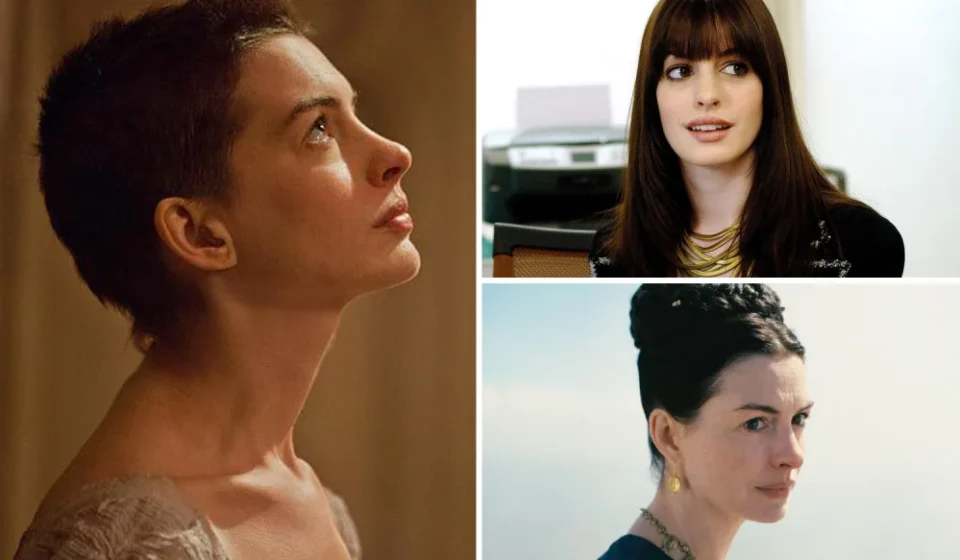
The Ever-Evolving Icon: Celebrating 25 Years of Anne Hathaway’s Cinematic Mastery

For over a quarter of a century, Anne Hathaway has occupied a singular space in the Hollywood firmament. From her wide-eyed, breakout debut as a teenage royal in San Francisco to the searing, raw vulnerability of her Oscar-winning turns, she has navigated the treacherous waters of child stardom and transitioned into one of the most formidable character actors of her generation. As she enters a career-defining 2026—highlighted by her highly anticipated reunion with Christopher Nolan in The Odyssey and the return to the world of The Devil Wears Prada—we examine the trajectory of an actress who has never stopped reinventing herself.

A Legacy of Versatility: The Early Years
Born in Brooklyn and raised in the suburbs of New Jersey, Hathaway’s path to superstardom was not a gradual climb, but a sudden, undeniable explosion. After cutting her teeth on the Fox family drama Get Real, she landed the role that would define the early 2000s for a generation of moviegoers: Mia Thermopolis in Garry Marshall’s The Princess Diaries (2001).

Playing the awkward, frizzy-haired teenager who discovers she is the heir to the Genovian throne, Hathaway demonstrated an innate comedic timing and a rare ability to anchor a high-concept premise with genuine humanity. Perhaps most impressively, she stood toe-to-toe with the legendary Julie Andrews. The chemistry was palpable, the film was a global phenomenon grossing over $160 million, and the blueprint for the “Anne Hathaway persona”—relatable, earnest, and deeply charismatic—was cast.

However, Hathaway was never content to remain a studio-friendly ingénue. Following the 2004 sequel, she began a deliberate pivot toward more challenging material, transitioning from the whimsy of Ella Enchanted (2004) to the heavy, emotional weight of Ang Lee’s Brokeback Mountain (2005). As Lureen Newsome, the wife of a man hiding a secret life, Hathaway proved she possessed a mature, devastating screen presence that transcended the “rom-com” label the industry had attempted to apply to her.

The Mid-Career Pivot: From Comedy to the Academy
The mid-2000s marked a professional metamorphosis. While 2006’s The Devil Wears Prada proved she could hold her own against the icy brilliance of Meryl Streep in a blockbuster environment, it was 2008 that truly signaled her arrival as an elite dramatic force.

In Jonathan Demme’s Rachel Getting Married, Hathaway portrayed Kym, a drug addict fresh out of a rehab facility, navigating the explosive interpersonal dynamics of her sister’s wedding. It was a performance stripped of all vanity—raw, confrontational, and deeply empathetic. The film earned her a Best Actress Oscar nomination, cementing her status as an actress who could inhabit the darkest corners of the human psyche with technical precision.

This technical mastery reached a fever pitch in 2012 with Tom Hooper’s adaptation of Les Misérables. As Fantine, a woman reduced to poverty and despair, Hathaway delivered an interpretation of "I Dreamed a Dream" that remains one of the most significant musical sequences in cinema history. Filmed in a single, gut-wrenching take, the performance earned her the Academy Award for Best Supporting Actress. She had effectively bridged the gap between Broadway-caliber performance and grounded, cinematic realism.

2026: A Landmark Year of Reunion and Re-emergence
As we move through 2026, Hathaway is experiencing what many industry analysts are calling the “Hathaway Renaissance.” Having spent the previous decade diversifying her portfolio—from the cerebral sci-fi of Interstellar (2014) to the slick, ensemble-driven Ocean’s Eight (2018) and the psychological tension of Eileen (2023)—she is now at the absolute peak of her powers.

The announcement of her reunion with Christopher Nolan for The Odyssey has sent ripples through the industry. Nolan, known for his penchant for demanding high-concept, high-stakes performances, has previously worked with Hathaway on The Dark Knight Rises and Interstellar. Their creative shorthand suggests The Odyssey will be a cornerstone of the 2026 awards circuit.

Simultaneously, the return to the Devil Wears Prada universe has delighted fans and critics alike. The sequel represents more than a nostalgic cash-grab; it serves as a meta-commentary on the evolution of the fashion industry and the shifting power dynamics of the workplace, themes Hathaway has explored with increasing depth throughout her recent filmography.

Supporting Data: By The Numbers
To understand Hathaway’s durability, one must look at the data. Since her 2001 debut, she has appeared in over 40 feature films, with a combined global box office gross exceeding $6 billion. More importantly, she has demonstrated a unique ability to bridge the gap between "prestige" cinema and "streaming" dominance.

Her 2024 film The Idea of You, released on Amazon Prime, became one of the platform’s most-watched original films of all time, proving that even after 25 years, her influence remains a powerful driver of audience engagement. Whether she is in a tentpole blockbuster or an intimate, low-budget character study, the "Hathaway Factor"—a mix of intense preparation and screen magnetism—consistently elevates the material.

Industry Perspectives and Critical Reception
Critics have long lauded Hathaway for her "chameleonic" ability. In a 2025 retrospective, film critic David Ehrlich noted: “Hathaway is perhaps the only actor of her generation who is as comfortable playing a princess as she is playing a woman in the throes of chemical dependency. She doesn’t just play roles; she reconstructs the internal architecture of her characters.”

Industry insiders suggest that her longevity is due to a rare combination of discipline and risk-taking. Unlike many of her contemporaries who chose to settle into comfortable niches, Hathaway has consistently sought out directors—such as Ang Lee, Jonathan Demme, and Christopher Nolan—who force her to evolve.

Implications for the Future
The implications of Hathaway’s current trajectory are significant for the landscape of modern Hollywood. As she enters the next chapter of her career, she is increasingly moving into producing roles, using her clout to champion stories that center on complex, mature women. Her work in The Idea of You and her upcoming projects indicate a move toward a more "authorial" phase of her career, where she is not just an employee of the studio, but a creative architect of her own image.

As The Odyssey nears its release, the conversation surrounding Hathaway has shifted from "the girl from The Princess Diaries" to "the institution of Anne Hathaway." She has survived the fickle nature of tabloid scrutiny, the pressure of the awards circuit, and the changing tides of theatrical distribution.

If the last 25 years have taught us anything, it is that Anne Hathaway does not simply follow the industry—she helps define its boundaries. Whether she is singing on a stage in 19th-century France or navigating the high-fashion boardrooms of New York, her commitment to the craft remains the gold standard. As she approaches this new pinnacle in 2026, the question is no longer whether she can deliver, but rather, what new territory she will conquer next.

Ranking the Best of Hathaway: A Summary
While the full ranking is a subject of endless debate among cinephiles, the consensus remains that her work in Rachel Getting Married, Les Misérables, and The Devil Wears Prada represents the "Holy Trinity" of her career. However, her recent turn in Eileen suggests that she is still finding new, darker, and more experimental avenues for her talent. As we look toward the future, one thing is certain: the Hathaway era is far from over; in many ways, it is only just reaching its most interesting phase.