The Gridiron and the Grave: Peter Berg’s ‘The Mosquito Bowl’ Struggles to Reconcile War and Sport

Since the release of Steven Spielberg’s Saving Private Ryan, the cinematic depiction of World War II has operated under a rigid, high-stakes template: the intersection of intimate, human terror and the sprawling, mechanical carnage of industrial warfare. Filmmakers have consistently sought to render the battlefield with a visceral intensity that bridges the gap between historical spectacle and personal trauma. Director Peter Berg, a filmmaker known for his rugged, kinetic approach to survivalist cinema, attempts to inject a new layer into this saturated genre with his latest Netflix epic, The Mosquito Bowl.
However, as the film navigates the transition from the collegiate gridiron to the blood-soaked beaches of Okinawa, it becomes clear that Berg’s ambition—to draw a parallel between the teamwork of football and the camaraderie of the military—struggles to find its footing, ultimately resulting in a production that is as conceptually confused as it is technically proficient.
The Premise: A Game Played in the Shadow of Death
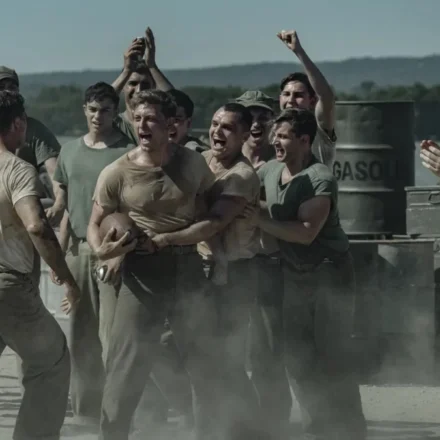
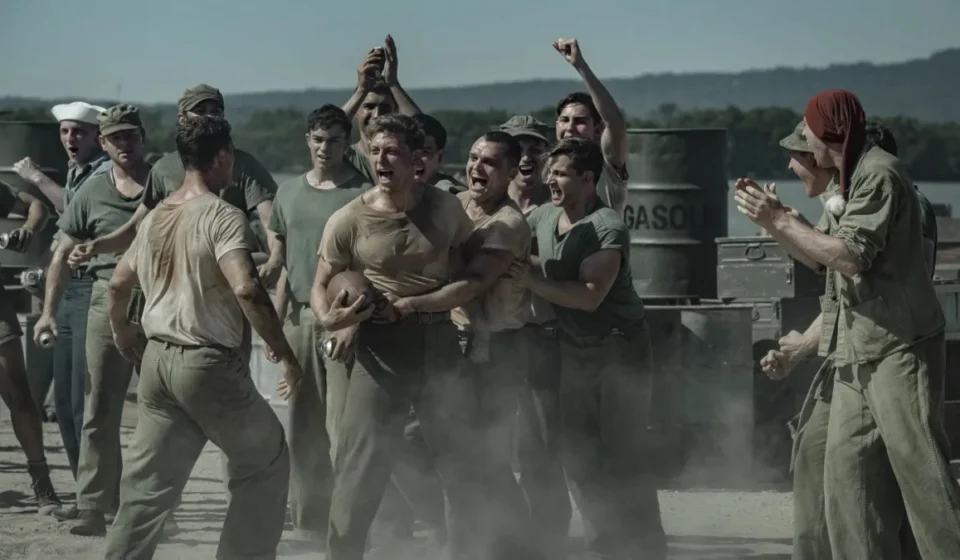
At the heart of the film is a historical footnote that borders on the surreal. On Christmas Eve 1944, as the Allied forces were preparing for the brutal assault on Okinawa, a group of soldiers—many of whom were former All-American college football stars—were ordered to participate in a high-stakes, morale-boosting game of two-hand touch.
The conceit is potent: these are young men in the prime of their athletic lives, possessing the physical grace and competitive fire of the era’s finest amateur athletes, now staring down the abyss of a conflict that would eventually claim many of them. For an eight-minute stretch in the middle of the film, Berg successfully leverages this irony. He presents a montage of impossibly athletic men playing a game of sport on a beach, a sequence that serves as a haunting prologue to their inevitable transition into cannon fodder. It is in these moments that the film glimpses the tragedy of "the greatest generation"—the senseless waste of talent, potential, and life. Yet, for the remainder of the 126-minute runtime, that profound waste is obscured by a narrative that fails to elevate its subjects beyond standard war-movie tropes.
Chronology of a Failed Synthesis
The narrative arc of The Mosquito Bowl is as predictable as the outcome of the battle it depicts. We are introduced to our protagonists—a collection of archetypal figures, from the stoic, square-jawed John McLaughry (Nicholas Galitzine) to the devil-may-care Bob Baumann (Bill Skarsgård)—in the halcyon days of their college football careers.
The film utilizes a sustained flash-forward, soundtracked by the shimmering, post-rock melancholy of Explosions in the Sky, to establish the emotional stakes. We know who survives; we know the cost. However, once the narrative shifts to Hawaii and the onset of military training, the film’s distinctive spark fades. The characters, once vibrant individuals with distinct motivations, are swallowed by the uniform.

The "Marine Corps as the greatest offensive line" metaphor is hammered home with a frequency that borders on the grating. While the film attempts to draw parallels between the training of an athlete and the training of a soldier, the logic collapses under scrutiny. War is not a game, and the film’s attempt to equate the two—often through dialogue that feels forced and modern—strips the combat of its unique, horrific reality, replacing it with a strange, fetishistic focus on the mechanics of death.
Supporting Data and Creative Choices
One of the most controversial creative decisions in the film is the casting of ESPN personality Pat McAfee as a drill instructor in the vein of R. Lee Ermey. It is a choice that highlights the film’s tonal dissonance; McAfee’s presence feels pulled from the world of contemporary sports entertainment, clashing violently with the somber, de-saturated aesthetic Berg employs for the combat sequences.
Furthermore, the film’s source material—a book by Buzz Bissinger—is treated with a lack of nuance. While Bissinger used the game as a lens to humanize the men involved, Berg and co-writer Mark L. Smith prioritize the kinetic "bang" of the battlefield over the quiet, essential bonds that defined these men’s relationships. The film is technically impressive, with handheld, naturalistic camera work that captures the claustrophobia of the Pacific theater, but it lacks the narrative depth required to make the audience mourn these characters as anything more than collateral damage.
A Lack of Contextual Depth
Perhaps the most significant failure of The Mosquito Bowl is its refusal to engage with the humanity of the "enemy" or the broader political implications of the war. While the film is quick to depict the Americans as both heroic and, at times, capable of monstrous behavior, it offers no window into the Japanese perspective, nor does it provide much insight into the individual motivations for enlistment.
The characters are rendered anonymous by the sea of shaved heads, and their civilian identities—the fact that they were stars, leaders, and men with futures—are largely forgotten as soon as the landing craft hit the beach. By the time the final act rolls around, the audience is left with a series of familiar images: snipers picking off characters we barely know, soldiers screaming in the mud, and the recurring, hollow realization that war is, indeed, hell.
Implications: The Limits of the Genre
The implication of The Mosquito Bowl is that the World War II genre, as it currently exists in Hollywood, has run out of new ways to tell its oldest story. By attempting to marry the high-octane excitement of professional sports with the grim reality of global conflict, Berg has inadvertently highlighted the shortcomings of both.

The film serves as a testament to the idea that some stories, even those rooted in historical fact, require more than just technical flair to resonate. It is not enough to show the horror; one must understand the human cost of the transition from civilian to soldier. In its current form, The Mosquito Bowl feels like a missed opportunity—a project that had the potential to be a character-driven, poignant meditation on youth and sacrifice but instead settled for being a loud, violent, and ultimately hollow exercise in genre mimicry.
Final Assessment: A Missed Touchdown
In the end, The Mosquito Bowl stands as a curious artifact of contemporary filmmaking. It is a movie that clearly loves its subjects, yet it refuses to spend the necessary time to actually know them. It is a movie that loves the "look" of war, yet it loses sight of the "why" of the struggle.
While individual performances—particularly that of Ray Nicholson as the magnetic Purdue fullback Tony Butkovich—provide brief flashes of what the film could have been, they are ultimately buried under the weight of a script that favors spectacle over soul. Peter Berg has delivered a film that is technically capable but thematically bankrupt, a piece of cinema that proves, quite violently, that the gridiron and the battlefield are worlds apart—and that pretending they are the same does a disservice to the memory of the men who walked both.
Grade: C
Netflix will release "The Mosquito Bowl" in theaters on Friday, October 30. It will be available to stream on the platform starting Wednesday, November 25.