A Lifetime of Luminosity: Ellen Burstyn Honored with Golden Lion at Venice Film Festival

The Venice Film Festival, a bastion of global cinematic prestige, played host to a poignant and triumphant moment on its historic Lido stage this week. Ellen Burstyn, the 93-year-old titan of the silver screen, was honored with the Golden Lion for Lifetime Achievement—a crowning recognition for a seven-decade career that has redefined the boundaries of performance art.
The ceremony was marked by grace, humor, and a profound sense of continuity as the industry gathered to pay tribute to a woman whose craft has shaped the landscape of modern acting.
The Ceremony: A Standing Ovation for a Living Legend
The atmosphere inside the Palazzo del Cinema was electric, yet softened by the vulnerability of the moment. Maggie Gyllenhaal, a contemporary luminary who directed the short film Flesh Impact—starring Burstyn as a reimagined Marilyn Monroe—took the podium to introduce the honoree.
“Ellen asked me to let you know that she recently took a fall,” Gyllenhaal told the audience, her voice steady but warm. “She’s OK, but she is moving more slowly—which is fine because it’ll give us more time to clap.”
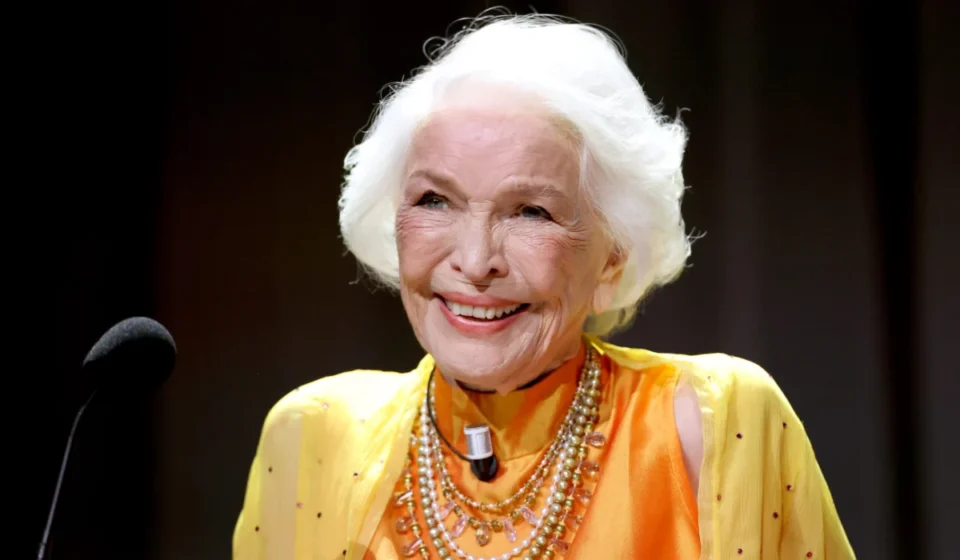
The audience needed little prompting. As Burstyn made her way to the stage, clad in a vibrant, radiant yellow gown and utilizing a walker, the room erupted into a spontaneous, thunderous standing ovation. Overcome by the reception, the nonagenarian paused, wiping away tears with a tissue.
“You’re making me cry!” she laughed, though the applause continued for several minutes. “You’re overwhelming me, you know! I don’t know how to recover from that generous greeting.”
A Chronology of Mastery: From Newcomer to Triple Crown Winner
To understand the weight of the Golden Lion, one must look at the foundation upon which Burstyn’s career was built. With a professional history spanning over sixty years, Burstyn is one of the few actors to achieve the “Triple Crown of Acting.”
Her decorated mantelpiece includes an Academy Award for her searing performance in Martin Scorsese’s 1974 classic Alice Doesn’t Live Here Anymore, a Tony Award for the 1975 production of Same Time, Next Year, and two Primetime Emmy Awards for her roles in Law & Order: Special Victims Unit (2009) and Political Animals (2013).
Her filmography reads like a syllabus for the history of American cinema:
- The 1970s: Burstyn cemented her status as a powerhouse with The Last Picture Show and the visceral, genre-defining The Exorcist.
- The 2000s: She delivered a performance of terrifying depth in Darren Aronofsky’s Requiem for a Dream, an act of vulnerability that earned her critical acclaim and global recognition.
- The Modern Era: Her collaboration with director Kornél Mundruczó on Pieces of a Woman (2020) and the upcoming Place to Be proves that her artistic curiosity remains unquenched.
Reflecting on the Path: Lessons from the White Line
During her acceptance speech, Burstyn moved beyond the standard tropes of industry gratitude, offering instead a philosophical reflection on what it means to reach the age of 93 in the public eye.
“At 93, it means you have a far amount of lifetime to look back on,” she mused. “I thought, maybe it’s not just a record of what you’ve accomplished, but what you’ve learned.”
She illustrated this with a vivid anecdote from the set of Alice Doesn’t Live Here Anymore. While filming a nighttime driving sequence, the production’s blocking meant she was essentially driving blind. “I couldn’t see the side of the road; I could go off and kill all of us,” she recounted. “But then I noticed, this is a two-way road. There’s a white line in the middle of the road, and I can see that. So all I have to do is look up to the left, and follow the white line. And that’s how I managed to not kill Martin Scorsese.”
The metaphor was not lost on the audience. Burstyn drew a sharp parallel between that moment of intense focus and the current climate of the United States. “I wanted to close out by saying how deeply appreciative I am of this Golden Lion and I hope—no, pray—that my own country will find its own white line.”
The Marilyn Monroe Connection: A Legacy Intertwined
The timing of the honor coincided with the debut of Gyllenhaal’s Flesh Impact, a 20-minute short dedicated to the memory of Marilyn Monroe on what would have been the icon’s 100th birthday. The film features Dakota Johnson as the famous Monroe, while Burstyn portrays the inner life of the actress—a version of the star rarely explored in public narratives.
Reflecting on her own, albeit brief, encounter with Monroe, Burstyn spoke with the reverence of a peer. “We never met. We saw each other once. We went to a nightclub, and she was sitting across from me,” she recalled. “She was such a magical creature. And then she looked at me and nodded at me. I was very early in my career, and I thought, was I just recognized by Marilyn Monroe?”
Burstyn later learned more about the star through Ralph Roberts, Monroe’s confidant and masseur. “He had lots of stories to tell me,” she said. “My favorite one was that her whole persona was a construction.” This understanding of the "constructed" nature of celebrity informs much of Burstyn’s own approach to her roles, emphasizing authenticity over artifice.
Implications: The Evolution of Gender in Hollywood
Beyond the personal accolades, Burstyn used the Venice platform to comment on the seismic shifts in the film industry regarding gender parity. Having worked in the business for over half a century, she noted that the landscape has changed "enormously."
“When I first started working, which was 150 years ago, there were no women on set. No women crew. No women directing. It was all men,” she explained. “If a woman was on set, it meant she was an actress. And then slowly, thanks to blessed Gloria Steinem, who just died, the consciousness started to be changed.”
While she acknowledged that the industry has not yet reached a perfect 50-50 split, she expressed optimism, noting that they are “close.” Her perspective serves as a bridge between the exclusionary practices of mid-century Hollywood and the more inclusive, albeit still evolving, landscape of today.
A Creative Philosophy: Why She Still Says "Yes"
When asked about her process for choosing projects at this stage in her life, Burstyn’s criteria remain as rigorous as ever. Her approach is rooted in emotional resonance rather than the demands of fame or commercial viability.
“When I get a script, I sit down and read it—and if it makes me laugh, that’s good. If it makes me cry, that’s good. If it makes me laugh and cry, that’s terrific,” she said. “By the time I finish the script, I have to feel moved in some way to say, ‘I want to do this.’”
This drive is evident in her upcoming project, Place to Be, a comedic drama starring Taika Waititi, Pamela Anderson, and Murray Bartlett. The trio, who were present at the Venice ceremony, were among the first to rise for her when she concluded her time on stage, underscoring the deep respect the younger generation of actors holds for her.
Conclusion: The Enduring Light
The Golden Lion for Lifetime Achievement is not merely a summary of Ellen Burstyn’s past; it is an acknowledgement of a career that continues to be defined by evolution. Whether she is recounting wisdom from Bette Davis—who once told her to view any obstacle to her work as an "enemy"—or finding the "white line" in a chaotic world, Burstyn remains a beacon of professional integrity.
As she stepped off the stage, surrounded by peers who have been influenced by her body of work, it was clear that for Ellen Burstyn, the work is never truly finished. She remains, as she has always been, a student of the human condition and a master of the craft. In the twilight of a legendary career, she continues to remind the world that true brilliance is not found in the spotlight, but in the dedication to the work itself.