
By Editorial Staff
August 9, 2026
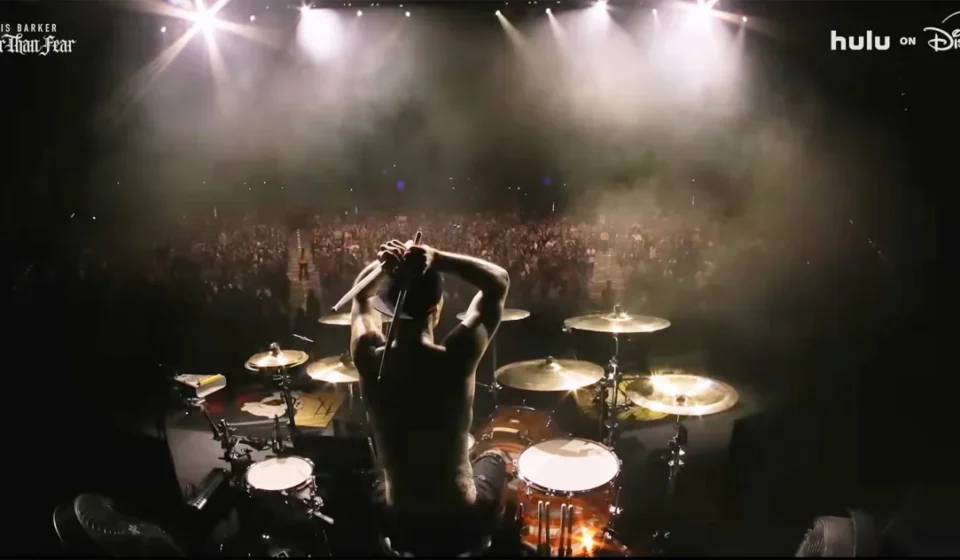
"Every hit is him communicating his story to the world." That is the haunting, rhythmic thesis statement behind Travis Barker: Louder Than Fear, the highly anticipated documentary chronicling the life, trauma, and meteoric career of the world’s most recognizable drummer. Following its successful debut at the 2026 Tribeca Film Festival, Hulu has officially released the main trailer for the film, confirming an August 13, 2026, streaming premiere on both Hulu and Disney+.
Directed by Justin Krook—known for his work on I’ll Sleep When I’m Dead—and Michael Dwyer, the film promises an unflinching look at the man behind the tattoos. While the public knows the face of Blink-182, Louder Than Fear seeks to peel back the layers of a complex figure who has spent his career navigating the thin, often blurred line between survival and surrender.
The Main Facts: A Portrait of Resilience
Travis Barker: Louder Than Fear is not a standard concert film or a chronological Wikipedia entry set to music. Instead, it is an intimate character study. The documentary traces Barker’s trajectory from his humble beginnings in Fontana, California—where he worked as a trash collector in Laguna Beach—to his transformation into the "driving pulse of a generation."
The narrative core of the film centers on the 2008 South Carolina Learjet 60 crash, a life-altering tragedy that left Barker with third-degree burns over 65% of his body. The documentary explores how this singular event recalibrated his entire existence, influencing not only his drumming style but his perspective on mortality, grief, and recovery. By focusing on the duality of his life—the high-octane stadium energy versus the quiet, agonizing recovery process—Krook and Dwyer offer a humanizing perspective on a man who has often been reduced to his public persona.

Chronology: From Fontana to Global Icon
To understand the weight of the documentary, one must look at the timeline of a life defined by rhythm and reinvention.
The Early Years and the Aquabats
Barker’s professional career began in earnest in 1996 with the ska-punk band The Aquabats. It was here that his distinctive, high-speed, and technically precise drumming style began to turn heads. However, his tenure was short-lived, as his immense talent could not be contained by the underground ska scene for long.
The Blink-182 Phenomenon
In 1998, Barker joined Blink-182 as a replacement drummer. His arrival marked the beginning of the band’s "golden era," characterized by the massive success of albums like Enema of the State and Take Off Your Pants and Jacket. Barker didn’t just join a pop-punk band; he redefined the role of the drummer in popular music, bringing a hip-hop sensibility and a sheer physical intensity that made him a global icon.
The 2008 Turning Point
The 2008 Learjet crash stands as the film’s central shadow. On the way back from a show in South Carolina, the plane failed to take off, crashing and killing four people. Barker’s survival was miraculous, but his psychological and physical recovery was a grueling, years-long process. The documentary highlights this period as the moment he transitioned from a musician seeking fame to a man seeking purpose.
The Solo Renaissance
In 2011, Barker released his debut solo album, Give the Drummer Some, an ambitious project that showcased his ability to transcend genre. By collaborating with rappers like Yelawolf, Asher Roth, and Nottz, he proved he was more than just a punk drummer—he was a producer and a sonic architect. This era is portrayed in the film as a testament to his refusal to let trauma silence his creative output.

Supporting Data: The Craft of the Documentary
The production team behind Louder Than Fear—led by Matthew Weaver of Media Weaver Ent. and Nick Stern—has curated an exhaustive look at Barker’s life. The film utilizes a combination of archival footage, never-before-seen home videos, and candid interviews with those in Barker’s inner circle.
Key Production Figures
- Justin Krook: Having directed Echoboom and A Fire Inside, Krook brings a proven ability to handle heavy, emotional subject matter with stylistic flair.
- Michael Dwyer: His background in gritty, reality-based narrative filmmaking (Hostile Border) provides a necessary grounding for a documentary that threatens to become overly romanticized.
- The Scope: The film serves as a tribute not just to Barker, but to the broader concept of perseverance. It features testimonials from cultural icons and collaborators who have witnessed Barker’s work ethic firsthand, emphasizing that his fame is merely a byproduct of his obsessive dedication to his craft.
Official Responses and Creative Intent
In a recent press statement regarding the release of the trailer, the directors noted that the film was intended to be "a tribute to those who keep going when the music almost stops."
The film’s marketing campaign has heavily emphasized the "raw and redemptive" nature of the journey. By framing Barker as a man fighting the "thin line between survival and surrender," the producers are signaling to audiences that this is not a feel-good celebrity documentary. It is an exploration of pain. Barker himself has remained relatively private about the deeper traumas of his life for years, making this documentary a significant departure for the artist. His participation suggests a level of transparency that fans have been craving for decades.
Implications: Why This Documentary Matters Now
The release of Travis Barker: Louder Than Fear comes at a time when the music industry is increasingly interested in the "behind-the-curtain" lives of its biggest stars. However, this documentary carries a specific weight due to the cultural evolution of mental health awareness.
The Normalization of Trauma
By centering a high-profile figure like Barker, the documentary plays a role in the ongoing conversation about trauma and recovery in the public eye. For a generation of fans who grew up listening to his music during their own formative years, seeing Barker navigate the long-term effects of his 2008 crash offers a relatable, if intense, example of resilience.

A Masterclass in Genre-Bending
From a musical standpoint, the documentary underscores Barker’s role in breaking down barriers between genres. His career serves as a roadmap for the modern musician, showing that one can pivot from pop-punk to hip-hop, to electronic music, and beyond, provided the fundamental passion remains the same.
The Streaming Era of Rock Docs
Hulu’s decision to position this film for a global streaming release on Disney+ signifies the shifting landscape of documentary distribution. Once relegated to film festivals and limited theatrical runs, rock documentaries are now finding massive, immediate audiences on streaming platforms. Louder Than Fear is poised to be one of the most-watched music documentaries of 2026, serving as both a legacy piece for Blink-182 fans and a discovery piece for a younger generation who may only know Barker through his current high-profile collaborations.
Conclusion: Experience the Sound of Survival
As the trailer suggests, "Experience a life louder than fear." Whether you are a lifelong fan of his drumming, a follower of his high-profile life, or simply someone interested in the psychology of survival, this documentary offers a compelling, visceral experience.
The film does not shy away from the darker elements of the drummer’s life, nor does it attempt to gloss over the immense effort required to continue creating art in the face of tragedy. It is a story about the man behind the tattoos, the man behind the drum kit, and the man who, when faced with the absolute worst, chose to keep the rhythm going.
Travis Barker: Louder Than Fear premieres on Hulu and Disney+ on August 13, 2026. For those who want to understand how a person builds a legacy out of the debris of a crash, this is essential viewing.