Beyond the Frame: Cristobal León and Joaquín Cociña’s Donkey Princess Redefines Hybrid Cinema

When directors known for the meticulously crafted, tactile worlds of animation attempt to bridge the gap into live-action filmmaking, the transition is rarely seamless. The history of cinema is littered with the ambitious experiments of visionaries who found that the "flesh-and-blood" reality of live-action sets often acted as a creative straightjacket. While some, like Mamoru Oshii (The Red Spectacles) or Brad Bird (Mission: Impossible – Ghost Protocol), managed to successfully translate their visual sensibilities to the physical realm, others found that their specific, controlled aesthetic was better suited to the boundless possibilities of the frame-by-frame medium.
Yet, a new paradigm is emerging: the hybrid feature. Rather than abandoning their roots, directors like Chilean duo Cristobal León and Joaquín Cociña are embracing a synthesis of techniques. Following their unsettling 2018 stop-motion masterpiece The Wolf House and their 2024 political foray The Hyperboreans, the pair has returned with Donkey Princess. Premiering at the 2026 Locarno International Film Festival, the film serves as a definitive statement on the future of mixed-media storytelling.
The Evolution of the Hybrid Aesthetic
For decades, the "live-action adaptation" of an animator’s sensibilities has been fraught with compromise. Henry Selick’s James and the Giant Peach famously relied on live-action bookends to frame its stop-motion core, essentially functioning as an animated feature in disguise. In contrast, Donkey Princess integrates the two mediums so thoroughly that the boundary between the physical performer and the simulated environment becomes intentionally porous.
León and Cociña have effectively weaponized their budget to expand their canvas. Where The Hyperboreans utilized puppetry and set design to interrogate the dark historical legacy of Miguel Serrano, Donkey Princess takes a more universal, albeit deeply surreal, approach. The duo has crafted a film that feels both like a sprawling epic and a claustrophobic, macabre diorama, proving that their transition to live-action is not a abandonment of their roots, but an evolution of their craft.
A Chronology of Chaos: The Narrative Framework
Donkey Princess takes its structural inspiration from the classic French fairytale Donkeyskin, most famously adapted by Jacques Demy. However, León and Cociña strip away the musical whimsy of the original, replacing it with a darker, more existential dread.
The Genesis of the Curse
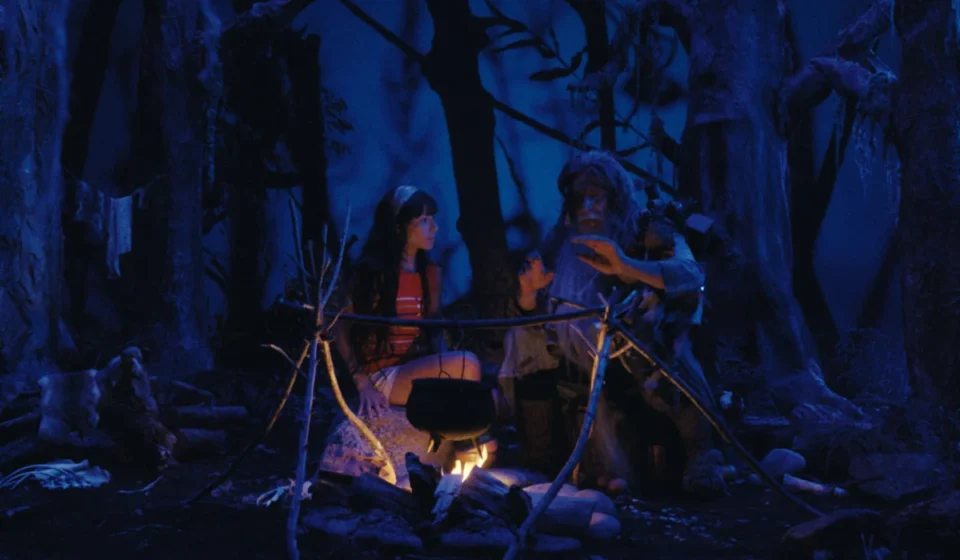
The narrative begins in a kingdom that functions as a fairytale reimagining of Chile—a place where the king, paralyzed by the grief of his wife’s death from the plague, has outlawed the "disease" of love. The visual language here is distinctly Leónean: characters traverse sets that feel plucked from a Laika production, skies are peppered with 2D-animated birds, and forest sequences utilize the silhouette-style animation reminiscent of Lotte Reiniger.
The Mechanism of Displacement
The inciting incident involves Diana (Antonia Giesen), a princess stifled by her father’s (Francisco Melo) obsession with their deceased matriarch. Her life is upended by Lalo (Andrew Bargsted), an outsider who appears at her birthday party via a mysterious magical bracelet gifted by a desert hermit. The bracelet acts as the film’s central narrative engine: when pressed, it transports the wearer—and their consciousness—to another version of themselves in a different time and place.
The Multiversal Reiteration
As the narrative progresses, the film shifts through various "kingdoms." In one, Diana finds herself in a contemporary urban landscape, working in pest control to combat a bat infestation while the government enforces a health-crisis curfew. In another, she is a television actress trapped in a literal donkey costume, forced to perform for the entertainment of a desensitized public. Each segment adopts a new genre aesthetic, constantly playing with the artifice of film history itself.
Supporting Data: Stylistic Influences and Comparisons
The film invites inevitable comparisons to Bertrand Bonello’s The Beast, which similarly explored the malleability of consciousness across disparate timelines. However, where The Beast leaned into a cold, sci-fi dread, Donkey Princess maintains a visceral, tactile warmth—or perhaps, a visceral, tactile horror.
The technical execution of these shifts is a masterclass in production design. The film treats the "glitch" in reality not as a visual effect, but as a textural change. In the urban timeline, the background traffic moves with the frenetic, stylized velocity of the Spider-Verse films, creating a jarring juxtaposition against the live-action performers. The film’s ability to pivot from fairytale pastoralism to modern, gritty malaise suggests a level of directorial control that is rare for a sophomore live-action effort.
Official Responses and Industry Reception
Critical reception at Locarno has been largely laudatory, specifically highlighting the film’s "viscerally upsetting" practical effects. While the final act has been noted for a slight dip in momentum—a common pitfall in high-concept, consciousness-hopping narratives—the consensus is that the film’s conclusion provides a haunting, albeit grueling, payoff.
Industry insiders have noted that Donkey Princess represents a significant financial risk that pays off in artistic dividends. By maintaining their unique, "macabre" vision, León and Cociña have positioned themselves as auteurs capable of scaling their work without diluting their signature style. The film is currently seeking U.S. distribution, a process that is expected to be competitive given the buzz surrounding the directors’ ability to balance arthouse sensibilities with a more accessible, albeit dark, fairytale premise.
Implications: The Future of Mixed-Media Cinema
The success of Donkey Princess raises a vital question for the industry: Is the future of high-concept cinema a hybrid one? By blending stop-motion techniques with traditional live-action, León and Cociña have bypassed the "uncanny valley" often associated with pure CGI. They have created a world that feels tangible, even when it is physically impossible.
The Shift Toward "Tangible" Surrealism
As audiences grow weary of the homogenized aesthetic of high-budget green-screen blockbusters, the "tactile" approach favored by León and Cociña offers a refreshing alternative. Their use of practical effects, crunching sound design, and hand-crafted animation textures provides an immersive experience that digital effects struggle to replicate.
The Potential for Horror
Perhaps most telling is the film’s final sequence, which utilizes practical body-horror effects with a level of grit that has left even seasoned festival-goers unsettled. If the directors choose to pursue the horror genre in future projects, they have already laid the groundwork for a masterclass in practical, visceral terror.
Donkey Princess is not just a film; it is a proof-of-concept. It demonstrates that the transition from animation to live-action does not require a filmmaker to "grow up" or abandon the tools that defined their early career. Instead, it proves that when these tools are applied with surgical precision, they can elevate live-action filmmaking into something entirely new—a medium where the laws of physics, time, and biology are merely suggestions, subordinate to the director’s singular, imaginative vision.
As the film moves toward a wider release, it stands as a testament to the endurance of the "big swing." In an era of safe bets and franchise reboots, León and Cociña have delivered a work that is defiantly strange, structurally complex, and undeniably their own. Whether or not it finds a massive commercial audience, it has already secured its place as a landmark achievement in the evolving landscape of contemporary world cinema.