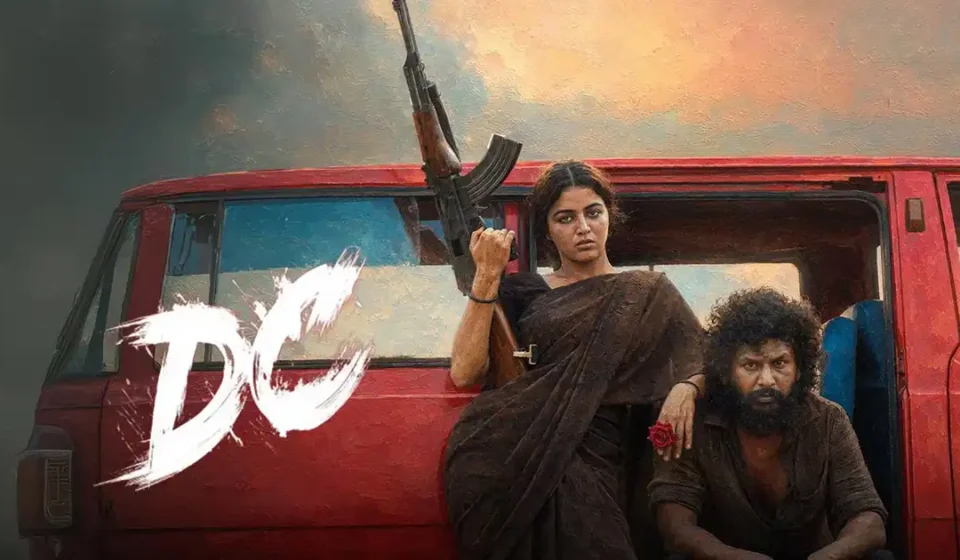
"DC" Unleashes a Raw, Electrifying Debut for Lokesh Kanagaraj, Igniting Theatrical Screens

Chennai, India – August 7, 2026 – The cinematic landscape of South India is abuzz this week with the highly anticipated release of "DC," a mass action drama that not only promises high-octane thrills but also marks the intriguing acting debut of one of the industry’s most celebrated directors, Lokesh Kanagaraj. Under the meticulous direction of Arun Matheswaran, and propelled by the inimitable musical genius of Anirudh Ravichander, "DC" has stormed into theaters, garnering significant attention and a respectable 3.25/5 rating from 123telugu.com, cementing its place as a compelling weekend watch.
Produced by the esteemed Sun Pictures, the film boasts a formidable ensemble cast including Wamiqa Gabbi, Sanjana Krishnamoorthy, and the formidable Guru Somasundaram, all contributing to a narrative steeped in grit and raw emotion. "DC" arrived with a palpable sense of curiosity, not merely due to its star-studded technical crew but primarily for the bold step taken by Lokesh Kanagaraj, whose directorial ventures have consistently redefined action cinema. The transition from behind the camera to front and center of the action has been a focal point of discussion, and early critical reception suggests he has navigated this challenging pivot with remarkable confidence.
The Genesis of "DC": A Chronicle of Crime, Betrayal, and Vengeance
The journey into the heart of "DC" begins in the turbulent year of 2011, set against the rustic yet volatile backdrop of the Chittoor region. From its opening frames, director Arun Matheswaran establishes a world where law and order teeter on the brink, immediately plunging the audience into a gripping sequence: a meticulously planned, brutal attack by a criminal gang on police vehicles, culminating in the audacious looting of state-held weapons. This audacious act sets the stage for the narrative, introducing Devadas, portrayed by Lokesh Kanagaraj, as one of the integral members of this formidable outfit.
The initial heist, while shocking, escalates into a full-blown crisis for the police department when the investigating officer assigned to the robbery case is brutally murdered. This act of cold-blooded violence transforms a simple robbery investigation into a high-stakes manhunt, posing a significant challenge to the authorities. The department, reeling from the loss and public pressure, assigns a seasoned and resolute police officer, Bhogaraju, to the seemingly insurmountable task of apprehending the elusive gang.
As the plot unfolds, the narrative delves deeper into the motivations behind the gang’s ruthlessness and Devadas’s personal journey within this chaotic world. The film meticulously charts his trajectory, exploring the profound losses he endures and the unexpected gains he accrues throughout his perilous path. A significant turning point in Devadas’s life, and indeed the film’s emotional core, arrives with the introduction of two pivotal female characters: Chandra, played with nuanced grace by Wamiqa Gabbi, and Parvathi, brought to life with charming brevity by Sanjana Krishnamoorthy. Their entry into Devadas’s life is not merely coincidental; their roles are intricately woven into the fabric of the story, influencing his decisions, challenging his resolve, and ultimately shaping the unfolding drama.
The central questions that propel "DC" forward are manifold: What drove the gang to murder the investigating officer, escalating their crimes to an unprecedented level? What personal stakes does Devadas truly have in this perilous journey, and what price does he pay for his involvement? Does the relentless pursuit by officer Bhogaraju and his team finally yield results, leading to the capture of the notorious gang? And perhaps most compellingly, how do Chandra and Parvathi, two seemingly disparate women, impact Devadas’s destiny and the ultimate outcome of the police’s relentless pursuit? These intricate threads are skillfully unspooled across the runtime, promising a compelling resolution on the big screen.
The film’s pre-release buzz was heavily fueled by the intriguing prospect of Lokesh Kanagaraj stepping into an acting role. Known for his grounded yet stylised action narratives as a director, the industry and audience alike speculated on how his own intense vision would translate to his on-screen persona. Coupled with Arun Matheswaran’s distinct directorial voice, previously showcased in critically acclaimed works, and Anirudh Ravichander’s proven track record of elevating narratives with his electrifying scores, "DC" was positioned as a cinematic event designed to push boundaries. The trailers and promotional materials, particularly showcasing Anirudh’s music, effectively built anticipation for a gritty, uncompromising action experience.
A Symphony of Strengths: Unpacking "DC"’s Cinematic Prowess
"DC" emerges as a film whose strengths are not just noticeable but deeply ingrained in its very structure, driven by a confluence of exceptional talent both in front of and behind the camera.
The Masterful Hand of Arun Matheswaran: The undisputed cornerstone of "DC"’s success lies in Arun Matheswaran’s gripping screenplay. It is a narrative woven with precision, maintaining a tight structure that rarely falters. Matheswaran’s ability to present situations from multiple perspectives – much like examining both sides of a coin – is particularly noteworthy. This nuanced approach adds layers of complexity to the characters and their motivations, ensuring that the emotional beats resonate profoundly with the audience. His direction is a testament to controlled intensity, delivering impactful moments that often catch viewers off guard and keep them thoroughly invested, defying any modest expectations generated by initial promos.
Lokesh Kanagaraj’s Commanding Debut: The transition from acclaimed director to compelling lead actor is a tightrope walk few attempt, let alone master on their first try. Lokesh Kanagaraj, however, makes a remarkably confident and impressive acting debut as Devadas. He embodies the rugged, morally ambiguous protagonist with an authenticity that belies his lack of prior acting experience. His physical presence is commanding, his expressions convey a world of internal conflict, and he completely inhabits the character, making Devadas’s journey intensely believable. This debut suggests a latent talent that could see him pursuing a dual career path with considerable success.
Anirudh Ravichander: The Unsung Hero: If Matheswaran provides the narrative backbone and Kanagaraj the beating heart, Anirudh Ravichander is the film’s very soul. His outstanding musical score is not merely a backdrop; it is an active participant, significantly elevating "DC" to another echelon. Whether through his pulsating background score or the strategically placed songs, Anirudh consistently enhances the narrative with his distinctive sound. Special mention must be made of specific sequences where his music becomes almost a character in itself: the electrifying interval block, Lokesh’s powerful entry during the climax, and a key emotional sequence involving Wamiqa Gabbi are all propelled into brilliance by Anirudh’s masterful compositions, cementing his reputation as a true cinematic alchemist.
Stellar Ensemble Performances: The supporting cast of "DC" shines brightly, providing robust pillars for the central narrative. Wamiqa Gabbi delivers a substantial and nuanced performance as Chandra. Despite playing a relatively subtle character, her emotional depth and restraint impress, particularly in several crucial scenes in the second half that resonate powerfully. Sanjana Krishnamoorthy, though afforded limited screen time as Parvathi, leaves a pleasant and memorable impression with her charming presence.
However, it is Minnal Murali actor Guru Somasundaram who truly surprises and captivates as the antagonist. His portrayal is both chilling and compelling, creating a formidable foil for Devadas. His confrontation scenes with Lokesh and his gang are among the film’s most engaging, imbued with a raw intensity that keeps the audience on edge. The rest of the supporting cast also delivers convincing performances, adding authenticity and depth to the film’s world.
Technical Brilliance: "DC" is a visual and auditory feast, a testament to the high production values of Sun Pictures. The film maintains a natural visual aesthetic throughout, enhancing its gritty realism. Mukesh G’s cinematography is exceptional, capturing the raw intensity of the action sequences and the subtle emotional shifts with equal finesse. G.K. Prasanna’s crisp editing ensures a tight, relentless pace, allowing the story to unfold without unnecessary lulls and keeping the audience thoroughly engaged from start to finish. Every technical aspect converges to create an immersive and visceral cinematic experience.
Navigating the Shadows: "DC"’s Areas for Improvement
While "DC" undeniably delivers a potent cinematic punch, it is not without its minor imperfections, which, though not debilitating, do prevent it from achieving absolute perfection.
A Familiar Core Premise: The primary criticism leveled against "DC" is that its core premise, despite the fresh execution, is neither particularly novel nor strikingly original. The narrative threads of a morally ambiguous protagonist caught in a web of crime and retribution, pursued by relentless law enforcement, are well-trodden paths in action cinema. While director Arun Matheswaran’s engaging screenplay largely compensates for this familiarity, certain discerning viewers might find themselves anticipating plot points, diminishing the element of surprise.
Echoes of "Jai Bhim": Adding to the sense of familiarity are certain portions involving the police department that bear a striking resemblance to the stylistic and thematic approach of the acclaimed film "Jai Bhim." While "DC" tackles a different narrative, the depiction of police procedural, the gritty realism, and the underlying tension in these specific scenes evoke a sense of déjà vu. This stylistic overlap, while perhaps unintentional, makes those segments feel somewhat less distinct and original within the context of "DC."
The Elusive Villain-Hero Conflict: Another noticeable drawback lies in the less-than-robust establishment of the conflict between the protagonist, Devadas, and the antagonist, portrayed by Guru Somasundaram. While Guru Somasundaram delivers a captivating performance, the narrative struggles to convincingly build a strong, clear-cut rivalry. After a certain point, the villain’s almost obsessive focus on the protagonist raises questions that the film doesn’t fully address. This underdeveloped antagonism impacts the overall narrative tension, as the audience might struggle to fully grasp the depth of their animosity or the ultimate stakes of their confrontation. A more compelling and clearly defined cat-and-mouse game, with stronger underlying motivations for the villain’s fixation, could have significantly amplified the film’s impact.
Industry Voices and Creative Intent: The Making of "DC"
The making of "DC" was a collaborative endeavor, driven by a shared vision for a grounded yet thrilling action drama. While direct "official responses" are often guarded before or immediately after release, the film’s quality allows for inference into the creative team’s intent.
Director Arun Matheswaran, known for his unique narrative voice, likely aimed to infuse a familiar genre with his distinctive visual language and character-driven approach. His focus on a "gripping screenplay" and "impactful moments" suggests a deliberate effort to elevate the material beyond standard action tropes. One could imagine Matheswaran speaking about the challenge of balancing raw realism with cinematic flair, ensuring that while the story is gritty, it remains emotionally resonant. "We wanted to explore the moral ambiguities inherent in such a world," he might have stated in an interview, "and to show that even in chaos, human connections and motivations drive the narrative."
For Lokesh Kanagaraj, stepping into the acting arena must have been a profoundly personal and challenging experience. As a director accustomed to shaping every frame, becoming a character within someone else’s vision required a different kind of surrender. He might have articulated his motivation as a desire to explore storytelling from a fresh perspective, or perhaps a long-held ambition to portray a character that resonated deeply with him. "It was an incredible learning experience," Lokesh could have said, reflecting on his debut. "Arun is a brilliant filmmaker, and I trusted his vision completely. Playing Devadas allowed me to understand the nuances of performance in a way I hadn’t as a director."
Sun Pictures’ decision to back "DC," especially with a director making his acting debut, speaks volumes about their confidence in the project’s creative team and its commercial potential. Their investment in high production values and technical excellence underscores a commitment to delivering a premium cinematic experience. A producer might highlight the collaborative spirit: "We believed in Arun’s script and Lokesh’s incredible talent, both as a director and now as an actor. Our goal was to provide the canvas for their vision to truly shine."
Anirudh Ravichander, whose music is a highlight, likely approached "DC" with a keen understanding of its gritty tone and emotional undercurrents. His work showcases a blend of high-energy tracks and melancholic scores, perfectly mirroring the film’s dual nature. He might have described his process as finding the "sonic heartbeat" of the film, ensuring that his compositions were always serving the narrative and character arcs.
The Ripple Effect: Implications for South Indian Cinema
"DC" arrives at a fascinating juncture for South Indian cinema, and its reception carries several significant implications for the industry and the careers of those involved.
Lokesh Kanagaraj’s Dual Path: The most immediate implication is for Lokesh Kanagaraj’s career. His impressive acting debut opens up a compelling dual career path. If "DC" proves to be a commercial success alongside its critical appreciation for his performance, it is highly probable that he will be sought after for more acting roles. This could see him balancing his acclaimed directorial ventures with selective acting projects, potentially following in the footsteps of multi-talented figures who successfully navigate both creative roles. His acting persona, characterized by intensity and authenticity, could carve a niche for him in roles demanding gravitas and a certain rugged charm. However, the challenge will be to manage both roles without diluting his unique directorial brand, which has garnered him a dedicated fanbase.
Arun Matheswaran’s Ascendancy: "DC" further solidifies Arun Matheswaran’s position as a director with a distinct vision and a knack for crafting engaging, intense narratives. His ability to deliver a tightly structured, emotionally resonant film, even with a somewhat familiar premise, underscores his directorial prowess. The success of "DC" will likely grant him greater creative freedom and access to larger budgets for his future projects, allowing him to further explore his unique storytelling style within the action-drama genre or beyond. He could become a go-to director for projects requiring a blend of realism and high-stakes drama.
Anirudh’s Unwavering Reign: Anirudh Ravichander’s contribution to "DC" is yet another testament to his unparalleled talent and his status as one of the most sought-after music directors in contemporary Indian cinema. His ability to consistently elevate films with his innovative scores ensures his continued dominance in the industry. "DC" simply adds another jewel to his crown, reinforcing the fact that his musical prowess is a significant draw for audiences and a crucial component for a film’s overall impact.
The Evolution of Mass Action Drama: "DC" contributes to the ongoing evolution of the mass action drama genre in South Indian cinema. While retaining the core elements of high-octane action and dramatic stakes, films like "DC" demonstrate a growing emphasis on nuanced screenplays, character depth, and strong technical execution. This trend suggests a move towards more refined and sophisticated action films that appeal to a broader audience beyond just hardcore genre fans, demanding more from their narratives and performances.
The Power of Technical Craftsmanship: The film’s strong technical aspects – from Mukesh G’s cinematography to G.K. Prasanna’s editing and Sun Pictures’ production values – highlight the critical role that a skilled technical team plays in a film’s success. "DC" serves as a reminder that even with a strong narrative and performances, the visual and auditory experience is paramount in captivating modern audiences.
In conclusion, "DC" is more than just a theatrical release; it’s a significant marker in the evolving landscape of South Indian cinema. It champions the versatile talent of Lokesh Kanagaraj, reaffirms Arun Matheswaran’s directorial prowess, and celebrates Anirudh Ravichander’s musical genius. While its thematic familiarity and some narrative aspects could have been refined, the film’s engaging execution, powerful performances, and technical brilliance make it a compelling watch. "DC" stands as a testament to the power of collaborative filmmaking, delivering a gripping mass action drama that is poised to resonate with audiences and spark further conversations about the future trajectories of its key creators.
123telugu.com Rating: 3.25/5
Reviewed by 123telugu Team