The Provocateur’s Mirror: Inside Gregg Araki’s Audacious New Film ‘I Want Your Sex’

In the landscape of contemporary independent cinema, few directors have consistently challenged the boundaries of desire, morality, and identity quite like Gregg Araki. From his early days as a cornerstone of the New Queer Cinema movement to his genre-bending explorations of youth culture, Araki has always favored the visceral over the didactic. His latest feature, I Want Your Sex, continues this tradition, offering a razor-sharp, neon-soaked examination of power dynamics, artistic ego, and the shifting sexual landscape of the digital age.
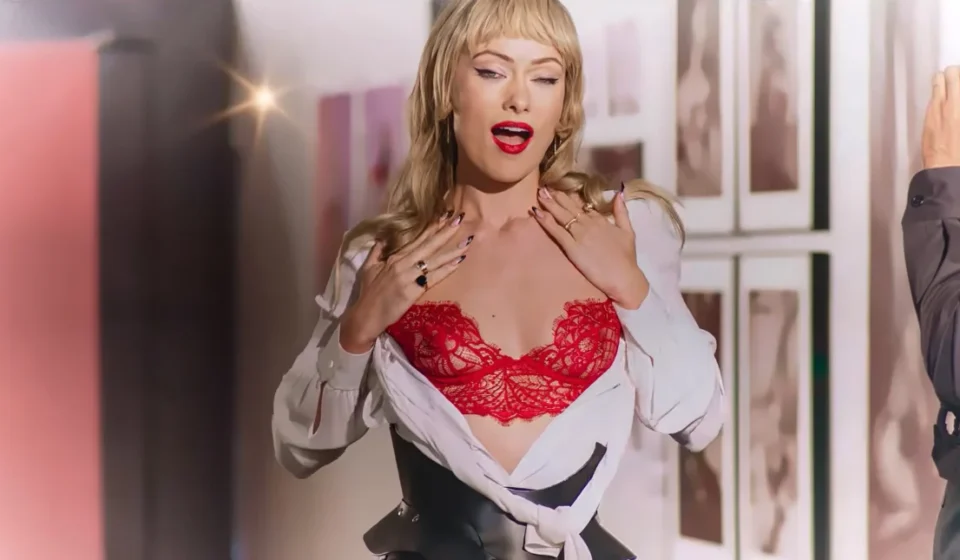
Starring Olivia Wilde as the enigmatic artist Erika Tracy and Cooper Hoffman as her unsuspecting, younger assistant Elliot, the film is a deliberate Rorschach test. It is a work that manages to be simultaneously hilarious, erotic, and deeply uncomfortable, leaving audiences to grapple with a central, gnawing question: Is Erika a visionary mentor or a predatory narcissist?
Main Facts: A Study in Power and Provocation
At its core, I Want Your Sex follows the volatile professional and personal entanglement between an established, avant-garde artist and her eager, naive assistant. Erika Tracy is a woman defined by her work—art that is as erotically charged as it is intentionally outrageous. As she pulls Elliot into her orbit, the film begins to deconstruct the blurred lines of consent, professional hierarchy, and the transactional nature of modern mentorship.
The film, which arrives in theaters on July 31 via Magnolia Pictures, is not designed to provide easy answers. Instead, it invites the audience to become active participants in the moral ambiguity on screen. Wilde’s performance is a masterclass in calculated precision; every glance and gesture is tuned to elicit maximum comedic and dramatic effect, ensuring that the viewer never quite lands on a definitive judgment of her character.
A Chronology of Creation: From Concept to Screen
The path to I Want Your Sex was neither linear nor traditional. For Gregg Araki, the genesis of the project began as a reaction to the cultural zeitgeist. Following a series of reports and articles highlighting a decline in sexual activity among Gen Z, Araki found himself both perplexed and inspired.

"Sex has been a really integral part of my journey as a person, and as an artist and filmmaker," Araki noted in an exclusive interview for the Filmmaker Toolkit podcast. "It’s really what formed me. So when Erika and Elliot are sitting on the couch talking about this, it’s literally what I would say: ‘You guys are all about FOMO, and you don’t care about missing out on the sexual prime of your lives?’"
The script underwent a significant evolution during its development phase. Originally, the gender dynamics were reversed, with a male artist and a female assistant. However, in the post-#MeToo era, Araki felt a shift was necessary. He expressed a desire to move away from the traditional power dynamics often seen in cinema—specifically, the trope of a woman being "dragged around by the hair." He noted that he did not want to propagate imagery that felt regressive, even within the context of a fictional, consensual relationship. By flipping the roles, Araki found a more compelling, fresh narrative vein: the exploration of the female "Dom" versus the male "sub," a dynamic he found both intellectually stimulating and creatively liberating.
Supporting Data: The Anatomy of a Character
To understand the complexity of the film, one must look at the specific DNA of the protagonist. Araki characterizes Erika Tracy as a blend of "Madonna meets Robert Mapplethorpe"—a figure defined by a larger-than-life presence that makes her irresistible to the younger, less experienced Elliot.
Araki admits that, despite her narcissism and her "a little nuts" persona, Erika is a profound mouthpiece for his own views. "A lot of the things that Erika Tracy says in the first interview when Elliott is watching her on the laptop, they’re literally quotations of things that I’ve said in interviews," the director confessed. This adds a meta-textual layer to the film; Erika is not merely a character, but an avatar for the director’s own history of being a provocative, often polarizing figure in the art world.
The casting process was perhaps the most critical hurdle. Araki knew the role of Erika required a performer who was entirely fearless. During his initial meeting with Olivia Wilde, he set the stakes clearly: the character had to be someone who "just can’t give a f—k." Wilde, according to Araki, immediately grasped the nuance. She understood that playing a character who abuses her power—while simultaneously acting as a mentor—required a level of detachment from the audience’s moral judgment. Her ability to "jump in the pool" and embrace the darker, more questionable facets of Erika is what anchors the film’s success.

Official Responses and Creative Intent
The director has been vocal about his desire to avoid "lecturing" the audience. In his view, the theater should be a space for collision rather than consensus.
"The movie is a wild and crazy ride—it’s meant to be entertaining and fun and pop," Araki explained. "But at the same time, it does have a lot of things on its mind, a lot of sort of conversation starters. And that’s what I hope, that people will have a good time and be entertained, but also leave the theater and start to talk about it, argue about it, get into fights about it."
This approach to filmmaking—using the screen to spark debate—is a hallmark of Araki’s career. By embedding his own frustrations with modern apathy regarding intimacy into the dialogue of the film, he creates a friction that forces the audience to confront their own biases. Are we judging Erika because of her gender? Are we protecting Elliot because of his youth? These are not questions the film answers; they are questions the film forces the viewer to ask of themselves.
Implications: The Legacy of ‘I Want Your Sex’
The implications of I Want Your Sex extend beyond its immediate box-office performance. By addressing the "sexual recession" and the complex intersections of art and power, the film positions itself as a significant entry in the discourse surrounding modern relationships.
Cultural Significance
The film arrives at a time when the conversation around power dynamics in professional spaces is at a fever pitch. By choosing a female protagonist who occupies a position of dominance, Araki challenges the audience to look past the surface-level tropes of the "predator." It invites a nuanced discussion about whether power in a relationship is inherently corruptive, or if it can be a tool for personal and artistic transformation.

The Evolution of the "Araki Aesthetic"
For fans of the director, I Want Your Sex represents a maturation of his style. While the neon colors and pop-culture sensibilities remain, there is a newfound depth in how he approaches character psychology. The film serves as a bridge between his earlier, more chaotic works and a more introspective, albeit still subversive, stage of his career.
A Call to Discourse
Ultimately, the success of I Want Your Sex will be measured by its ability to linger in the minds of the audience. If, as Araki hopes, viewers leave the cinema arguing about the motivations of Erika and the vulnerability of Elliot, then the film has achieved its primary goal. It is an invitation to engage with the uncomfortable, to embrace the messiness of human desire, and to acknowledge that, in the world of art and passion, there are rarely any easy answers.
As we await the full release of the Filmmaker Toolkit podcast episode featuring Araki, the film itself stands as a testament to the power of provocative storytelling. Whether one views Erika Tracy as a villain or a liberator, the conversation she inspires is, in itself, the most profound artistic statement of all.
‘I Want Your Sex’ opens in theaters nationwide on July 31. To hear the full, unedited conversation with Gregg Araki, subscribe to the Filmmaker Toolkit podcast on Apple, Spotify, or your preferred streaming platform.