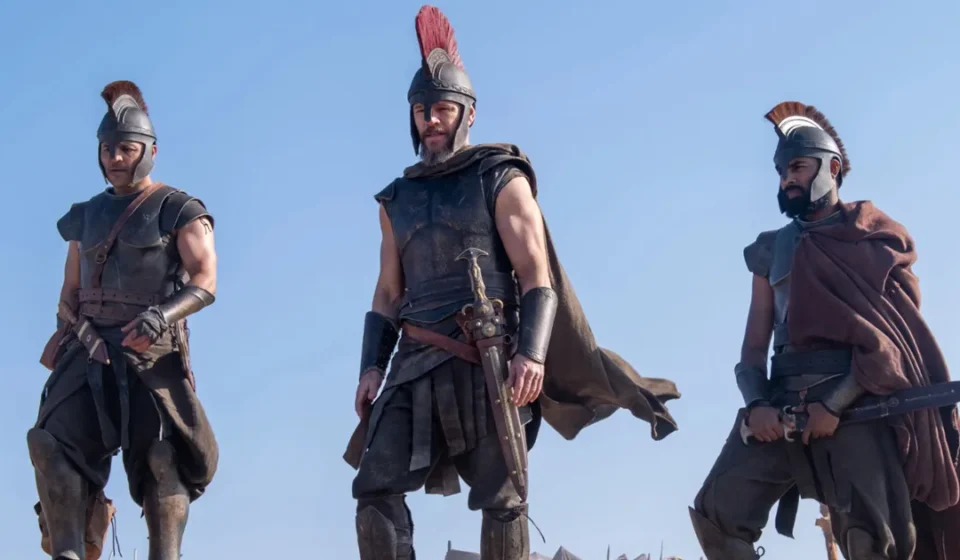
Christopher Nolan’s "The Odyssey": A Mythical Journey Reimagined for the Big Screen

Release Date: July 17, 2026
123telugu.com Rating: 3.75/5
Cast: Matt Damon, Tom Holland, Anne Hathaway, Robert Pattinson, Lupita Nyong’o, Zendaya, Charlize Theron
Director: Christopher Nolan
Producers: Emma Thomas, Christopher Nolan
Music Director: Ludwig Göransson
Cinematographer: Hoyte van Hoytema
Editor: Jennifer Lame
Related Links: Trailer
Hollywood’s most anticipated cinematic event of the year, "The Odyssey," has finally graced theaters, unleashing an unprecedented wave of hype and critical discussion. Helmed by the visionary filmmaker Christopher Nolan, this epic fantasy action-drama boldly tackles Homer’s immortal Greek epic, bringing its legendary hero Odysseus and his arduous journey home to life with a star-studded ensemble cast. Featuring Matt Damon as the titular king of Ithaca, alongside luminaries such as Tom Holland, Anne Hathaway, and Robert Pattinson, the film arrived with towering expectations. The question on every cinephile’s mind: has Nolan once again delivered a transcendent experience, living up to the colossal buzz surrounding his latest magnum opus? Our comprehensive review delves into the intricate layers of this cinematic marvel.
The Epic Journey Unfolds: A Narrative Chronology
"The Odyssey" commences in the immediate aftermath of the Trojan War, a conflict that saw the Achaeans emerge victorious, largely due to the ingenious stratagem devised by Odysseus (Matt Damon). His cunning masterplan, involving the infamous Trojan Horse, allowed the Greeks to infiltrate the seemingly impenetrable city, bringing Troy to its knees. However, this triumphant deception, born of necessity and military brilliance, inadvertently sowed the seeds of a much greater, more personal conflict for Odysseus. His actions, perhaps perceived as an act of hubris or a direct affront to certain deities, incur the wrath of the Olympian gods, particularly Poseidon, god of the sea.
What follows is not a celebration of victory, but a harrowing decade-long odyssey across treacherous seas and mythical lands, as Odysseus endeavors to return to his beloved kingdom of Ithaca. His voyage home becomes an epic saga of survival, fraught with supernatural encounters, divine interventions, and profound personal sacrifices.
The film meticulously chronicles Odysseus’s sequential trials:
- The Cicones and Lotus-Eaters: The initial stumble, where Odysseus’s men plunder the Cicones, incurring losses, followed by the intoxicating forgetfulness offered by the Lotus-Eaters, threatening to derail their journey before it truly began.
- The Cyclops Polyphemus: A chilling, almost horror-like sequence unfolds within the cave of the monstrous, one-eyed giant. Odysseus’s quick thinking, introducing himself as "Nobody" and blinding the Cyclops, allows for a daring escape. Yet, this act of cunning directly provokes Polyphemus’s father, Poseidon, setting the stage for the divine vengeance that plagues the rest of Odysseus’s journey. This episode is rendered with visceral intensity, truly sending chills down the spine as the crew navigates claustrophobic terror.
- Aeolus, God of Winds: A brief respite and a gift of bagged winds, which Odysseus’s curious men foolishly unleash, blowing them back to Aeolus’s island, where they are denied further aid, deemed cursed by the gods.
- The Laestrygonians: A terrifying encounter with a race of towering, cannibalistic giants who decimate much of Odysseus’s fleet, leaving only his own ship to escape. The visual scale of this sequence, depicting the colossal figures battling the desperate men, is pure cinematic bliss, showcasing Hoyte van Hoytema’s masterful eye for grand spectacle.
- Circe’s Island: The enchanting sorceress (Charlize Theron, delivering a captivating performance) transforms Odysseus’s men into swine. Odysseus, aided by the god Hermes, resists her magic, ultimately compelling her to restore his crew and provide crucial guidance for their onward journey, including a perilous trip to the Underworld.
- The Underworld (Land of the Dead): A somber, ethereal segment where Odysseus consults the prophet Tiresias, gaining vital prophecies about his return and the challenges awaiting him. He also encounters the shades of fallen heroes and his own mother, adding a profound emotional weight to his trials.
- The Sirens: The infamous seductresses whose irresistible songs lure sailors to their doom. Odysseus, forewarned by Circe, has his men plug their ears with wax while he, bound to the mast, endures the mesmerizing, yet deadly, melodies. This sequence is a testament to the film’s sound design and Göransson’s evocative score.
- Scylla and Charybdis: An agonizing choice between two monstrous perils – the six-headed Scylla who snatches sailors from their ship, or the whirlpool Charybdis that swallows entire vessels. Odysseus navigates this impossible decision, sacrificing some men to save the rest, highlighting the heavy burden of leadership.
- The Cattle of Helios: A tragic misstep where, despite Odysseus’s warnings, his starving men slaughter and eat the sacred cattle of the sun god Helios. This act of sacrilege results in the destruction of his remaining ship and crew, leaving Odysseus as the sole survivor.
- Calypso’s Island: Odysseus is held captive by the nymph Calypso (Lupita Nyong’o, in a poignant portrayal) for seven years, offered immortality but yearning for his mortal life and home. His deep-seated desire for Ithaca ultimately leads to his release through divine intervention.
- The Phaeacians: Washed ashore, Odysseus finds succor with the benevolent Phaeacians, to whom he recounts his incredible journey. Their king, Alcinous, provides him safe passage home.
Upon his clandestine return to Ithaca, Odysseus discovers a kingdom in turmoil. For two decades, his absence has been presumed fatal, and a horde of arrogant, rapacious suitors has invaded his palace, vying for the hand of his faithful wife, Penelope, and intent on seizing his throne and wealth. A far greater challenge than any monster or god now awaits him: reclaiming his home, his family, and his legacy from these earthly usurpers. How he, disguised as a beggar, overcomes this final, formidable hurdle and reasserts his rightful place is the gripping climax of this extraordinary film.
A Masterpiece in the Making: Supporting Data and Analysis
Christopher Nolan’s "The Odyssey" is not merely an adaptation; it is a cinematic reinterpretation that elevates an ancient text to contemporary relevance, demonstrating why he stands as one of the greatest filmmakers of his generation. Telling a story as universally known and revered as Homer’s epic presents a unique challenge: how to captivate an audience already familiar with the narrative arc. Nolan, with his characteristic brilliance, does not merely retell; he re-contextualizes, deepening the psychological underpinnings of the characters and amplifying the inherent drama and spectacle.
Christopher Nolan’s Visionary Direction
Nolan’s directorial signature is unmistakable throughout "The Odyssey." His penchant for non-linear narratives is subtly woven into Odysseus’s recounting of his journey to the Phaeacians, allowing for a dynamic interplay between past perils and present tension. However, where he truly excels is in grounding the fantastical elements of the epic in a palpable sense of reality, albeit one imbued with mythical grandeur. The "mesmerizing narrative" is achieved through a meticulous balance of sprawling action sequences and intimate character moments.
The film’s pacing, though occasionally deliberate, is a conscious artistic choice that allows the emotional weight of Odysseus’s struggles to fully resonate. This "restraint" is essential for the audience to fully absorb the enormity of his losses and triumphs, preventing the film from becoming a mere succession of action set pieces. Nolan masterfully orchestrates a symphony of genres: the grand scale of epic adventure, the visceral thrill of action, the profound resonance of human drama, and even moments of unsettling horror, such as the unforgettable cave episode with the Cyclops. This sequence, playing out like a psychological thriller, stands as a testament to Nolan’s versatility, proving his ability to conjure genuine fear amidst the heroic saga. The strategic deployment of the "wooden horse episode" that brings Troy to its knees, and the "block featuring the towering Laestrygonians battling Odysseus’s men," are not just spectacles but integral narrative beats that underscore the immense scale of the hero’s trials and the brutal cost of war.
Stellar Ensemble Performances
The emotional core of "The Odyssey" is undoubtedly its exceptional cast, with Matt Damon delivering a career-defining performance as Odysseus. Damon embodies the multifaceted hero with astonishing depth: the cunning warrior, the compassionate leader, the guilt-ridden survivor, and the yearning husband and father. He is "stunning in the action sequences," displaying both raw power and strategic intellect. Yet, it is in the "emotional segments" where Damon truly shines, conveying the immense pain and weariness of a man who has lost everything but his resolve to return home. His portrayal of vulnerability, particularly the guilt over the lives lost under his command and the moral ambiguities of war, is rendered "with utmost perfection" and is genuinely "award-worthy."
Anne Hathaway, as Penelope, delivers a performance of profound "grace and subtlety." Her resilience in the face of relentless pressure from the suitors, her unwavering loyalty to Odysseus, and her intelligent defiance are powerfully portrayed. Her interactions with Tom Holland, playing their son Telemachus, are particularly poignant, highlighting the generational gap and the shared burden of waiting. Hathaway’s Penelope is not merely a passive object of desire but a formidable woman, navigating a treacherous political landscape with quiet strength.
Tom Holland’s portrayal of Telemachus is "a sincere show," depicting a young man grappling with the legacy of a legendary father he barely knows, and the responsibility of protecting his mother and kingdom. His journey from an uncertain youth to a determined warrior forms a crucial parallel narrative, echoing his father’s trials.
Robert Pattinson, as the arrogant and ruthless Antinous, the chief suitor, is "ferocious as the antagonist." He embodies the encroaching threat to Odysseus’s household with a chilling blend of entitlement and cruelty, making him a truly formidable human foil to the mythical dangers Odysseus has already faced.
Zendaya "shines as Goddess Athena," providing divine guidance and intervention with a blend of ethereal wisdom and pragmatic support. Her presence underscores the constant interplay between mortal and immortal realms, a fundamental aspect of the Greek epic. The extensive supporting cast, including Lupita Nyong’o (likely Calypso, showcasing quiet longing and strength), Charlize Theron (potentially Circe, exuding dangerous allure), Himesh Patel, John Leguizamo, Samantha Morton, Benny Safdie, and Jon Bernthal, all deliver "first-rate performances," each adding texture and depth to this expansive world. The film is enriched by the unwavering loyalty of characters like Eumaeus, the swineherd, whose steadfast devotion to his master serves as a powerful emotional anchor amidst the chaos.
Technical Brilliance
Technically, "The Odyssey" is nothing short of a marvel. Ludwig Göransson’s musical score is a character in itself, "elevating the proceedings to a whole new level." His compositions are not just background music; they are an intrinsic part of the storytelling, underscoring emotional moments with haunting melodies and propelling action sequences with rhythmic intensity. The score’s thematic complexity reflects the narrative’s depth, creating a soundscape that is both ancient and contemporary, perfectly complementing Nolan’s vision.
Hoyte van Hoytema’s cinematography is a "visual feast." From the vast, turbulent seas to the intimate chambers of Odysseus’s palace, every frame is meticulously crafted. The use of "stunning real locations" combined with "neat VFX" creates an immersive world that feels both authentic and fantastical. The grandeur of the landscapes, the terrifying scale of the monsters, and the subtle nuances of human emotion are all captured with breathtaking precision. His ability to switch between sweeping vistas and claustrophobic terror (e.g., the Cyclops cave) demonstrates his mastery, making the audience feel completely "immersed."
Jennifer Lame’s editing is another cornerstone of the film’s success. She deftly manages the complex narrative threads, ensuring that the film’s two-hour-plus runtime never feels bloated. The pacing, though occasionally deliberate, is controlled and purposeful, building suspense and allowing crucial emotional beats to land with maximum impact. The seamless transitions between Odysseus’s epic flashbacks and the unfolding drama in Ithaca are a testament to her skill.
Beyond these core elements, the overall production values are exceptional. The costume design, set decoration, and creature effects are all meticulously crafted, bringing the ancient world and its mythical inhabitants to vivid life without ever feeling artificial. The sound design, particularly during the terrifying encounters with monsters or the cacophony of battle, is incredibly immersive, drawing the audience deeper into the visceral experience.
Critique and Nuance
While "The Odyssey" stands as a monumental cinematic achievement, no film is entirely without its nuances. The primary "minus point" highlighted by the initial review centers on the film’s pacing. Nolan’s signature deliberate approach might indeed "not work for a few," particularly those accustomed to faster-paced blockbusters. However, as noted, this "restraint" is "genuinely demanded" by the subject matter. An epic of this magnitude, steeped in profound themes of resilience, loss, and the human condition, requires space to breathe, allowing the "emotions to take over amidst the fiery battles." It’s a film that rewards patience, revealing its depths to those willing to surrender to its rhythm.
Another minor point of consideration is that "for those unfamiliar with the story, a few moments might be difficult to follow." While Nolan makes a valiant effort to render the narrative accessible, the sheer density of characters, divine interventions, and mythological references means that "it is advisable to know the characters beforehand to enjoy the film better." This is less a flaw in the filmmaking and more an inherent characteristic of adapting such a rich and complex source material. Nolan, however, ensures that even without prior knowledge, the emotional journey of Odysseus remains universally comprehensible and deeply moving.
Beyond the Screen: Implications and Legacy
"The Odyssey" is not just a film; it is a significant cultural event that will undoubtedly leave an indelible mark on Christopher Nolan’s already illustrious career and on the broader landscape of epic cinema.
Nolan’s Evolving Oeuvre
For Nolan, "The Odyssey" represents both a departure and a culmination. While he has previously explored historical events (e.g., "Dunkirk"), this is his first direct adaptation of an ancient mythological epic. Yet, it resonates deeply with his recurring thematic interests: the subjective nature of time, the burdens of memory, the complexities of identity, and the struggle against overwhelming odds. Odysseus’s journey is a profound exploration of human endurance and the psychological toll of prolonged suffering, themes Nolan has masterfully tackled in films like "Inception" and "Interstellar." The film further solidifies his reputation as a director who consistently pushes the boundaries of cinematic storytelling, merging intellectual depth with unparalleled spectacle.
The Epic Genre Reimagined
Nolan’s "The Odyssey" is poised to redefine the epic genre for a new generation. In an era often dominated by superhero franchises, this film reasserts the power and relevance of classical narratives. Nolan’s approach—combining practical effects with judicious CGI, focusing on character psychology, and delivering a truly immersive experience—offers a refreshing alternative to previous, sometimes overly stylized, adaptations of ancient myths. It demonstrates that the human stories embedded within these grand tales are timeless and capable of resonating with contemporary audiences through innovative filmmaking. This film sets a new benchmark for how such venerable texts can be translated to the screen with both reverence and bold artistic vision.
Awards Season Prospects and Box Office Performance
Given the critical reception and the sheer scale of its ambition and execution, "The Odyssey" is an undeniable frontrunner for numerous awards. Matt Damon’s performance as Odysseus is already garnering significant buzz for Best Actor, while Nolan himself is a strong contender for Best Director. The film’s technical prowess makes it a shoo-in for nominations in Cinematography, Score, Editing, Production Design, Visual Effects, and Sound Design. A Best Picture nomination, and potentially a win, seems highly probable.
Commercially, the combination of Christopher Nolan’s directorial brand, a universally recognized epic story, and an A-list ensemble cast positions "The Odyssey" for immense global box office success. Its broad appeal, spanning action, drama, and fantasy enthusiasts, ensures a wide audience, making it one of the highest-grossing films of the year.
Cultural Resonance
The enduring appeal of Homer’s "Odyssey" lies in its universal themes: the arduous journey home, the unwavering love of family, the consequences of hubris, the struggle against fate, and the indomitable spirit of humanity. Nolan’s film brilliantly captures these elements, making a story from millennia ago feel strikingly relevant in the 21st century. It speaks to the human experience of overcoming adversity, the longing for belonging, and the profound impact of war on individuals and families. The film’s "grand Indian commercial entertainer" finale, with its cathartic release of tension, its blend of spectacle and emotional resolution, transcends cultural boundaries, proving that certain narrative archetypes resonate deeply across diverse audiences, eliciting whistles, claps, and roars of approval.
Conclusion
In sum, Christopher Nolan’s "The Odyssey" is a truly exhilarating cinematic spectacle, showcasing the director’s brilliance in abundance. Matt Damon’s mesmerizing, award-worthy performance as Odysseus anchors a narrative rich with "outstanding action sequences, beautiful emotions, and solid drama." Nolan tackles a familiar epic and narrates it in his trademark style, offering a wealth of riches for the audience to relish, from the terrifying "horror-like sequences" to the profound moments of human connection.
While some might find the deliberate pacing challenging at times, and prior familiarity with the source material can enhance the experience, these minor considerations are utterly overshadowed by the film’s profound strengths. "The Odyssey" overcomes its negligible flaws with a "highly rewarding finale," delivering a cathartic and emotionally resonant conclusion that cements its place as a modern masterpiece.
This is more than just a movie; it is an immersive journey, a testament to the enduring power of storytelling, and a triumphant return to the grandeur of epic cinema. "The Odyssey" is a solid cinematic package that demands to be seen. Book your tickets, choose the biggest screen possible, and prepare to experience this epic on an unforgettable scale.
123telugu.com Rating: 3.75/5
Reviewed by 123telugu Team