Growing Pains on Baker Street: Why ‘Enola Holmes 3’ Struggles to Find Its Footing

Time is a relentless force, and nowhere is that more apparent than in the evolving landscape of popular film franchises. Even the sharpest minds—and the most charming detectives—are not immune to the awkward, often uneven process of maturation. This is the central tension at the heart of Philip Barantini’s Enola Holmes 3, the latest installment in the Netflix juggernaut that imagines the legendary Holmes family tree as having a secret, brilliant branch: a younger, fiercely independent sister.
Over the course of three films and six years, Millie Bobby Brown has solidified her status as a magnetic leading lady. She has tackled the role with a sprightly, plucky sensibility, navigating both high-stakes mysteries and the series’ signature wackier, fourth-wall-breaking flourishes. Yet, as Enola Holmes 3 makes its debut, it becomes clear that the series is experiencing a mid-life crisis of sorts—a collection of "hinks and kinks" that hinder the film from achieving the effortless joy of its predecessors.
A Change in Command: The Creative Shift
The transition behind the camera is the most immediate change for the franchise. Philip Barantini, best known for his work on Adolescence, takes the directorial reins from Harry Bradbeer, who helmed the first two entries. Reunited with series screenwriter Jack Thorne, Barantini attempts to pivot toward a more mature, grounded portrayal of Enola’s transition into adulthood. While the desire to evolve the character is both logical and necessary, the execution feels at odds with the franchise’s DNA.
The series, based on Nancy Springer’s beloved YA novels, has always thrived on a specific kind of vibrant, kinetic energy. By attempting to inject a "grown-up" weight into the proceedings, Barantini and Thorne have inadvertently muted the very exuberance that made Enola such a compelling figure. The result is a film that feels caught between two worlds: trying to be a serious detective drama while maintaining the lighthearted, whimsical tone of its roots.

Chronology of a Disjointed Mystery
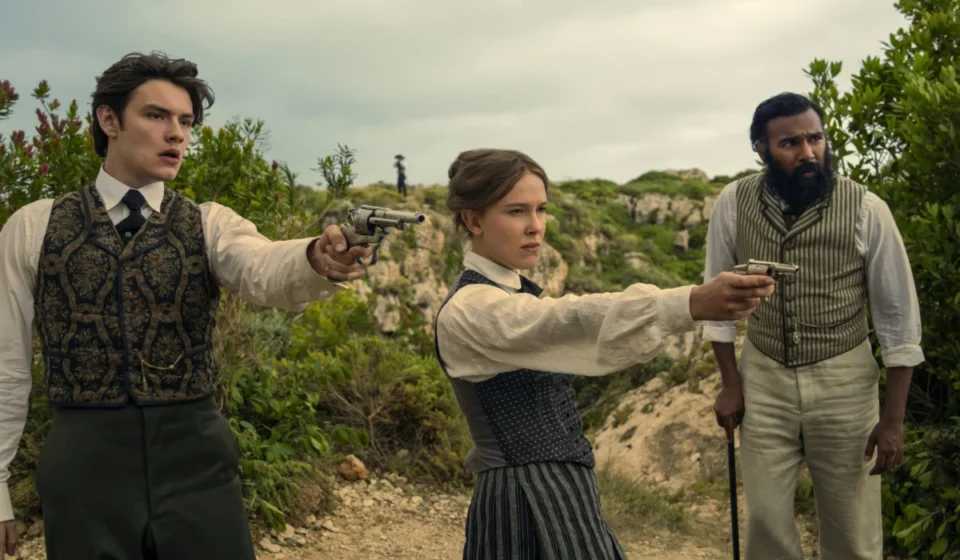
The narrative opens on a grand, high-stakes note: the long-awaited wedding of Enola and Lord Tewkesbury (Louis Partridge). The setting—a stunning, sun-drenched backdrop in Malta—is a visual departure from the smog-choked streets of London, and for a moment, the shift feels refreshing. We find our heroine racing to the altar, only to be intercepted by mysterious highwaymen.
However, the narrative momentum hits a wall when the inciting incident occurs: the kidnapping of Sherlock Holmes (Henry Cavill). What should be a pulse-pounding race against time quickly becomes a muddled affair. While the film relies on the series’ trademark zippy flashbacks and snappy montages, they feel uninspired here, serving as crutches to bridge a fractured plot rather than tools to enhance the storytelling.
As the film progresses, the stakes escalate—Tewkesbury’s mother is abducted, their hotel is razed to the ground, and a formidable villain from the past resurfaces—but the emotional resonance remains curiously flat. Enola dutifully moves from one location to another, following breadcrumbs that feel more like a rote exercise in screenwriting than a genuine investigation.
Deductions vs. Visual Shortcuts
Perhaps the most glaring issue in Enola Holmes 3 is the simplification of the "detective" element. In the early films, Enola’s brilliance was showcased through her genuine observation and deductive reasoning. Here, that intelligence is replaced by visual shorthand.

"Detecting, thy name is dolly zoom," one might say. Rather than witnessing the gears turning in Enola’s mind, the audience is subjected to rapid-fire camera zooms on props or documents, effectively spoon-feeding the viewer the "clue" without the satisfying journey of discovery. A particularly frustrating sequence involves a flashback explaining Lady Tewkesbury’s obsession with the Maltese wedding; the event is revealed through information Enola could not possibly have known, and worse, it fails to provide any logical motivation for the character’s behavior. It is a classic case of plot dictating character, rather than the other way around.
The Weight of Expectation and Past Success
To understand why Enola Holmes 3 feels like a misstep, one must look back at the trajectory of the series. The first film was a masterclass in balance, blending mystery with a social conscience that felt relevant to its target audience. It was instructive, entertaining, and deeply invested in the societal shifts of its era.
The second film, while ambitious, began to show signs of bloat, rehashing the original’s charms without introducing enough new elements to justify its runtime. Critics and fans alike hoped the third entry would return to the "basics"—the sharp, focused, and intimate detective work that made Enola such a standout. Instead, the film has leaned too far in the other direction, becoming an overly complicated, yet hollow, spectacle.
The Implications: Where Does Enola Go From Here?
Netflix has yet to comment on the potential for a fourth installment, but the implications of this third chapter are clear: the series needs a recalibration. The "growing pains" referenced at the start of this review are not just a narrative theme; they are a production reality. If the franchise is to continue, it must decide what it wants to be.

If Enola is to grow up, the mystery must grow up with her. The audience has matured alongside the character, and they are ready for a more complex, nuanced, and clever brand of storytelling. The "paint-by-numbers" approach seen in Enola Holmes 3 is no longer sufficient.
Official and Critical Response
The industry response has been largely mixed, with many critics pointing to the loss of the "spark" that characterized the previous films. While Millie Bobby Brown continues to deliver a strong, committed performance, she is often let down by a script that refuses to challenge the audience.
Industry analysts suggest that the franchise remains a vital asset for Netflix, particularly in the YA space. However, the drop in critical reception highlights a common trap for streaming sequels: the assumption that higher stakes and larger budgets automatically equate to a better story.
Conclusion: A Call for Complexity
Enola Holmes 3 is a reminder that charm is a delicate ingredient. It can be easily lost when a film stops trusting its audience to follow the breadcrumbs and starts relying on pyrotechnics to hold their attention.

As it stands, the film earns a grade of C. It is a functional, often beautiful, but ultimately hollow experience that fails to capitalize on the potential of its cast or its premise. We know Enola is a "tough cookie," and we know she is capable of far more than what this film provides. It is time for the series to stop playing it safe, abandon the repetitive tropes, and finally embrace the complexities that a truly clever detective story demands.
The mystery is there to be solved, but for now, the series seems to be looking in the wrong direction. We remain hopeful that the next chapter will find the wit, the verve, and the intelligence that made us fall in love with the detective in the first place.
Enola Holmes 3 begins streaming on Netflix on Wednesday, July 1. For more analysis on the latest in film and television, subscribe to the In Review newsletter by David Ehrlich, where we explore the deeper, often overlooked layers of today’s biggest cinematic offerings.